20/Twenty: Bombardier’s Challenger Is A Champ
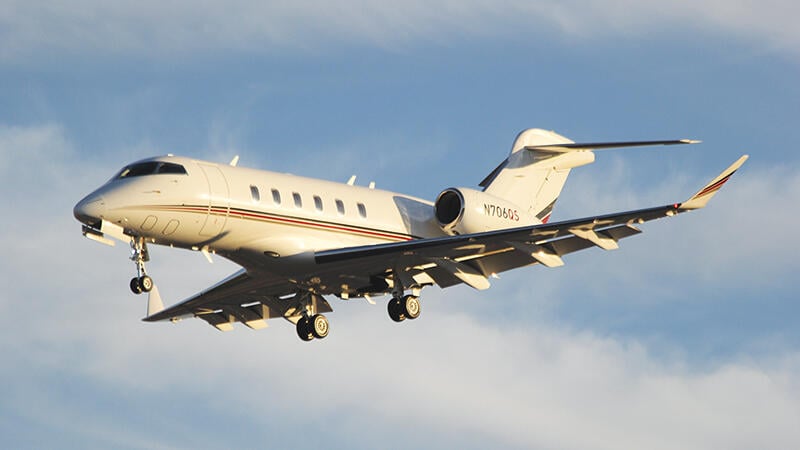
The Challenger 350 and first-generation 300 were the most active model of business jet in 2024 based on departures.
Large fractional operators such as NetJets and Flexjet fly their aircraft hard—usually more than 400 hr. a year—and expect a lot in return. The aircraft they use must have good and predictable operating economics, reliability and passenger comfort. For these operators, the Bombardier Challenger 300 series delivers.
More than 1,000 super-midsize Challenger 300s have been delivered since 2003 over three generations—the Challenger 300, 350 and current 3500. Seating eight to nine passengers, they offer a unique combination of range—flying 3,200-3,400 nm with four passengers, two pilots and NBAA IFR reserves—speed (Mach 0.83 or 470 kt. fast cruise) and short-field capability. Passengers are accommodated in a 7-ft. 2-in.-wide, flat-floor cabin that is 6 ft. 1 in. tall and 25 ft. 2 in. long, with 106 ft.3 of stowage.
In 2024, WingX reported that the Challenger 300 and its second-generation successor, the Challenger 350, accounted for 210,000 annual North American departures, making it the most active model of business jet for the year. The popularity continues, with 14,630 departures recorded in February 2026.
Bombardier produced the Challenger 350 from 2014-22. After that, production shifted to the third-generation Challenger 3500. According to the Aircraft Bluebook, pre-owned Challenger 350s are trading in the retail range of $15.5-19.5 million—if you can find one. Approximately 428 remain in service of the 431 produced.
Data from a variety of sources indicates that there have been as few as seven Challengers on the market, with average time-on-market as little as 100 days. Blink and you miss it. And do not expect much of a deal for an aircraft that sold new for between $26 million and $27 million.
Compared to the 300, the 350 offers substantial differences in performance, comfort and maintainability. While the 300 and 350 are virtually indistinguishable from the outside, there are subtle clues. The winglets on the 350 are canted, increasing the overall wingspan by about 5 ft. and enabling direct climbs to 43,000 ft. compared to 41,000 ft. on the 300.
The 350’s cabin windows are 20% larger. Inside, those windows have a new surround design. Other cabin differences for the 350 include fresher styling, more modern passenger cabin controls and better passenger noise reduction. The 350’s cabin monitors are larger (22 in. versus 15 in.).
The jet’s Lufthansa Technik nice HD cabin management system uses in-cabin wall transducers for exceptional sound experience and supports a variety of Bluetooth connections to devices including Blu-ray, DVD and CD players. Inflight internet is available via Gogo Avance L5 or SwiftBroadband systems.
The cockpit is equipped with an updated Collins Pro Line 21 avionics system featuring four large displays, synthetic vision, MultiScan radar and dual FMS. A head-up display and enhanced vision system are optional. Some, but not all, Challenger 350s are equipped with Safe Flight Instrument AutoPower autothrottles, available via service bulletin after Serial No. 20875 and as factory equipment from Serial No. 20937.
As one would expect, 350s with autothrottle have a price premium, and retrofits are not generally seen as cost-effective. Propulsion is courtesy of a pair of Honeywell HTF7350 turbofan engines that provide 497 lb. more thrust each than the HTF7000s on the Challenger 300, due largely to updated software. The increased efficiency contributes to the 350’s greater range (145 nm) compared to the 300.
Typical cabin layouts feature a double club-four grouping of single executive seats that can accommodate eight passengers or a club four followed by a half club opposite a three-place divan that can seat nine.
The cabin is separated from the forward galley by a sliding pocket door. The galley has ample stowage for the passenger load and can be equipped with a microwave oven, coffee maker, ice drawers and options such as sinks and wine chillers. The aft belted lav (certified for takeoff and landing) provides inflight access to the pressurized baggage compartment and features a chemical toilet, vanity, sink and 115-volt outlet.
The Challenger 350 differs from its peer group in that it is the only super-midsize jet that does not offer a vacuum toilet system—something to keep in mind for longer flights and when considering menu selections. Chili and beer might not be a good idea.
The 350 is frequently seen as having the lowest direct operating costs in class, but not by much. The engines are well-supported by Honeywell’s Maintenance Service Plan and engines are maintained on condition, as opposed to hourly intervals.
In the crowded super-mid field, the Challenger 350 is not the longest-legged, fastest or most luxurious option. But after more than two decades in service, it continues to be renowned for its cabin comfort and reliability. And that’s why the Challenger is a champ.
Related Content