Falcon 10X Revives Dassault's Visibility In Business Jet Market
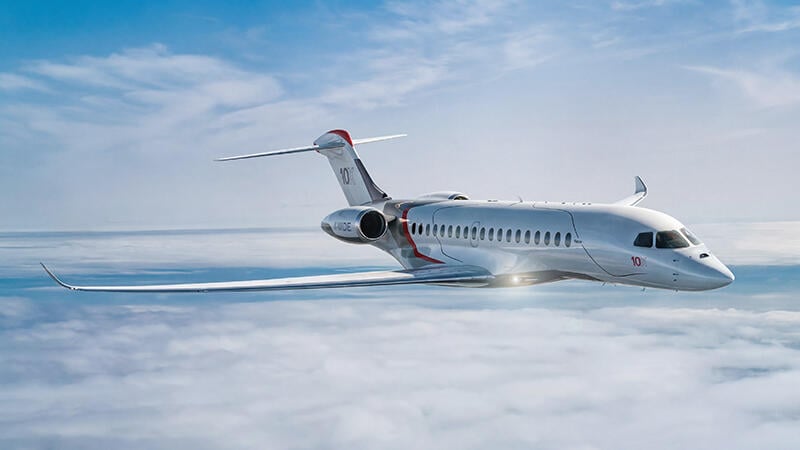
The shape of the Falcon 10X, such as its slightly upturned nose, was designed for high-speed cruise.
Slow Falcon deliveries, delayed introductions of new models and a focus on Rafale fighter production had made Dassault Aviation’s commitment to business aviation look faltering. But in fact, at its design office in Paris and new assembly line in Bordeaux, the airframer was preparing its biggest bet to reinvigorate that portfolio.
The Falcon 10X, with the industry’s largest cabin, ultra-long range, higher speed and safety features, has required a massive—albeit unspecified—investment.
Having sought to catch up with or surpass the offerings of archrivals Bombardier and Gulfstream, Dassault now has the edge in cabin size, at least. The other two still offer slightly higher speeds and longer ranges, but the Falcon 10X belongs to the same higher performance class.
The Paris-based airframer has been behind in orders and deliveries, and the Falcon 10X—if it meets Chairman and CEO Éric Trappier’s expectations—will contribute to regaining a significant market share. Dassault delivered 37 Falcon jets last year, while Gulfstream delivered 136 large-cabin business aircraft and Bombardier handed over 86. Dassault intends to ramp up production to 40-60 Falcons per year, helped by the introductions of the Falcon 10X as well as the Falcon 6X, which has been gradually entering customer service since 2024.
The new factory in Bordeaux could produce two Falcon 10Xs per month (Dassault counts 11 working months per year), Trappier said on the sidelines of the jet’s unveiling event in Bordeaux March 10. The company may sell hundreds in the coming years, he added. The aircraft’s price stands at close to $80 million before cabin completion.
Dassault’s Falcon 10X development timeline reflects the challenges of recent years. The product is debuting about two years late due to disruptions stemming from the COVID-19 pandemic and industry-wide global supply chain issues. Delays in obtaining certification of the Falcon 6X also prevented the airframer from redeploying its limited engineering resources to the Falcon 10X.
As Dassault prepares for an intense period of flight trials to deliver the product into user hands at last, the first two aircraft have been assembled and two more are being built to support the development effort. The third and fourth aircraft will feature customer cabins to validate performance before entering service. Trappier expects the first customer delivery to occur two to three years after first flight.
The Falcon 10X’s cabin width stands at 2.77 m (9.1 ft.) and its height at 2.03 m, making it the widest and tallest cabin in purpose-designed bizjets. The increased width allows a passenger to leave the table in a conference area without disturbing other passengers, Philippe Reignier, technical sales manager, told reporters. The aft bedroom accommodates a 60-in.-wide bed.
The four-zone, 78.7-m3 cabin is highly modular, meaning customers can have partition walls installed virtually anywhere. “We describe an area as a three- or six-window lounge, for instance,” Reignier said.
Systems such as electric wiring and emergency oxygen ducts offer enough interfaces in the cabin for each zone to have sufficient outlets, whatever the zone’s length. Layouts in previous bizjet designs made it difficult to install a partition outside the planned location, a Dassault engineer explained. The small intervals between the structure’s frames and the large number of windows—38, each with a 30% greater surface area than on the recent Falcon 6X—contribute to the improved flexibility in the cabin’s floor plan.
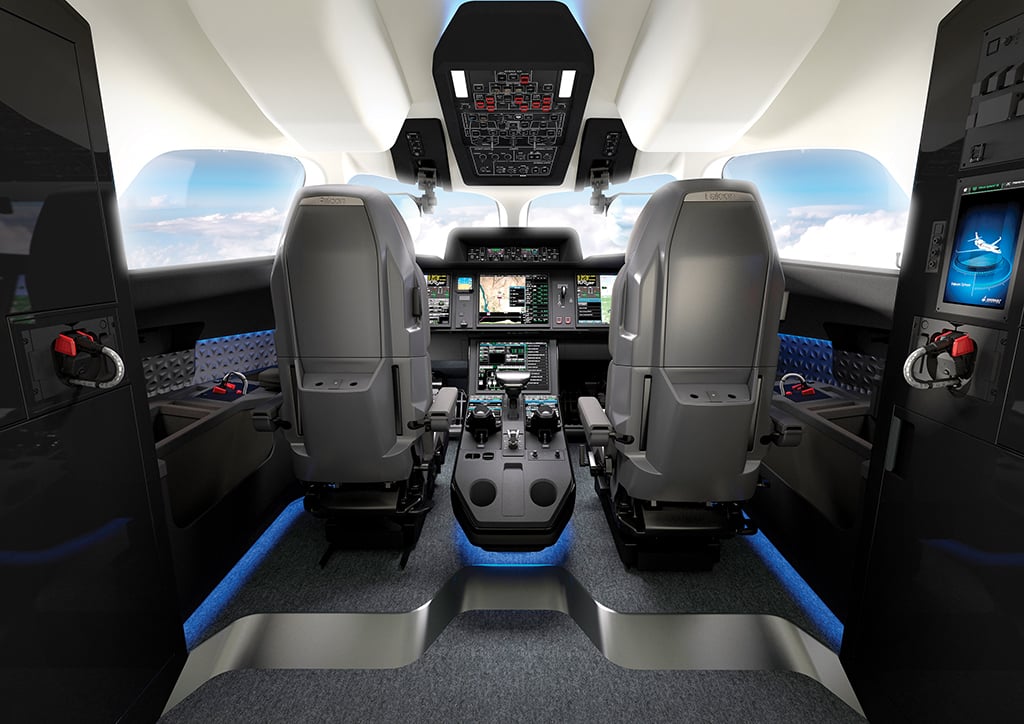
In the Falcon 10X’s flight deck, Dassault has included innovative pilot assistance features, reducing workload and increasing automation. While the airframer has long promoted a pilot-in-the-loop approach, meaning the crew should always be aware of the aircraft systems’ actions, the Falcon 10X is ushering in an unprecedented level of self-regulation. Systems can prevent emergency situations or take over and recover autonomously.
Under Dassault’s approach, systems keep the aircraft in the flight envelope while pilots retain control. The airframer’s engineers designed an operational speed protection feature to prevent the aircraft from entering speeds that are too low or too high. If the crew reduces engine power to idle, forgets about the action and leaves the aircraft speed declining, the system will react, said Antoine Doussaud, an experimental test pilot. It will issue an aural warning and, if a pilot still does not respond, it will give the so-called smart throttle—which controls both engines with a single lever—a flick. The aircraft helps pilots keep minimum speed, Doussaud said, adding that they can override the throttle.
Dassault expects to in-crease safety levels through its so-called ultimate protection modes. One automates terrain avoidance if the crew does not react to a warning, pulling up at 2.5g and preventing a controlled flight into a hill. Similarly, the autopilot and autothrottle can engage and follow a resolution advisory from the traffic collision avoidance system. Moreover, like what Airbus introduced on the A350, a loss of pressurization triggers an automated emergency descent to 15,000 ft.
Perhaps most spectacular on the Falcon 10X, the automated upset recovery mode was designed to help pilots who experience spatial disorientation or face wake turbulence. Pushing the recovery button, located on the glare shield next to the sidestick, levels the aircraft off into a safe attitude, with wings level at a secure speed.
To draft operating procedures for pilots, Dassault engineers used an engineering simulator, said Jean Kayanakis, senior vice president of worldwide Falcon customer service. The flight simulator’s introduction into a Dassault business jet program is intended to streamline and expedite entry into service. The Falcon 6X received type certification from the European Union Aviation Safety Agency and the FAA in 2023, but slow pilot training impeded the first customer deliveries. Dassault selected pilot training specialist FlightSafety International as a partner for the creation and use of the full-motion simulator.
The aircraft’s top speed is Mach 0.925, slightly below the Gulfstream G800’s Mach 0.935 and the Bombardier Global 8000’s Mach 0.95. “At the Falcon 10X’s long-range speed of Mach 0.85, our competitors fly a bit farther, but at Mach 0.9, we will offer a longer range,” Reignier said. “We will confirm that during flight trials.” At Mach 0.85, the Falcon 10X’s range is 7,500 nm.
The shape of the Falcon 10X was designed for high-speed cruise. Dassault’s engineers have worked to retain the slow-speed characteristics of other Falcons, and therefore their ability to operate on short runways. That makes the resulting aerodynamics of the Falcon 10X sometimes unusual.
The front fuselage sports a slightly upturned nose and a relatively flat, forward-leaning roof. The nose’s shape helps the airflow remain laminar, improving cruising attributes at Mach 0.9, Reignier said. Meanwhile, the roof was designed to limit noise in the cockpit, he added.
The wing’s sweep angle is constant along the leading edge to maximize efficiency at high speeds, Reignier said. In contrast, the trailing edge is curved, with low-speed performance in mind. Using composite materials for the wing helped engineers, as carbon fiber enabled a thinner wing and a limited wingspan, he said. Composites saved 400 kg (880 lb.) compared with a metal wing, he added.
The area around the wingbox that houses wiring and tubes also has been reshaped to reduce vortex-generating drag, Reignier said. Instead of the Falcons’ traditional cross-shaped tail, usually chosen as favorable for the trade-off between low- and high-speed performance, Dassault engineers designed a T-tail optimized for higher speeds.
The twinjet’s engine, the Pearl 10X, is Rolls-Royce’s first Dassault business jet application and the most powerful in the Pearl engine family to date, with more than 18,000 lb. of thrust, said Philipp Zeller, Rolls-Royce Deutschland’s Pearl 10X project lead. The engine-maker has emphasized maturity, especially as Dassault terminated the Falcon 5X program due to persistent issues with the Safran Silvercrest turbofan before launching the Falcon 6X with Pratt & Whitney Canada engines.
The Pearl 10X is Rolls’ first time applying additive-layer-manufactured parts in the hot section for optimum combustion. That feature should reduce nitrogen oxide emissions, Zeller noted.
The engine has accumulated around 3,500 hr. in testing, including 25 flights on a modified Boeing 747-200. The engines to power the Falcon 10X’s first flight have already flown on the testbed, Zeller said.


Related Content