This article is published in Aviation Week & Space Technology and is free to read until Jul 26, 2026. If you want to read more articles from this publication, please click the link to subscribe.

Interview: Why Airbus CEO Is Bullish On Launching A320 Replacement In 2030
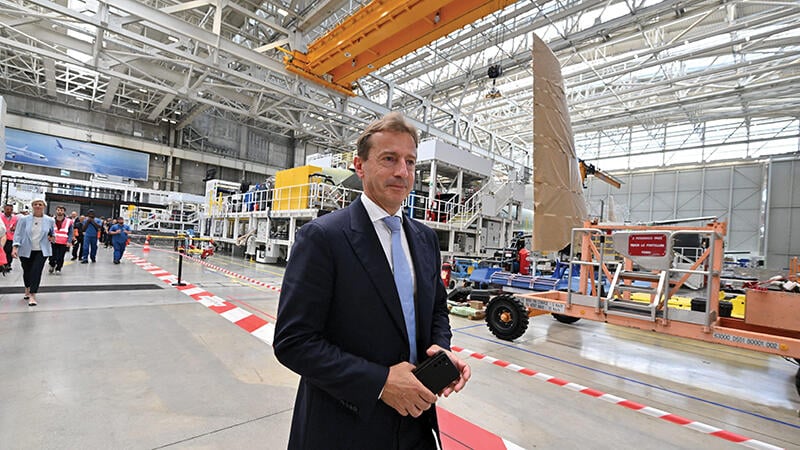
Airbus CEO Guillaume Faury

Airbus CEO Guillaume Faury, who in June opened a new A321 assembly line, is already focused on what comes next.  

Credit: Laurent Dard/MAXPPP/Alamy Live News

Airbus CEO Guillaume Faury talks to Aviation Week Executive Editors Jens Flottau and Robert Wall about the next single-aisle aircraft and plans for defense, space and helicopters.

AW&ST: You have started preparing the launch of a next-generation narrowbody. What is the status of the project? 

Faury: Yes. We say what we do; we do what we say. We are preparing the successor of the A320, which we call eAction, with a view of launching the program in 2030. We have a lot of research and technology development going on, comparison of technology solutions, pre-projects and simulations. There is work [happening] with partners to review the different options for wings, fuselage, propulsion system and industrial systems. We are moving forward.

The timeline has not changed?  

No, no, no: Launch in 2030, entry into service in the second half of the next decade. We are very focused, very committed.

Your Boeing counterpart, Kelly Ortberg, indicates to us that their timeline will likely shift to the right because he does not see demand for the aircraft yet.  

Perfect.

So you are fine with moving first despite the fact that you already have a leading market share?  

We have a very strong product that will need a very strong successor. We don’t want others to do what we are best placed to do—being strong, being able to invest, having the capacity to put engineering and financial resources into it, attracting appetite from suppliers. If we move first, the supply chain will come to us. It is important to explain to suppliers that we will replace a very successful product with another successful product. We want to be mastering the time. You don’t want to do this reacting to something else. If they move much later, well, their problem. I think that when we move, they will have to take that into account.

It sounds like you are past the stage of asking, “Are we going to do it?” and are only defining what exactly you are going to do. 

Do we want to do it? The answer is “yes” and has been “yes” now for years. When do we want to do it? We have defined our timeline. There are so many things to prepare, and if you fail to prepare, be prepared to fail. Things are converging. Maybe the others could or should have done things differently in the past. I don’t know what they are thinking.

That the Boeing 737 MAX is selling so well, so why should they move? 

I like this thinking.

How many people are working on eAction?  

We are not communicating on the money we spend nor the number of people working on it. But you have an idea of the trajectory when you come close to a program. It is not the majority of what we are doing today; it is a lot of [research and technology], advanced projects, a lot of engineering work. We are not at scale with prototypes or industrial activities. That is what is starting when we come close to the launch of the program and mostly after the launch. But we have a ramp-up of resources.

You ramped up production of the A320 over many years. Realistically, that needs to be much quicker on the next aircraft, doesn’t it?  

There are reasons to want to go fast, and there are reasons to not want to go fast. We have a backlog of A320s to deliver, and we believe the backlog will still be strong at this moment [of eAction entry into service]. Demand is much higher than supply, and this is here to stay. You want to go fast, but you don’t want to go too fast. Defining the appropriate rate of ramp-up is something that we are also studying, and there are actually different schools of thought.

We are not at the point yet of defining whether it will be a very steep ramp-up, which comes with benefits and risks as well. If you have issues with an innovative program at the beginning, you have too many aircraft in service that you have to retrofit or modify. If you have to delay, you have to delay a lot of aircraft. We do a slow ramp-up in defense exactly for this reason. We want to ramp up quickly, but that does not mean we will ramp up as quickly as the production system would enable us. The production system will most likely be very different from the one we have today.

So you will build the two in parallel for a period of time? 

Yes, that is always happening. When we [introduced] the [A320neo] there was still the [A320ceo].

But that was on the same line.  

Yes, but even there we did a transition. And the A320 will probably remain very popular for a long time. We have to be flexible in the overlap and the speed of ramp down and ramp up of the two products.

Is there enough physical space here? 

We have Saint Martin [in Toulouse] that will no longer produce [A320s]. But we are not necessarily limited to Toulouse or Hamburg, [Germany]. The world is large. We have facilities in the U.S., [that] we have been expanding. We have been expanding in China, and there are other places in the world that are interested and are potentially very interesting for us. Most probably a part of the production system will be new, but we will also progressively reuse some of the assets we have as we ramp down. It is very similar to what happened when the A350 replaced the A330.

For when are you targeting the next major milestones? 

For when we are ready.

If the launch is 2030, then. . . 

I don’t want to tell you. That is the more honest answer. It will be significantly before 2030. We have a timeline, we have decision points and decision trees; they are shared with the partners, especially when it comes to the engines. These are internal milestones, and we have plenty of technical choices to make. And we are converging as we move forward. A lot of them are already behind us.

Do you want to offer your customers an engine choice? 

Notionally yes, but it is not certain we will be able to offer a choice. And there are not only technical trade-offs we need to look at but also business trade-offs. Ideally, we want to be able to offer two engines. If we are going with a technology where there is only one engine-maker at the beginning, we [must] have the certainty we need, a low level of risk relative to one engine. You know the [Boeing] 737 has one engine, the A320 has two, we have one engine on the A350, the 787 has two engines. So different models can work. It comes with pros and cons.

Are you really prepared to take that risk of going with one engine supplier, given everything you and your customers have been through over the past few years?  

Yes. That is what Boeing is doing on the 737. Why is it OK for the MAX and not for us?

One could argue that it is not OK for the MAX or any other aircraft. 

Why?

It is too risky, and it limits you to a certain part of the market. You have access to a broader market if you have two engines. 

I am not completely sure the market is broader. If it is not offset by something else, it does not make sense to have only one engine. But having two engines also comes with some negatives: more distraction in different directions, you have to have two configurations, you have to have two supply chains, you multiply by two the risk of having problems. Of course, then you only have a problem on half of your fleet, but you still have it. It is not that straightforward. If you select one, it has to work.

The same is true for the wing or avionics—we don’t have two avionic systems onboard. There is one hydraulic system that has to work. The propulsion system is larger and more complex. In terms of customer support, it is contracted between the engine-maker and the airlines. We prefer to have two engines, but not at the detriment of performance or competitiveness. It is all about trade-offs. We might be in a situation where the second manufacturer will follow later.

As for the production system: Are you thinking differently about horizontal versus vertical integration and supply chain diversification to avoid some of the past pitfalls? 

We are not completely verticalized; that is not a model we are familiar with. We may do more build-to-print and [control] more engineering and more [intellectual property] for the aircraft; [that is] still to be defined system by system. There are plenty of possibilities to be a bit more verticalized in key systems, but decisions have not been taken, and everything depends on the security we are getting from the suppliers. The supply chain is also superfragmented, and that is not something you can change easily. What we have experienced recently is also very much linked to [the COVID-19 pandemic]. We should not view everything in the supply chain through the lenses of the last few years when the supply chain was basically on hold for a year or two. Some completely stopped their activities [and] laid off the majority of their staff.

There are a lot of learnings about how to deal with crises. I think we managed it reasonably well. We did not stop production. Others did. Other large aircraft [programs] were on pause for a long time. That had a lot of consequences for the supply chain. We see other risks than we had in the past popping up. We have to be super careful with cybersecurity and cyberprotection for our suppliers. The risks are evolving. We are trying to get rid of single points of failure, derisking, diversifying the supply chain more than we did in the past—mostly because of geopolitical risks, but not only. That is most likely something we will take into account from Day 1 on the supply chain side.

AerCap CEO Aengus Kelly recently said he does not see a market for the A220-500. Air France-KLM CEO Ben Smith instead is concerned that it would come too late. Where are you in your decision-making process?  

We have a lot of customers telling us that they are interested in the stretch. When Ben says it is too late, he means it has to come as soon as possible. “Too late” means we no longer need it, but that is not what I am hearing. We have a lot of challenges; we have a lot on our plates. We need to focus on our priorities and do well on what we have already contracted.

We have two young platforms, the A220 and the A350. And for both we hear from the market that they want more, and they want more performance, more capabilities. We agree with this. But we won’t launch a new platform until we have the bandwidth to do it well, and we are not in a hurry. Some are in a hurry. We hear this, and we try to take that into account appropriately. Ben has been very clear for some years, but we don’t have the conditions yet to do it. [The launch] remains a matter of when, but “when” is not today.

Are you in the camp of doing a simple stretch or a more complex one that protects the range capabilities of the aircraft?  

I am in the camp of competitiveness. We need to have a product that makes sense in the long run. You have to have the right product not just for tomorrow but also the day after. In this case, it is not obvious. Airlines have different views.

Is the same true for the A350 stretch?  

Yes, it is even more true for the A350. We are in a challenging ramp-up. There is by far more demand than supply even for the existing products. The challenge on the A350 is first and foremost industrial.

You have been trying to fix the supply chain for more than 20 years, and it seems to not get fixed. Why?

That is a fair comment. We saw COVID as an opportunity for more consolidation. But it has not really happened, and that is quite disappointing. Instead, we diversify; we create double or triple sources to derisk the supply chain. We sometimes tap into new suppliers, so we are aggravating the case. There are a lot of conversations about consolidation. We see Indian companies scouting Europe about opportunities to acquire. We have had to stay with a lot of small suppliers, not because of competitiveness, but because there were no alternatives.

This industry was too fragmented and remains too fragmented. It’s true for helicopters, business jets [and] in defense as well. We are working with companies that are used to low volumes; and it is difficult to move them away from that way of doing business. Have we improved over the last 25 years? I think we have. But have we improved enough? No, and I guess it is never finished. Supply chain management will remain a key competence in aerospace.

testing an aircraft door
“You have to have the right product not just for tomorrow, but also the day after,” Airbus CEO Guillaume Faury says. Credit: Airbus

Airbus Commercial Aircraft CEO Lars Wagner has identified much higher production rates for the A350 as one of his key priorities. Where are you in the planning for them?  

What Lars said is that we see a need for much more, but we are not where we need to be. We are moving to 12 aircraft per month in a short period of time. We lost a year because of the Spirit [AeroSystems] difficulties of 2024, which impacted 2025 [deliveries] a lot. That is the short-term priority.

What is the limit for Toulouse’s A350 production system? Fifteen per month?  

That’s the question for which we need an answer from the teams: Where do we want to go in which time frame, based on which production system? Toulouse? Do we need more? If we need more, it is a much bigger thing. Where do you go? The easy answer is to stay in Toulouse and grow incrementally, but is that big enough to meet the demand? It is all about trade-offs again. We don’t have the answers today, and we would like the teams to focus on the ramp-up itself. We also have advance projects on the production systems, but they work in parallel, and they have less pressure than the ones that deal with the ramp-up.

What happens to the two old A320 production lines in Toulouse? 

They are ramping down. One will probably go down completely—not yet decided—but we will keep one as a buffer. They can’t produce A321s. These lines are not here to stay. It’s just about the time we will take and to ramp them down, and then it will be a facility that will be [used] for something else in the future.

Embraer is considering getting into the single-aisle game. What do you think?  

It’s for them to answer. It is a tough call. Obviously, entering this market, having Boeing, Airbus and now Comac coming, is not easy. I would think twice. I think it is a big risk.

How do you see the evolution in your helicopter segment? 

We have a lineup [that] is well spread between the different classes. The H145 is a four-ton-class helicopter, but it’s very capable. We have the single-engine helicopters, the H135 and now H140. We have the H160; we have the H175—so it’s a fantastic lineup. And they’re ramping up. The big challenge on the H145 is the ramp-up.

Now, that’s not the end of product policy evolution. We see the workload in engineering in helicopters skyrocketing, given all the different programs we have contracted. So we do a lot of R&D, we do a lot of development, not necessarily on new platforms, but on militarization and derivative of the platforms at helicopters, plus the drones.

There is a lot going on in defense and space in the company. We have just had the death of the New-Generation Fighter program, and you are looking to merge your satellite efforts with Leonardo and Thales. How are you thinking about that business and its products?  

These are very sophisticated and complex systems, large systems that require a lot of technologies, a lot of investments and skills, and tomorrow a lot of computation power. So scale matters. And when we have the scale, compared to competitors, we do well. When we don’t have the scale, it’s much more complex to either be competitive on the commercial market, on a civil market, or bring a platform to our military customers that is at par with the ones that have the scale. In commercial aviation, we have the scale that works; in helicopters, we have the scale that works; in missiles, we have the scale that works; in military transport aviation, we have the scale that works.

In space, when space was rather fragmented, and Europe was big, we were reasonably at scale. It’s no longer the case. The U.S. is spending by far more money, private or public money, in space. We have to regain scale. That’s what we’re doing with the satellite business.

That’s what Europe did a long time ago on launchers that worked for decades. Elon Musk did something incredible with SpaceX. [Now] we’re on the back foot with launchers. We are trying to regain competitiveness [by] going to reusable launchers, but we have to be careful that Europe spends enough money on launchers [and that] Europe spends money in Europe. Because if we spend money [on] U.S. launchers, we don’t make the European industry stronger.

How about scale in the fighter business? 

We’re not in that place when it comes to combat, and that’s a big issue in Europe. That’s why we have cooperative programs. That’s why the Global Combat Air Program was launched. That’s why the [Future Combat Air System (FCAS)] was launched, but we see that cooperation also comes with complexities.   

We tend to take the [Lockheed Martin] F-35 as a blueprint of what to do, but it’s also the blueprint of what not to do. They wanted to do three planes in one. Actually, they have three different planes, and the overruns of the problem are not affordable for European countries.

I think what has happened with FCAS is not just the result of difficulties between industrial companies in their governance model, [it] is also the indication of the difficulties to come to decisions for a plane that was supposed to fulfill the needs of Germany and Spain on the one hand and France on the other.

We will have to move forward with another way of cooperating. The need for a sixth-generation fighter remains very, very strong. We, Airbus, are capable of doing this type of product and of cooperating, so we want to continue to bring a solution. But ideally we would need to have Europeans working better together. And . . . at [some] point in time, we would need a company that has the scale to do this much better than today. It’s not the case [now].

Combat is seen as very sovereign in Europe, so individual countries have difficulties [giving] up their national capabilities for the sake of more sovereignty at a European level or at a consolidated level. So I’m not very optimistic that there will be much better results on combat than what we have today. We will have to continue to work within the field of constraints we have, and this is not making things easy.  I don’t see the conditions for scale, unfortunately.

Industry in German and Spain has said they are ready to build a fighter. But if the opportunity for scale is not there, should Airbus be in the market?  

We will be in it if the conditions for success are there, and you saw that. We have plenty of potential solutions. We can start to work again, but what the new combat aircraft will look like is not defined. The two consortiums are the companies that work around Airbus, and this group of companies can do a fighter jet, of course. There’s no contractual link between those companies. They just came together, expressing [that] we stand ready to move forward.

You are looking for more A400Ms orders. If those come, would you go up in rate or look to extend the production run? 

I would prefer the latter, but some customers want aircraft soon, so we have to serve customers [one] way or the other, but first stabilize at the current rate and try to regain visibility on the longer term. I think that’s what would satisfy us. Then we would stand ready to go up in rates, as we were at a certain point in time, to fulfill expectations in a reasonable time frame.

How about the drone market? 

The drone situation is quite interesting, because we have a huge fragmentation of drones today. This fragmentation is not a problem, because the market is rather small. So it’s a lot about innovation, investment, testing and inventing. It costs money to the industry, but it creates a lot of innovation. What we saw happening with the [electric vertical-takeoff-and-landing was a bit of the same—lots of companies everywhere. I think we had 130 companies at [one] point in time. Now only a few have survived, and maybe one or two or three will make it ultimately. I think [for] drones we are also in this phase where everybody is developing [them]. There will be consolidation on the drones. We are not at the point of consolidation. But we at Airbus [have] scale, and we are using that scale to develop a lineup of drones, which is becoming really competitive.

Jens Flottau

Based in Frankfurt, Germany, Jens is executive editor and leads Aviation Week's global team of journalists covering commercial aviation.

Robert Wall

Robert Wall is Executive Editor for Defense and Space. Based in London, he directs a team of military and space journalists across the U.S., Europe and Asia-Pacific.