This article is published in Aviation Week & Space Technology and is free to read until Aug 24, 2026. If you want to read more articles from this publication, please click the link to subscribe.

Airbus Advances Propulsion, Wing Tests Ahead Of Single-Aisle Decision
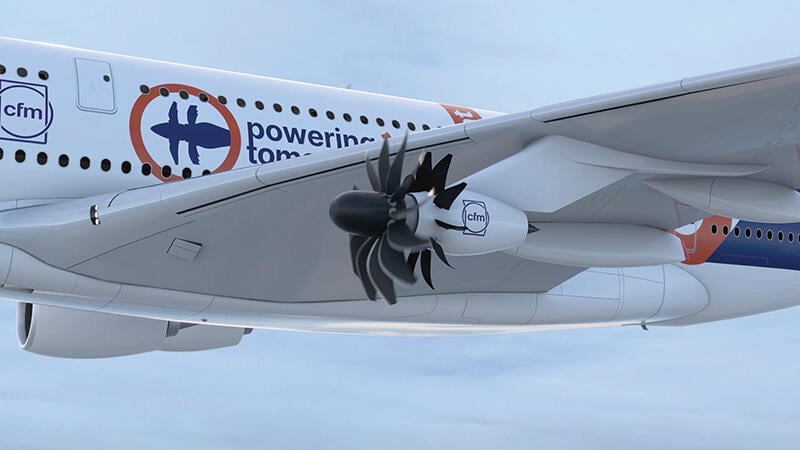
Open Fan engine on Airbus A380

Airbus and CFM International plan to flight-test an early version of the RISE Open Fan engine onboard an Airbus A380.

Credit: Airbus

For Ryanair CEO Michael O’Leary, the case is clear. “The last thing we need is Boeing and Airbus blowing their brains out developing new jet programs,” he said at the beginning of the Farnborough Airshow week. “There will not be a need for a new jet program until probably the end of the 2040s.”

It is fair to assume that even Boeing—whose CEO Kelly Ortberg said the timeline for a new narrowbody built by his company will shift to the right—disagrees with that view. Certainly, Airbus does. The company reaffirmed at Farnborough its plans to launch a successor to the A320neo family in 2030. Lars Wagner, CEO of Airbus’ Commercial Aircraft unit, said the move will also be a “once-in-a-lifetime opportunity to rebalance the business model.” Airbus hopes to become much more active in the services side of the program for decades, among other things.

  • Airbus needs to choose an engine architecture by 2028  
  • The airframer plans to design, build and flight-test full-scale wing extensions 

Airbus also laid out at Farnborough further steps toward the decision it plans during the next several years. The key elements are: selecting the propulsion system and finding the right design for a much more efficient, long, thin wing made of composites; inventing a new, more efficient production system; and making it as open as possible for future upgrades.

“What I see today as potentially a game changer is linked to everything that is around our global platform system approach, because we need to build this next generation of aircraft on a system platform that will be sufficiently resilient to onboard the evolution of the technology,” said Karim Mokaddem, Airbus senior vice president for Aircraft of Tomorrow research and technology.

“This is something that was never done before,” he added. “It’s probably a huge ambition to think of this aircraft as an asset that is likely not to depreciate over time but appreciate in a positive sense because we will be able to onboard new technologies.”

“We are in a privileged position we rarely have had at Airbus,” said Bruno Fichefeux, head of future programs. “We have time to sharpen the saw and prepare for a launch.” The formal launch of Airbus’ next single-aisle aircraft is provisionally set for 2030. But it is of course subject to hitting milestones and being in a position to make key decisions.

“The big decision factor is conviction-building in the engine choice,” Fichefeux said. “For that we need to get through steps of maturation. The most ambitious target is the [GE Aerospace and Safran Revolutionary Innovation for Sustainable Engines (RISE)] Open Fan. We need to convince ourselves that it works in terms of performance, maintenance and other factors.”

Airbus and CFM International have agreed to flight-test an early version of the engine onboard an A380. Neither is revealing the timing of the test flights. But a decision on whether Airbus will go with the open fan architecture or revert to a more traditional setup will have to come around 2028, insiders estimate, if Airbus wants to stick to its current launch schedule.

Flight tests will continue well after the fundamental decision to validate the concept further. Fichefeux emphasized that “it makes sense to test some of the technologies on more ducted alternatives.”

Airbus will have to perform similar tests with other technologies including the wings and how a future long, thin composite wing would work in combination with an open-rotor engine.

As a first step, Airbus plans to flight-test an experimental high-aspect-ratio-wing extension on an A321neo by 2029 as part of its Wing of Tomorrow research program. The company says will design, build and flight-test full-scale wing extensions over the next three years to “evaluate how the different wing geometries perform in real flight conditions.”

The added tip sections, measuring several meters, “will replicate a folding wing in the fully extended position during a flight,” Airbus says. “They will be fitted with comprehensive testing equipment to capture behavior in flight and evaluate how the longer wingspan impacts aircraft handling.”

“The wing is one of the biggest levers we have to improve flight efficiency, which is why the Wing of Tomorrow is so critical for our next-generation single-aisle aircraft,” said Sue Partridge, head of the Wing of Tomorrow program. “This flight-test campaign will allow us to safely challenge traditional design limits and explore the benefits of longer wings.”

“The size and shape of the wing calls for composites,” Fichefeux said. “For the rest of the aircraft, it is a decision we still have to take. It is a very disruptive wing.”

By no means is the project only about the aircraft. “We believe a new program should be the best in terms of the product, but also make a big step in production systems to gain efficiencies all over the place and ensure a very smooth ramp-up in a shorter time frame,” said Florent Massou dit Labaquère, Airbus executive vice president of production. “This requires us to think outside the box of our legacy systems and to think big in terms of integration.”

Airbus is looking to add more automation and digital tools as well as work with artificial intelligence. “It is a big opportunity to invent something new,” Massou dit Labaquère said. “There are things that will not change—we will have a final assembly line; we will have a flight line; we will assemble the aircraft, but in a different way.”

Airbus is also ramping up systems and potential partner involvement in its next-generation single-aisle (NGSA) eAction program under an initiative dubbed future supplier engagement, or FUSE.

Although details remain sparse, Airbus appears to be using the program to assess system technology readiness levels suitable for its A320neo successor while also judging the ability of suppliers to support production rates of 75-100 aircraft per month.

The process involves issuing a form of simulated requests for proposals that allow prospective suppliers to work closely with Airbus at a detailed technical level without the standard contractual obligations or industrial commitments.

Supplier industry sources say Airbus’ engagement is currently at a deeper level on eAction than Boeing’s is on its new single-aisle project that would replace the 737. However, Boeing is working more closely at a high level with prime contractors—such as engine manufacturers.

The differing intensity of supply chain interaction dovetails with what appears to be an emerging gap between the two airframers’ timelines for launching their next-generation products. Airbus is sticking to its target of greenlighting the A320 replacement by 2030, while Ortberg recently told Aviation Week that Boeing’s plans for the next all-new aircraft launch were sliding to the right, suggesting a likely launch date well into the next decade.

“We have a unique position in that we get to talk to both behind closed doors,” GE Aerospace CEO Larry Culp said. “But I don’t think any of us really know exactly how this is going to play out and when it’s going to play out. And our posture has been to make sure that we are ready, and we think we have the defining architecture of the next generation with Open Fan. We couldn’t launch something with Open Fan tomorrow.”

For O’Leary, that would be no problem, and he does not expect anything to emerge anytime soon anyway. “Until somebody gets to Star Trek travel and starts beaming people around the world, I think we’re dealing with 737 MAXs and A320s or A320neos for the next 10 or 15 years,” he said.

Jens Flottau

Based in Frankfurt, Germany, Jens is executive editor and leads Aviation Week's global team of journalists covering commercial aviation.

Guy Norris

Guy is a Senior Editor for Aviation Week, covering technology and propulsion. He is based in Colorado Springs.

Christine Boynton

Christine Boynton is a Senior Editor covering air transport in the Americas for Aviation Week Network.

Graham Warwick

Graham leads Aviation Week's coverage of technology, focusing on engineering and technology across the aerospace industry, with a special focus on identifying technologies of strategic importance to aviation, aerospace and defense.