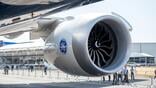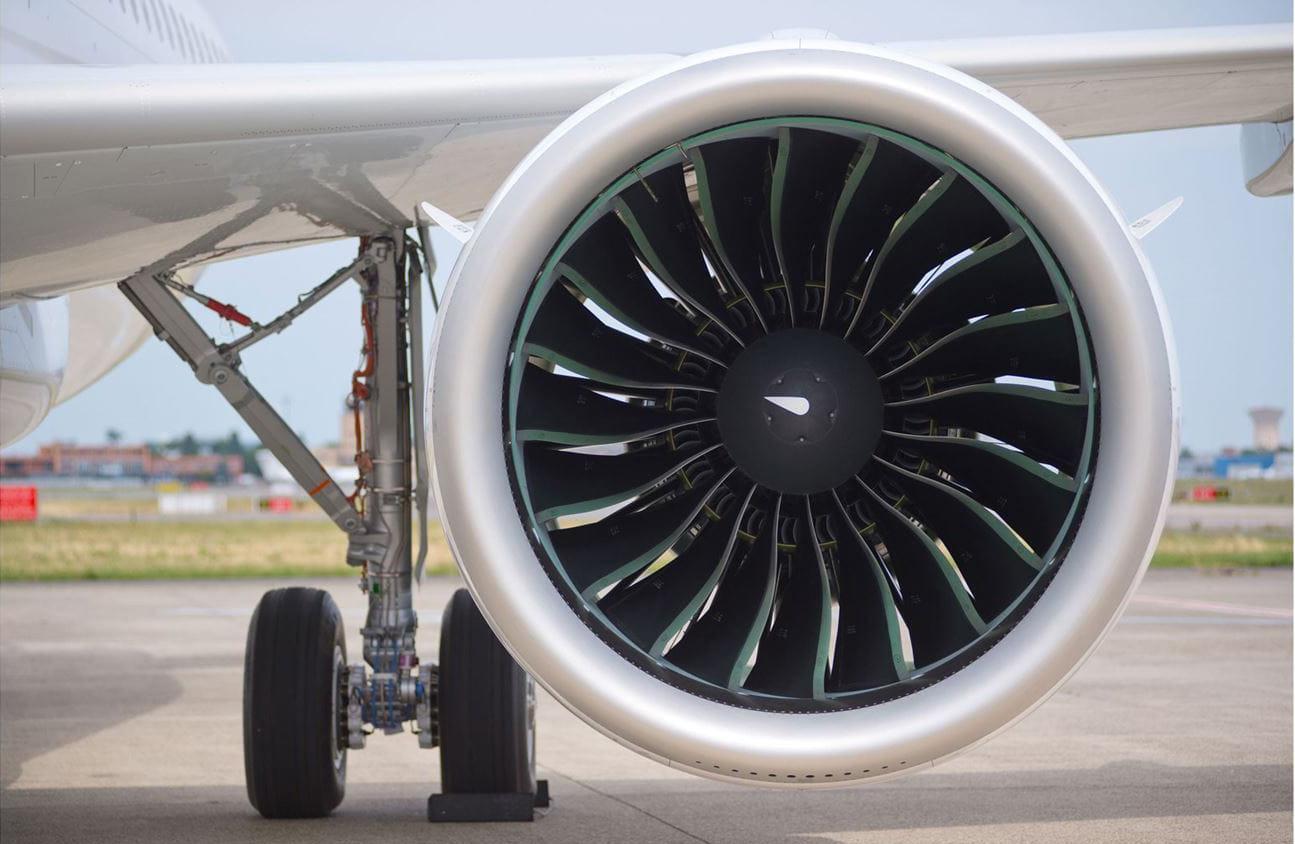
Pratt & Whitney's PW1000G geared turbofan (GTF)
Durability issues with Pratt & Whitney’s PW1000G (GTF) engine have been a focal point of market analysis in recent years. Now, with the curtain closed on 2025, Flight Friday takes the opportunity to review the state of the engine market.
The analysis looks at aircraft ground days as a percentage of monthly days. Note that ground days are not exclusively associated with an aircraft having its engines removed, or the normal operations of the operator, or an aircraft undergoing maintenance, or an aircraft on ground (AOG) issue; it is merely designed as a guide.
Back in 2023, Pratt revealed issues with the high-pressure turbine (HPT) 1 and 2 blades and said 600 engines would need to be checked. This issue escalated quickly, and the data shows that in late 2023, operators had to keep aircraft on the ground so engines could be removed, inspected and rectified. With the engine still relatively new on the market, and with a distinct lack of available spare engines, some of these aircraft were sacrificed so that operators could keep some of their aircraft in the air.
GTF-powered Airbus A320 aircraft have been the hardest hit. Ground days raced to more than 40% in early 2024, with a reduction in the northern hemisphere summer in 2024, before moving back up late 2024.
This cyclical pattern was observed during 2025. As 2025 ended, ground days headed back up to the upper 30s, and if the pattern follows, during 2026 the number should fall again. With engine turnaround times improving marginally, the northern hemisphere winter highs are becoming less severe, and the summer periods more favorable.
The other two GTF-powered programs, the A220 and the Embraer E2, have been impacted less, but both programs suffer from around 25% ground days. For context, CFM International’s CFM56-powered narrowbody fleet had a 21% ground days figure for December 2025, with the CFM56 taken as an industry benchmark for narrowbody engines, alongside the IAE V2500.
The CFM56 successor, the Leap, is performing well and sits at around 12% ground days. Despite issues with the reverse bleed system, which is an ongoing issue, a fix has been developed for the Leap-1A for the Airbus fleet. However, the Leap-1B fix for the Boeing 737 MAX fleet is still to come to market.
This data was put together using Aviation Week’s Tracked Aircraft Utilization database.

Related Content