This article is published in Aviation Daily part of Aviation Week Intelligence Network (AWIN), and is complimentary through Jun 09, 2026. For information on becoming an AWIN Member to access more content like this, click here.

Avelo Looks Ahead To E2s, Plans For Measured Growth

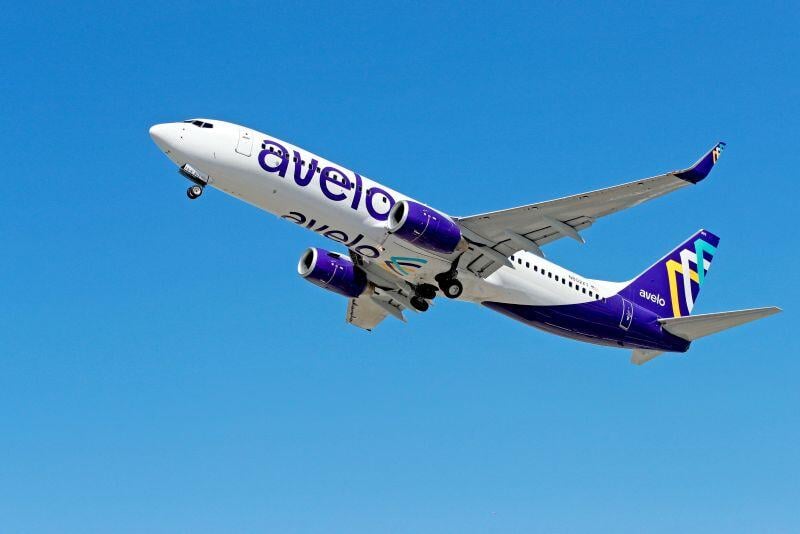
Avelo Airlines aircraft inflight
Credit: Joe Scarnici/Getty Images for Avelo Air

CHARLESTON, South Carolina—U.S. ULCC Avelo Airlines is weighing how long it may operate a two-type fleet, once it takes deliveries of the 50 Embraer E195-E2s it has on order.

“We do plan to fly the [Boeing 737]-800s alongside the E2s,” Avelo CEO Andrew Levy said at the CAPA Airline Leader Summit in Charleston. Given the measured cadence of deliveries, that will likely continue for some years. But, he added, “we’ll see if we do that long-term or not.”

Today Avelo has a fleet of 16 737-800s, according to Aviation Week’s Fleet Discovery database, and orders for 50 E2s. It expects to receive all 50 by 2033, with first delivery slated for 2028. The Houston-headquartered carrier is bullish on the new jet’s potential both from a customer experience standpoint, and in its ability to better serve current and future markets. Citing fuel efficiency and lighter weight, the E2 will allow Avelo to offer more frequency, the CEO said, and strengthen its competitive positioning.

“We’re in the shadow of a lot of hubs ... to be nearby, I think you have to offer some level of utility, aka frequency. You can’t just fly twice a week and gain much of a following,” Levy said. “The E2 we think is going to be really, really powerful for our business, both for growing in the existing basis we’re in, but then also expanding in the new bases.”

Following a recent streamlining of its network and fleet, Avelo is preparing to open a fifth base by year’s end—McKinney National Airport near Dallas. Had deliveries of the Embraer jet already begun, Levy said the carrier would have launched its new location “with nothing but E2s, because it’s a lower trip cost airplane, which lowers the risk of starting new markets.”

As it takes delivery of new aircraft, scales existing bases, and considers new locations, Avelo is still planning for slow and steady growth. In five years, its CEO projects to have just “a couple more” bases.

“The next one is going to be quite big, and we have in mind what the sixth one will be,” Levy said, noting that some represent longer-term projects requiring capital and regulatory work. And though New Haven, Conn., is its largest base today, it’s not necessarily the biggest opportunity for the carrier in the long-term, Levy said. The CEO nodded to “massive metropolitan areas” near Avelo’s three other bases, noting also future growth potential from its soon-to-open McKinney location.

“The Dallas metroplex is soon to be the third-largest metropolitan area in the country,” he observed.

Avelo’s four existing bases comprise Tweed New Haven Airport in Connecticut; Wilmington Airport in Delaware; Concord-Padgett Regional Airport near Charlotte, North Carolina; and Lakeland Linder International Airport in Central Florida. Earlier this year, the carrier moved to close crew bases at two other North Carolina airports—Raleigh-Durham International Airport and Wilmington International Airport—and at Phoenix-Mesa Gateway Airport in Arizona. It used the latter to operate deportation flights for the U.S. Department of Homeland Security (DHS) under a contract signed in April 2025. Avelo ended the DHS charter flights in January.

Looking ahead, the carrier sees other opportunities around the U.S., while noting that not every city or major metro area has an airport that would be viable for its operation. “I haven’t found one in Chicago yet, as much as I’d like to,” Levy said. Its operations in secondary markets come with opportunity, but also certain challenges—discovery being one Levy views as significant.

“I’ll be honest with you, the biggest challenge is Google Flights,” he told the crowd, stating the search engine’s powerful algorithm steers customers to suggested selections, rather than a comprehensive list. “Google Flights is actually probably the biggest impediment, much more so than infrastructure.”

Christine Boynton

Christine Boynton is a Senior Editor covering air transport in the Americas for Aviation Week Network.