This article is published in Aviation Daily part of Aviation Week Intelligence Network (AWIN), and is complimentary through Mar 30, 2026. For information on becoming an AWIN Member to access more content like this, click here.

Finnair Orders Embraer E2s, Seeks Older A320s In Single-Aisle Refresh
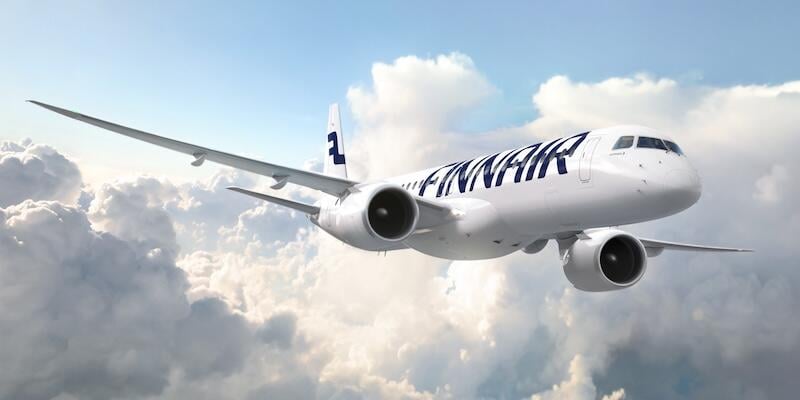
Finnair E2

Finnair Embraer E195-E2

Credit: Embraer

Finnair has placed a firm order for Embraer E195-E2s, to be operated by its regional partner Nordic Regional Airlines (Norra) and is seeking up to 12 used Airbus A320/321ceos to replace its oldest A319s and A320s, along with six ATRs and four E1s for interim regional capacity.

Alongside an initial firm order for 18 E2s, Finnair has taken 16 options and 12 purchase rights, plus spare Pratt & Whitney PW1900G geared turbofan (GTF) engines. It has also signed a maintenance services agreement with Pratt.

“This mix of new and used aircraft supports our growth and profitability targets,” Finnair CEO Turkka Kuusisto said, announcing the order on March 23. The deal is notable as Finnair has been talking about its narrowbody renewal for several years.

Kuusisto said the E-Jet deal took 18 months to finalize. “This is one of the largest investments in Finnair’s 102-year-old history, and a vital step in our strategy. The Embraer E2 will enable us to strengthen our European network and tap into the growth opportunities,” Kuusisto said. “As Russian airspace is closed, regional operations are getting more important.”

The E2s—which are able to reach the Iberian Peninsula from Helsinki—will be used to broaden Finnair’s regional network, strengthen point-to-point connectivity and feed Asian and North American long-haul operations.

This is particularly relevant because Finnair has been actively reworking its network following the Russian airspace closure.

“The gauges and the numbers of aircraft that we need are different, so it’s not as simple as doing a one-for-one replacement,” Finnair chief revenue officer Christine Rovelli said. “What we’ve looked to do is reorient the network, in terms of our home Nordic market that we are serving, which—by definition—has smaller destinations that are better suited to a smaller gauge of aircraft.”

The E2s will be configured with 134 reclining seats at a 29-30 in. pitch, which is roughly equivalent to Finnair’s narrowbody product. Seats will be equipped with USB power and inflight connectivity, and Finnair has opted for a third toilet on board.

Rovelli said the A220 was also in the mix, but the E2 was ultimately a better fit. “The A220 has a longer range; it carries more people. But the question was, was that something that was best suited to our network or not? And at the end of the day, looking at those two aircraft together, we really felt like the E2 is the best decision.”

Norra performs regional flights for Finnair with 12 E1s and 12 ATRs. Last year, Finnair negotiated a new collective labor agreement with its pilots, increasing the maximum number of jets operated by Norra from 12 to 18, paving the way for the renewal.

The first 134-seat E195-E2 will join the fleet in the third quarter of 2027. Three E2s will arrive in 2027, followed by six in 2028, another six in 2029, and the final three in 2030. The delivery date was partly led by timings for Pratt’s engine upgrades.

“We had a lot of discussions with Pratt & Whitney, as you might imagine, throughout this process, to get comfortable with where the build of the engine is currently, and where they expect it to be by the time we take delivery,” Rovelli said. “They have been pretty public about the fact that the GTF Advantage and the HS Plus [Hot Section Plus] will be installed on the engine, at the latest the [third quarter of] 2027 ... we felt comfortable moving forward with deliveries at that time.”

In the run up to the first E2 arrival in the third quarter of 2027, Finnair is seeking some additional regional aircraft. “We have already issued an RFP [request for proposals] in the market for the [six] E1s and the [four] ATRs, so we are actively sourcing those now, with a view to getting some of them in the fleet as early as 2026,” Rovelli told Aviation Week.

Regarding the Airbus aircraft, the Finnair executives said Airbus and Boeing do not have any larger MAX or neo delivery slots until 2032 or 2033. This is problematic because Finnair’s A319s and A320s—which have an average age of over 23 years —will need replacing from 2027-2028. According to CAPA data, Finnair’s oldest A319 dates back to 2000, and its oldest A320 was manufactured in 2001. Finnair’s A321s are “much younger” models.

As a bridge solution, Finnair will imminently launch an RFP for up to 12 used A320/321ceos to join the fleet during the next few years. Finnair already operates both International Aero Engines (IAE) V2500- and CFM-powered A320 family aircraft. Asked about engine preferences, Rovelli said, “We don’t have any view on that at the moment.”

The exact number of ceos, their age and delivery timings are yet to be confirmed. Finnair will look to strike a balance between aircraft age and configuration. “We’ve been tracking the market for quite a while, and we’ve been pretty pleased with the developments that we’ve seen in it recently, in terms of availability and pricing,” Rovelli said. “That’s one of the reasons why we decided to make this move now.”

Finnair’s current fleet comprises 18 A350s, six A330s, 14 A321s, 10 A320s, five A319s, 12 E190-E1s and 12 ATR 72s. The airline’s final A350 on order is scheduled to arrive in December 2026.

The E2 order will be added to Embraer’s first-quarter 2026 backlog.

Victoria Moores

Victoria Moores joined Air Transport World as our London-based European Editor/Bureau Chief on 18 June 2012. Victoria has nearly 20 years’ aviation industry experience, spanning airline ground operations, analytical, journalism and communications roles.

Kurt Hofmann

Kurt Hofmann has been writing on the airline industry for 25 years. He appears frequently on Austrian, Swiss and German television and broadcasting…