This article is published in Aviation Week & Space Technology and is free to read until Jun 05, 2026. If you want to read more articles from this publication, please click the link to subscribe.
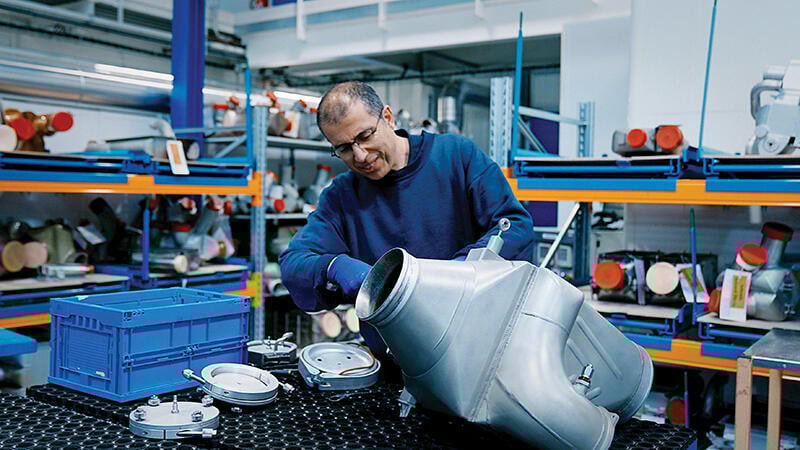
Liebherr-Aerospace has seen maintenance revenue rise faster than production sales since the height of the COVID-19 pandemic.
Despite new-technology reliability problems and slow deliveries of their core products, engine manufacturers are the biggest aerospace companies on the planet. The market capitalizations of GE Aerospace and Pratt & Whitney owner RTX exceed those of Boeing and Airbus, while CFM International partner Safran and Rolls-Royce are not far behind.
This preeminence is based on surging revenue from maintenance and spare parts provision, which allow a company like Rolls-Royce to beat stock market darling Nvidia in share price growth over the past three years—despite waning demand for one of its new-generation engines, the Trent 1000, and its lack of presence in the lucrative narrowbody market.
“Equity value is accruing to services-oriented business models with locked-in customer bases,” lessor Avolon noted in its 2026 outlook. This raises a question: To what extent can other aviation manufacturers reap similar benefits from the aftermarket?
Harald Mehring, chief customer officer of cabin and avionics specialist Diehl Aviation, cautions that engine maintenance paradigms are a poor fit for the component market.
“Our products have much lower unit values, and the component MRO landscape is far more fragmented, with many independent and airline-owned shops,” he says. “Consequently, the natural market power and built-in lock-in that engine OEMs enjoy simply do not exist at the component level.”
Another constraint is that component maintenance has lower technical and certification barriers to entry than do engines, which also makes for more competition. Additional players in the MRO market are attracted by volume economics, too, since many components do not follow fixed overhaul cycles.
That said, there is still room for component OEMs to increase their share of the MRO market through effective application of their intellectual property (IP), data and global presence.
“We are leveraging our OEM design authority with real-time data, applying our capabilities with predictive maintenance to improve decision-making in collaboration with our customers,” says Doug Dilley, group vice president of global aftermarket services and support operations at Parker Aerospace, a diversified component OEM that acquired UK-based Meggitt in 2022.
“One key strategy is to make stronger use of OEM IP and technical data, along with more structured licensing models and selective partnerships that help us bring work back from independent MROs,” Mehring notes.
Such policies are relatively common among component OEMs, although they can create friction with independent and airline MRO providers, which sometimes complain about restricted access to technical manuals and data.
However, another component OEM, Liebherr-Aerospace, stresses that it views such providers as partners in the aftermarket, not competitors. Sven Dicke, director of business and services at Liebherr Aerospace & Transportation, points out that the OEM’s own maintenance business does not receive any priority for Liebherr-built parts over external providers.
“Ensuring they have equal access to materials helps the entire market maintain sufficient global capacity, ultimately benefiting operators who depend on availability and predictable service,” he says.
POST-PANDEMIC GROWTH
Like the engine companies, component OEMs have enjoyed strong growth in maintenance sales, elevating the aftermarket to a critical part of their business and strategy. Diehl Aviation, for example, has moved from a heavy focus on its line-fit business to expansion of aftermarket services, achieving double-digit growth for its spares and repairs volumes in each of the past three years.
“MRO has evolved from a must-have capability to a core, value-creating component of our commercial aviation strategy,” Mehring says. “Over the past 10 years, we have deliberately expanded our aftermarket business. We have professionalized our MRO and spare parts activities on a global scale, strengthened our relationships with airlines and MRO providers and significantly improved our reactivity, response times and service levels.”
Apart from higher profits, the aftermarket offers OEMs the chance to extend global reach by growing their international customer base among airlines, MRO providers and other aftermarket companies.
“Our aftermarket offerings anchor our long-term customer relationships, reinforce our role as both OEM and technical authority and drive life-cycle improvements across platforms,” Dilley notes.
Constrained deliveries of new aircraft have contributed to the growth of OEM aftermarket activities, affecting component-makers’ line-fit volumes and indirectly boosting maintenance demand by forcing airlines to operate older aircraft longer.
“Post-pandemic, maintenance revenues grew faster than production, reflecting customer demand for support and availability,” Dicke says. And while he expects “a natural rebalance between production and MRO activities” once airframer output ramps up, Liebherr’s aftermarket surge is being replicated across other component OEMs.
“Delayed aircraft deliveries and slower-than-desired ramp-up in aircraft production have clearly increased the importance of maintenance and spare parts for our business,” Mehring says, pointing out that average age of the global fleet has increased by four years since before the pandemic. “Taken together, these factors have shifted more value creation into the aftermarket, creating higher demand for spare parts, repairs and availability solutions for in-service fleets while production is still ramping up.”
Dilley agrees: “Operators are extending aircraft life, and the demand for repair and overhaul continues to rise.”
Time on wing and reliability are priorities for airlines, he adds, meaning that data and predictive maintenance have become key tools for Parker to manage surging aftermarket demand. “We can prioritize maintenance actions, improve planning accuracy and help operators reduce unplanned downtime,” he says.
Dicke observes that the changing supply-demand dynamics have affected how airlines structure their maintenance, favoring fixed-price transparency and guaranteed turnaround times since the pandemic.
“Today, the mix has shifted toward stable, predictable cost models and, above all, availability-driven maintenance solutions that keep customers’ aircraft operational,” he says.
At Diehl, Mehring believes that after a swing toward power-by-the-hour services in the early 2000s, component maintenance is evolving again.
“Many customers still appreciate pay-by-the-hour solutions for cost predictability and simplified administration,” he says. “At the same time, a growing number of airlines are using time-and-materials contracts for certain components where they want more direct control over costs and repair decisions.”
SUPPLY STRATEGIES
Supply chain problems are hurting aerospace OEMs from both the production and maintenance sides of their activities. A Boeing spokesperson tells Inside MRO that while the supply chain is starting to stabilize, “recovery is still many years away.”
They add: “Supplier capacity constraints continue to hinder our ability to meet demand, and we continue to encounter unexpected shortages due to obsolescence, nonconformance and subcomponent shortages in the OEM supply chain.”
Diehl reports that average turnaround times have risen 20-30% from the company’s typical pre-pandemic target of 15-20 days. “The main bottleneck we are still facing is the limited availability of certain parts and materials, rather than labor,” Mehring explains. “To mitigate this issue, we are building higher safety stocks of critical parts, which increases inventory and financing costs. Constrained material availability has also led to backlogs of units in our facilities that cannot be completed until specific parts arrive.”
Boeing, which offers component, wheels, brakes and battery repair services in addition to supplying the wider MRO market, is boosting stock levels to keep its customers supplied.
“Our largest investment is in inventory—transactional spares, component repair and exchange programs—to support customer maintenance needs,” the spokesperson says. “We are also expanding capacity of our exchange pools, which provides customers with the critical parts they need on a planned schedule.”
Boeing highlights its move into used serviceable material as another way of easing supply chain constraints, and forecasts annual market growth in the material of 10%.
Parker, meanwhile, has expanded its regional repair capability and global service centers, “allowing us to strengthen supplier alignment,” Dilley says. “We also use the data we collect to improve planning and workflow. This allows us to focus on consistent delivery today with a more resilient model over time.”
Finally, as part of a growing trend toward regionalization, OEMs have established more warehouses and distribution hubs in areas like the Middle East and Southeast Asia. This allows them to shorten logistics chains, improve turnaround times and ultimately improve relationships with customers in those regions.