This article is published in Aviation Week & Space Technology and is free to read until Aug 05, 2026. If you want to read more articles from this publication, please click the link to subscribe.

Sustainability Pressures Reshape Aviation Repair Strategies

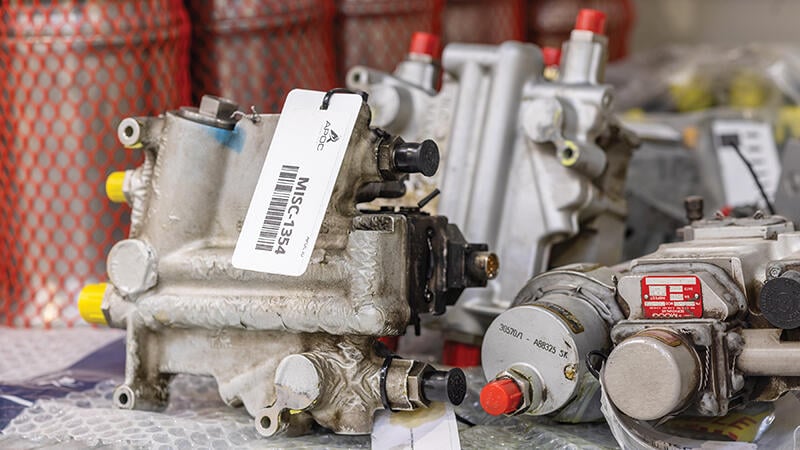
used parts and materials

Factors such as carbon impact, emission reduction and material reuse are increasingly part of repair-versus-replace discussions.

Credit: APOC Aviation

Sustainability pressures are reshaping the aftermarket far more fundamentally than through maintenance practices alone. Across teardown specialists, MROs and component suppliers, there is growing recognition that OEM design choices are redefining what can realistically be refurbished, recovered or kept in service.

The industry appears aligned on both the challenges and opportunities. Discussions reveal a consistent pattern: Sustainability influences decisions largely by reinforcing existing economic drivers rather than replacing them, while the pressure to design parts that are easier to repair, disassemble and recycle intensifies. 

ADAPTING TO DESIGN

Recent OEM design trends are reshaping teardown and repair economics across the aviation aftermarket, AerFin Chief Operating Officer Simon Bayliss says. The company reports that the increasing use of composite airframes and more integrated structural designs is altering how components can be repaired, recovered and returned to service.

“We are seeing more sealed and nonmodular assemblies entering the market, which can limit traditional repair pathways and increase the complexity of disassembly,” he says. Concurrently, he notes that advanced alloys and protective coatings are improving durability and operational performance, but they also require more specialized repair capabilities, equipment and technical expertise.

While these advances deliver clear efficiency and performance gains for operators, Bayliss says that they also heighten the need for aftermarket specialists that can adapt their repair strategies.

GA Telesis works with OEMs to support airlines in the ecosystem, and CEO Abdol Moabery warns of potential constraints. The most material shift has come from highly integrated assemblies and proprietary digital controls embedded within components, he says.

“Some of these designs are engineered for performance and weight reduction, but that often comes at the expense of modularity, thereby tightening the practical repair boundary,” Moabery notes.

GA Telesis also points to the growing use of advanced coatings and embedded sensors. While these technologies enhance efficiency and monitoring, Moabery says they create new constraints around approved repair schemes, tooling access and data ownership. “In effect, the technical capability to repair often exists, but the economic and regulatory pathways are more restricted than they were a decade ago,” he says.

Experts at Barfield say today’s biggest obstacles to repair, refurbishment and life extension fall into three distinct areas: newer components with highly integrated avionics and electromechanical assemblies, older components where obsolescence is driving long delays, and design trends toward sealed modules and embedded software that limit repair options. 

LIMITED SOURCING

From APOC Aviation’s perspective as a teardown and component supply specialist, recent OEM designs do not directly limit its ability to provide parts to customers. However, earlier‑standard equipment that is still technically repairable is increasingly being classified as beyond economic repair (BER) because manufacturer control over component maintenance manuals restricts the scope for independent MRO innovation.

Pascal Parant, chief commercial and marketing officer at Vallair Group, echoes this view, noting the growing monopoly dynamic and shrinking number of independent sources for subcomponent materials as a major obstacle to effective repairs.

“I fully understand that OEMs invest millions—even billions in the case of engine manufacturers—in R&D and certification and that they recover these costs through the aftermarket,” he says.

As Parant observes, though, the combination of single‑source parts, licensing constraints, royalties and other barriers is steadily reducing the number of capable repair providers, even as customer costs continue to rise.

He adds that cost remains the decisive factor in determining whether a component is repairable or classified as BER. He maintains that this has little to do with sustainability and is driven primarily by economics.

SUSTAINABILITY PRESSURES

Airlines are progressively engaging with aftermarket providers that more closely align with their sustainability and environmental initiatives. Consequently, these providers are likely to face growing sustainability pressures that increasingly shape customer decisions around repair, reuse and replacement.

Parant recalls a period when Jet A‑1 prices surged to nearly $1,900 per metric ton from about $700, and life-limited part (LLP) costs were climbing roughly 10% year over year—a backdrop against which sustainability can easily feel like an expensive “nice to have.” In that environment, such initiatives, which often require up-front investment, can feel like a luxury rather than a necessity, he explains. “That said, there is a very tangible sustainability benefit in used serviceable material,” he says.

According to Parant, when considering the total energy required to produce a component—from mining and melting to forging, machining and assembly—each part effectively becomes a reservoir of embedded CO2 and energy.

“Maximizing the full life potential of each component therefore has a clear and positive sustainability impact,” he says. “This is particularly true for LLPs and engine components, provided engines are rebuilt intelligently to balance [exhaust gas temperature] margin with remaining LLP life.”

Bayliss at AerFin says sustainability increasingly influences customer decision-making, but reinforces economics rather than replacing it. “Repair-versus-replace discussions are no longer based solely on cost and availability,” he notes, citing carbon impact, emission reduction and material reuse as now part of the equation.

“We are also seeing sustainability shape end-of-life decisions,” Bayliss says. He points to rising maintenance costs, long lead times and supply chain disruption all accelerating teardown activity, with harvesting increasingly viewed as a more responsible and commercially viable alternative to scrapping assets outright.

John Rogers, senior vice president for sales and marketing at Barfield, detects strategic trends across Airbus and Boeing narrowbody fleets. He says operators are extending asset life through repair and retrofits versus outright replacement. Airlines are leveraging exchanges over the cost of repairs due to surging piece parts costs from OEMs, until market supply dries up as well as extending aircraft life cycles due to delayed deliveries of new aircraft.

lab technician working on hardware
Design trends toward sealed units and embedded software are some of the biggest constraints on extending part life. Credit: Barfield

ALTERNATIVE FACTORS

Ian Foster, vice president for MRO and technical at APOC Aviation, says sustainability is still not visible as a primary customer priority—pricing and quality remain the main factors guiding repair decisions. “However, sustainability through supply of repaired and recertified components makes them more attractive to some customers,” he says.

While sustainability has long been a key consideration for GA Telesis, Moabery has seen it become a direct influence on procurement strategy for an increasing number of airline customers, particularly among larger carriers.

He says the decision is no longer a simple balance of cost versus availability. It is shaped more and more by both availability pressures and environmental impact. GA Telesis sees this most clearly in two areas. First, airlines increasingly extend asset life through used serviceable material and repair programs where reliability can be assured. Second, lessors are pushing for end‑of‑lease conditions that prioritize reuse and documented traceability.

“The reality is that used serviceable material delivers measurable sustainability outcomes, and airlines have realized that reliability and availability are at levels that are operationally pleasing,” Moabery says.

ATR’s Life-Cycle Approach

Through feedback from operators and in-service data, ATR has identified components where design adaptations can allow longer maintenance intervals, fewer removals and reduced logistics flows. According to the OEM, this directly contributes to lowering material consumption and transport-related emissions over time.

The airframer says end‑of‑life considerations are embedded in its eco‑design work through a life‑cycle approach. ATR says about 85.5% of one of its aircraft’s mass is recyclable, largely due to its metallic structures.

The airframer says it ensures that dismantling, recyclability and end‑of‑life assumptions are fully integrated into its life-cycle analyses with the vast majority of its suppliers, so that aircraft-level design choices remain aligned with industrial realities and the practices established across its shareholder partners.

ATR reports that since 2025, every new design or modification undergoes an environmental assessment alongside technical, safety and certification criteria. Material choices are never evaluated in isolation, the company says.

For example, ATR explains, aluminum and composites present different environmental trade‑offs: Aluminum is highly recyclable, whereas composites offer significant weight reduction, directly lowering fuel burn during the aircraft’s use phase, by far the most impactful stage of the life cycle. In many cases, weight reduction remains the decisive factor because of its strong influence on operational emissions.

That said, ATR believes circularity criteria such as material durability, dismantlability, production scrap, transport impacts and end‑of‑life treatment are becoming more formalized within its decision‑making process. The OEM says its objective is not to impose a single solution but to arbitrate based on life‑cycle performance, using quantitative tools wherever possible. 

Keith Mwanalushi

Keith Mwanalushi primarily writes about the global commercial aviation aftermarket and has more than 10 years of experience covering it. He is based in the UK.