This article is published in Aviation Week & Space Technology and is free to read until Jul 18, 2026. If you want to read more articles from this publication, please click the link to subscribe.
ACMI aircraft rarely return to fixed bases, so obtaining spare parts for them can be trickier.
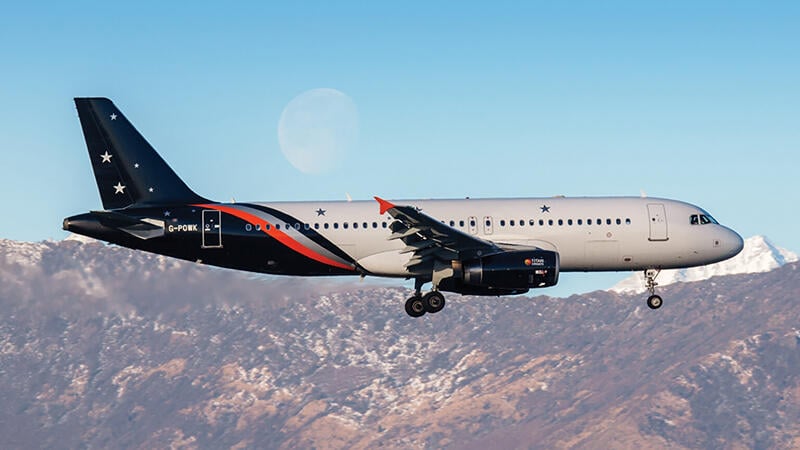
Aircraft, crew, maintenance and insurance operator Titan Airways is moving to join the International Airlines Technical Pool, signaling a broader shift in how nonscheduled carriers are approaching spares support as supply chain constraints persist and operational models become more unpredictable.
Philip Donohoe, the airline’s head of supply chain, is clear that parts pooling is no longer optional for aircraft, crew, maintenance and insurance (ACMI) operators. In other words, it is becoming operationally critical.
Titan’s business model is built around short-notice “go-now” charters, and global flying exposes the limits of traditional spares strategies. “We don’t know what we want, we don’t know when we want it, and we don’t know where we want it—but when we do, we need it,” Donohoe says. “Because there are 300 people with their bums on our seats waiting to take off.”
Unlike scheduled carriers, Titan’s aircraft rarely return to a fixed base. Its fleet operates globally, including round-the-world charter programs and government missions, often touching remote or irregular destinations where local spares support is limited or nonexistent. In that context, access to a global pooling network becomes a key risk mitigator.
“We have fairly regular stations that we drop in at, but we don’t stock anything there,” Donohoe adds. “So to be able to pool, for example, wheels in Australia or in India or in Hawaii would be a massive advantage for us and obviously gives us a degree or a level of security that we don’t have now.”
The operational case was reinforced by a recent aircraft-on-ground (AOG) event involving a UK government charter Airbus A321 in New York. Titan was unable to source a serviceable aircraft battery through conventional channels, highlighting a gap that traditional suppliers could not fill in time.
“The only organizations likely to have aircraft batteries ready to go, charged and available on the shelf are airlines,” Donohoe says. While the solution did not formally go through the International Airlines Technical Pool, it was enabled by industry contacts developed through the network.
“It completely sold the concept to the executive board of Titan Airways from that one event—the cost savings, both financially and in terms of reputational impact,” he adds.
The incident highlights an important point for ACMI operators: Having access to parts held by other airlines and the relationships that enable that access can matter more than traditional supplier channels, especially for urgent, time-critical components.
Titan already operates under power-by-the-hour (PBH) agreements, but Donohoe points out such agreements’ structural limitations. “A PBH is great, but it’s based around your home base,” he says, noting that ACMI flying patterns rarely align with fixed support networks.
Pooling also offers a way to reduce operational inefficiencies. Carrying spares onboard is not always viable due to weight and cost penalties, while positioning inventory globally is impractical. “You can’t have everything onboard,” Donohoe argues, pointing to the limitations of flyaway kits.
Beyond access, Titan is positioning itself as an active participant in the pooling ecosystem. The airline plans to contribute components from key stations, including London’s Gatwick and Stansted airports as well as Germany’s Leipzig/Halle Airport, focusing on critical no-go items, such as wheels and brakes. “We want to be active contributors, and we recognize it’s a two-way street,” Donohoe says.
Regulatory factors are influencing the shift. Post-Brexit, UK Civil Aviation Authority requirements have reduced parts interoperability, limiting access to components certified by the European Union Aviation Safety Agency and tightening supply options. Pooling provides a way to offset those constraints through broader network access.
For ACMI operators, the commercial stakes are high. Dispatch reliability directly affects contract performance, passenger disruption and financial exposure. “By offering that go-now service, imagine committing to a flight at short notice and then not being able to dispatch due to a technical issue,” Donohoe notes.