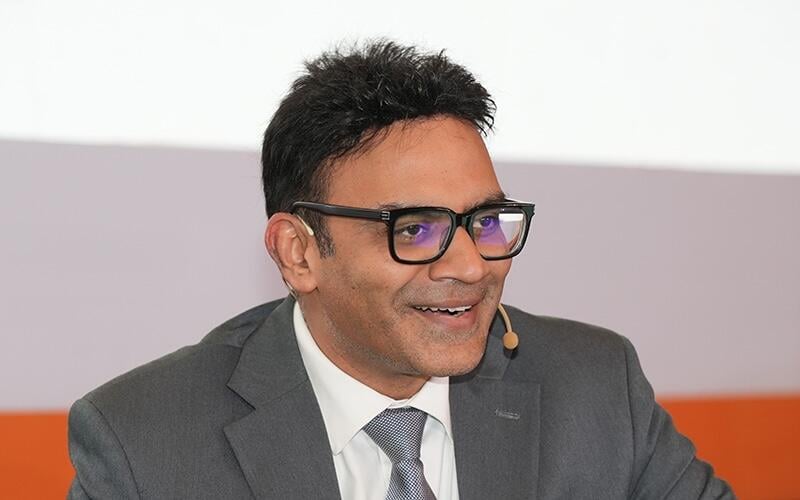
Ashish Rajvanshi, CEO of Adani Defense and Aerospace, speaking at Aviation India 2026.
NEW DELHI—Indian conglomerate Adani Group believes it will sign a deal within 18 months with CFM International or Pratt & Whitney to establish a new-generation engine MRO facility in India that would be open for business two years later.
Ashish Rajvanshi, CEO of Adani Defense and Aerospace, made the comments at Aviation India in early November.
Rajvanshi’s assertion about Adani’s intentions was mirrored by other Indian-based businesses, which are likewise eyeing engine MRO opportunities in a market where fleets powered by CFM Leaps and Pratt GTFs are growing rapidly.
Whoever successfully enters India’s engine MRO arena will join Safran. In August, Safran Aircraft Engines Services India inducted its first Leap into a brand-new $220 million engine-servicing plant it has built in Hyderabad, introducing full overhaul capability for Airbus A320neo and Boeing 737 MAX powerplants in the country for the first time.
The plan is to service 300 Leaps a year in Hyderabad when the facility is fully up and running. Safran and GE Aerospace are 50:50 joint-venture partners on the design and production of CFM’s market-leading Leap engine.
Adani wants to join this party. Rajvanshi argued that conducting engine MRO locally on behalf of the country’s airlines for existing aircraft types, and in the future an Indian-manufactured aircraft, was critical to giving carriers confidence in their engine-servicing costs and turnaround times.
“The first step [for Adani] is engine MRO. The second step, if there is willingness on the other side, is setting up engine production, all in India,” Rajvanshi said.
He said that Adani is in discussion with all the engine companies.
However, the group's new partnership with Embraer could hold the key. Adani and Embraer agreed in January to explore the establishment of a final assembly line in India.
Assembly of the Brazilian manufacturer’s E2 regional jet in India could point to a tie-up with Pratt, as the U.S. OEM's PW1900G engine powers the E2.
Taking a step into engine MRO and then production would be a further statement of Adani’s intent. However, it is confident about the growth prospects for aviation in a country of 1.4 billion people. “In most of the business we have done, we have taken risky bets, but India is basically allowing for opportunities,” Rajvanshi said.
Adani Group, India’s huge infrastructure conglomerate, has been making a strategic shift into aviation since 2019. It now runs eight airports in India, including both airports in Mumbai, and over the past two years has entered India’s airframe MRO market with the acquisitions of Air Works and Indamer Technics.
It will face competition to enter the engine MRO market.
State-owned AI Engineering Services Limited (AIESL), formerly the MRO arm of the Air India Group, is already an approved repair shop in India for CFM56 engines. AIESL argues it has the size and experience, as it enters a period of improved financial health, to make a move. It hopes its financial strength will enable investment in new-generation engine MRO.
India’s largest carrier, IndiGo, will play an important role in the direction of the country’s engine MRO evolution. In July, IndiGo signed a pact with CFM to order more than 1,000 Leap-1A engines to power 510 A320neo-family aircraft. The deal included “CFM’s extensive support in establishing IndiGo’s upcoming engine MRO facility.”
Whether IndiGo establishes this plant alone, in partnership with the OEM or with another MRO player, is not decided yet; all possibilities appear on the table.
Over the coming decade, India’s engine MRO story will transform from one where most of the work is sent overseas to a “Made in India” narrative. It is a huge market opportunity, and players such as Adani want to take a big slice of the action.

Related Content