Leading Indian Carriers Move Toward Self-Reliant MRO As Fleets Grow
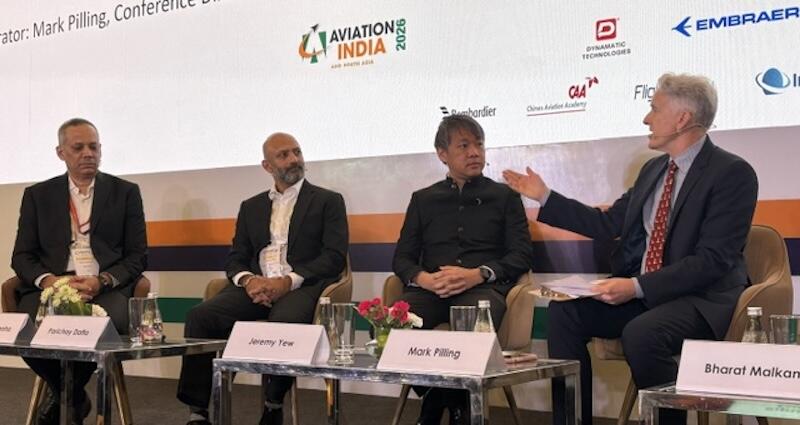
Indian airline MRO executives on stage at Aviation India 2026.
NEW DELHI—India’s three biggest airlines are building up their own maintenance, repair and overhaul (MRO) capabilities.
Engineering chiefs from the carriers all say the domestic aftermarket has not kept pace with fleet growth and that relying on overseas providers leaves them exposed.
Senior executives from IndiGo, Air India and Akasa Air made their cases for investment to delegates at the Aviation India summit in Delhi.
No choice for IndiGo
IndiGo says it operates 439 aircraft and expects to reach 444 by mid-November. Parichay Datta, its senior vice president for maintenance and engineering, said the domestic ecosystem has not grown in proportion.
“There is no choice but to be self-reliant,” Datta said. Airframe work, he noted, is only a fraction of what an aircraft needs. Components, auxiliary power units, engines and landing gear make up much of the rest.
Last year, IndiGo carried out more than half of its roughly 140 annual C checks in-house. That left outside MROs free to handle end-of-lease checks. Datta welcomed Safran’s new local facility in Hyderabad but said that would fill only “a very small part” of the airline’s needs.
IndiGo has held long-term partnership talks with MROs in India and abroad, he said. Some overseas providers currently look stronger on capability, capacity and price. Indian MROs “can and should do a lot more,” Datta said, adding that quality should match what the airline pays for.
Air India focuses on Bengaluru hub
Air India’s push is driven by geopolitics, said Jeremy Yew, its senior vice president for maintenance and engineering. The airline still outsources about 20% of its line maintenance but plans to bring all of it in-house within six to eight months.
Most narrowbody base checks are already done in India, while widebody work is split between Indian and foreign MROs. Yew, who joined Air India from shareholder Singapore Airlines, said the Middle East crisis earlier this year exposed the risk. Checks planned at Middle Eastern facilities had to be moved when aircraft could not reach them. The airline later curtailed its network because of high fuel prices and overflight problems. When it tried to speed up cabin retrofits, it again struggled to find slots.
“Without in-house capability ... you will forever be dependent on others,” Yew said. He added that the motivation is “even greater” than a year ago, citing control over costs and turnaround times as further drivers.
Air India is building a local MRO hub at Bengaluru, an airport that CEO Tewolde Gebremariam has designated as a third international hub for the flag carrier. It will begin with a five-bay hangar—for three widebodies and two narrowbodies—and grow to 13 bays over the next few years. Hangars are also being developed in Delhi.
Yew said in-house growth “need not squeeze out” independent Indian MROs. He pointed to possible partnerships on training and tooling, as long as commercial terms, quality and safety standards are met. He also called for an ecosystem that eases the movement of parts and for regulators to help the local industry “flourish to the next level.”
Akasa Air begins MRO at Noida
Akasa Air began flying in August 2022 and has grown from 20 aircraft to 45, said Daniel Saldanha, its senior vice president for maintenance and engineering. It plans to reach 50 by March 2027 and has 226 aircraft on order through 2032.
The airline originally meant to outsource most maintenance but moved line maintenance in-house within months of launching. The post-COVID market offered plenty of skilled engineers, Saldanha said, and “there’s no turning back from there.”
As the fleet is new, with an average age of about four years, heavy checks only became necessary in the third year. Akasa tendered the work and signed a three-year contract with GMR Aero Technic. Since June 2025, GMR has completed 24 aircraft. Saldanha said quality and pricing met expectations.
Akasa is now looking further ahead. It has tied up with the new Noida airport to open a small MRO facility by 2028 for basic work. The airline must still secure capacity for C2 and structural checks in about nine years, Saldanha said. It will balance in-house work against partnerships with growing Indian MROs such as GMR and Adani, which are also winning overseas business.
“If we don’t secure ourselves, we’ll run out of capacity,” Saldanha said.

Related Content