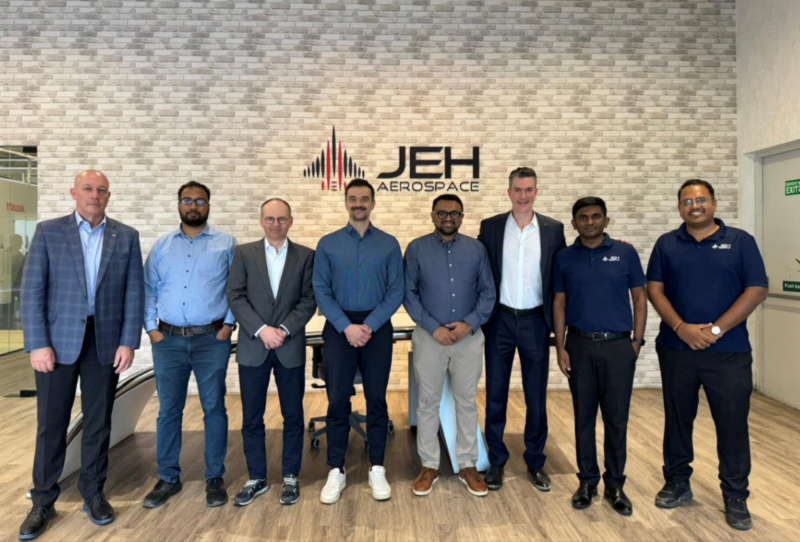
Jeh Aerospace has signed a long-term agreement with Liebherr Aerospace.
Jeh Aerospace is shedding new light on how India’s fast maturing manufacturing ecosystem is reshaping global supply chains, arguing that the industry’s pivot toward the country is not a temporary response to recent global shocks but a structural realignment with long-term consequences for OEMs and Tier 1s.
“The shift to India specifically reflects both the quality of what the ecosystem can deliver and the strategic imperative to diversify away from single region dependency. Neither of those drivers is going away,” Vishal Sanghavi, founder and CEO of Jeh Aerospace, tells Aviation Week.
The comments follow the company’s recent long term agreement with Liebherr Aerospace, announced April 15, to manufacture high precision landing gear components for major single aisle programs. But Sanghavi is already steering the conversation beyond the contract, using the opportunity to outline how supply chain expectations are changing, and why India is becoming central to that recalibration.
He argues that geopolitical risk between India and Europe has “structurally reduced,” pointing to the EU-India free trade agreement as a stabilizing force for long cycle aerospace manufacturing.
“Supply chain risk management in aerospace is never a single lever, and both sides need policy certainty to commit resources and make the relationship work,” he says. That stability, he adds, is reinforced by long term raw material agreements and a deliberate avoidance of single source dependencies.
“For precision components like landing gear parts, which require specific grades of titanium and high-strength alloys, forward planning on raw materials is not optional,” says Sanghavi.
The company’s new work with Liebherr is framed as an extension of that philosophy rather than a standalone win. Sanghavi describes Liebherr as “one of the most disciplined aerospace supply chain operators in the world,” and says the partnership is built on shared standards and long term alignment rather than opportunistic capacity placement.
Cost exposure, especially for energy and materials, remains a concern across the sector, but Sanghavi insists India’s engineering base provides meaningful insulation. “Our programmers and manufacturing engineers represent a level of capability that would cost multiples of what we pay in equivalent Western markets,” he says. He stresses that this is not a short term labor arbitrage, but a structural advantage rooted in the depth of India’s engineering education and the maturity of its industrial workforce in cities like Hyderabad.
On materials, Jeh relies heavily on long term agreements for titanium, Inconel and high grade stainless steels to avoid spot market volatility. “Planning ahead is a standard part of how we manage customer commitments,” he says.
Export control exposure is also mitigated through the company’s dual structure: a U.S. headquarters paired with Indian manufacturing. “That dual structure is a genuine risk mitigation, built into how the company was set up from day one,” says Sanghavi.
However, the most consequential shift, in Sanghavi’s view, is how OEMs and Tier 1s are now approaching supplier relationships. The era of awarding work to any qualified shop with spare capacity is largely over, he reckons, noting that OEMs and Tier 1s look for continuity once they have put that level of time, engineering effort and relationship capital into a supplier.
“That selectivity is healthy for the industry, and it rewards suppliers who build capability with discipline rather than those who simply have floor space,” he adds.

Related Content