India’s AIESL To Gain Financial Strength That Will Unlock Growth, CEO Says
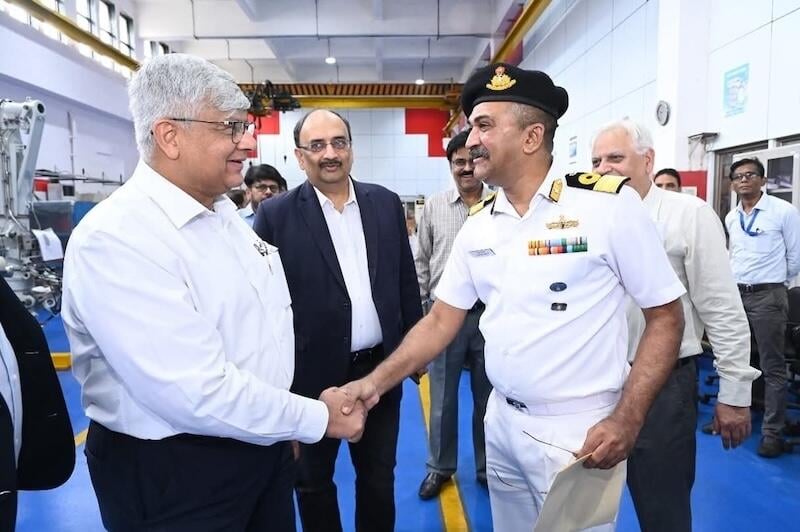
AIESL CEO Sharad Agarwal (left) has seen his firm’s defense-related MRO work grow in recent years.
AI Engineering Services Limited (AIESL), India’s biggest MRO provider, has been shoring up its financial stability and diversifying its revenue base over the past four years, putting it in a position to make “big-ticket” investments in new markets and capabilities, according to its CEO.
Sharad Agarwal, who has led AIESL since 2022, tells Aviation Week that investing in engine MRO is of particular interest to the wholly state-owned business.
“The government has already thrown a challenge to the MRO industry to make India a global MRO hub. As the largest MRO in India, it is our responsibility to drive India in this direction, making our country the first choice for global airlines for the maintenance of aircraft and components,” Agarwal says in an interview.
The cornerstone of AIESL’s expansion is to invest in the overhaul of next-generation narrowbody engines, such as CFM International's Leap-1, by the end of the decade, he says. Widebody engine capabilities will come after that, he says.
AIESL was formerly the MRO arm of the Air India Group and historically known as Air India Engineering Services Limited. But when the flag carrier was privatized and sold to the Tata Group in early 2022, AIESL remained under state ownership.
There are many skeptics who have given a non-Air India-affiliated AIESL little chance of making a business success in the highly competitive global MRO world.
However, Agarwal says his team understood it would need to find new business sources, with revenues falling from Air India as the airline established its own engineering operation and sent MRO work to others.
There was also a need to restore the firm’s balance sheet and its financial strength during this time. Over years of government ownership, AIESL had accumulated a negative net worth, which had prevented the business from investing in its future, Agarwal says.
In its 2025-26 annual results, to be published in October, Agarwal is confident the business will have recovered to a positive position, in addition to posting its highest-ever revenues.
“Once our net worth is positive, that creates confidence in the industry, makes us acceptable to the banks and lenders in India and makes us acceptable to the government of India. Then we can do some big-ticket investment into capability additions,” he says.
Despite being India’s largest MRO, about four times larger than its nearest rival, AIESL remains a modest player on the global stage. It posted revenues of $2.1 billion in 2025 and that figure should surpass $2.5 billion for this year.
Agarwal’s ambition is to see AIESL grow its annual revenues to beyond $4 billion in five years’ time.
The company has a strong platform in engine MRO, boasting three engine test cells and a major servicing capability on current-generation power plants. The next step is to advance into types such as the Leap or the Pratt & Whitney geared turbofan (GTF), which would propel AIESL into a higher league.
The firm has talked with all the engine OEMs about this prospect, but Agarwal notes: “To be very honest, the numerous discussions used to break down when it comes to [capital expenditure].”
With Agarwal anticipating a revived financial picture within months, he will hold a stronger hand and is ready to invest the millions needed to establish a large, new engine MRO plant in the target timeline of 2030 to 2031.
Defense Expansion
The addition of more commercial engine MRO work is an important element of AIESL’s strategy, as is its strong diversification of defense business in the past two to three years.
“We were expecting that the Air India business would reduce to nearly 50% in for four to five years, and we are there,” Agarwal says.
“It was part of the plan. We needed to diversify,” he adds. The company has focused on securing business from overseas airlines and military customers. From a low base in 2022, AIESL has won a slew of defense-related MRO contracts, such as a key deal to provide overhauls for components, including the landing gear, for the Indian Navy’s fleet of 12 Boeing P-8I aircraft.
AIESL’s proportion of defense MRO business has risen from low double-digit levels to around 50-50 today, Agarwal says.
As its existing defense contracts deliver consistent revenue streams, AIESL will look to capture more civilian commercial work to raise the non-defense proportion again.
This will be fueled by it having won European Union Aviation Safety Agency (EASA) approval to provide heavy maintenance checks for Airbus A320s and Boeing 737s in 2025, with more approvals set to follow soon, according to Agarwal.
“In the next 12 months, the target is to get EASA approval for widebodies such as the A350, 777 and 787,” he says.
“In the next year, you will see a very different picture at AIESL,” Agarwal says.

Related Content