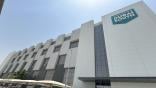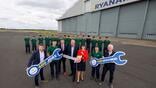
FL Technics Chief Executive Officer Arif Alameri.
FL Technics LLC, a subsidiary of maintenance provider FL Technics and part of Avia Solutions Group, has expanded its line maintenance approvals to include four modern commercial airliners as the first step toward building a maintenance network spanning the Middle East and Africa, according to its chief executive.
In August, FL Technics LLC added the Airbus A350, Boeing 777, Boeing 787 and Boeing 737 MAX with LEAP-1B engines to its authorizations. Its UAE line maintenance capability now covers 11 aircraft types.
Chief Executive Officer Arif Alameri told Aviation Week that the approvals were a “significant step” and “certainly not something that happens overnight.”
Each new type demands qualified certifying staff, tooling, technical documentation, procedures, quality oversight and infrastructure, after which the company must demonstrate to regulators that it can support the aircraft safely and consistently.
“The types were selected after a study of regional fleets rather than to pad out the approval list,” Alameri said. “The A350, 777 and 787 are central to long-haul flying in the region, while the 737 MAX is increasingly important for narrowbody fleets.”
He said the mix mirrors how Gulf airlines operate, combining short- and medium-haul regional networks with long-haul international routes.
“Here, you frequently see both,” Alameri said of narrowbody and widebody aircraft.
A320 and 737 family jets, he added, will continue generating heavy line maintenance demand across the Middle East, the Indian subcontinent, Africa and Central Asia.
FL Technics operates at the UAE's three major hubs: Zayed International Airport in Abu Dhabi, Dubai International Airport and Al Maktoum International Airport at Dubai World Central. Its focus is line maintenance, backed by aircraft-on-ground (AOG) assistance, flying spanners, technical support and parts support.
The company established its UAE entity and line maintenance operation in Abu Dhabi in 2022, initially supporting narrowbody aircraft, and it became the first independent maintenance organization at Terminal A.
Challenges
On challenges for the company, Alameri described them as “largely industry-wide.”
He said: “The foremost is a shortage of qualified licensed engineers as fleets grow and new-generation aircraft enter service. Supply chain gaps are another: A simple maintenance task can cause major disruption if a component, tool or material is not on hand.”
He added that regional tensions have added uncertainty through airspace restrictions, flight disruptions and schedule changes, although local airlines have continued operating under regulatory and safety oversight.
“From our operational perspective, it has largely remained business as usual, but with an additional level of flexibility required from us,” Alameri said, pointing to the resilience of Gulf carriers that continue to invest in fleets and networks.
On staffing, FL Technics trains selected engineers internally and recruits with future capabilities in mind.
The industry cannot solve its skills shortage “simply by moving experienced engineers from one company to another,” Alameri said, adding that employers have a responsibility to develop the next generation.
Outlook
Looking five years ahead, Alameri said he sees the UAE remaining at “the center of our regional strategy.”
He added: “We have built the foundation here, and the next stage is to deepen our capabilities, grow our customer portfolio and use the UAE as a platform for wider regional expansion”
Growth, however, will be disciplined.
“We do not want to open stations simply to add another location to a map,” he said. “There needs to be a genuine operational requirement and a sustainable business case behind it.’
Saudi Arabia is “a very important and rapidly developing aviation market and one we are looking at closely,” he said.
Africa is also of particular interest given significant growth potential, though maintenance infrastructure does not always develop at the same pace as airline operations.
“The objective is that when one of our existing or potential airline customers asks us, ‘Can you support us at this destination?’ increasingly our answer should be: yes, we can support you there,” Alameri said.

Related Content