This article is published in Aviation Week & Space Technology and is free to read until Nov 15, 2026. If you want to read more articles from this publication, please click the link to subscribe.
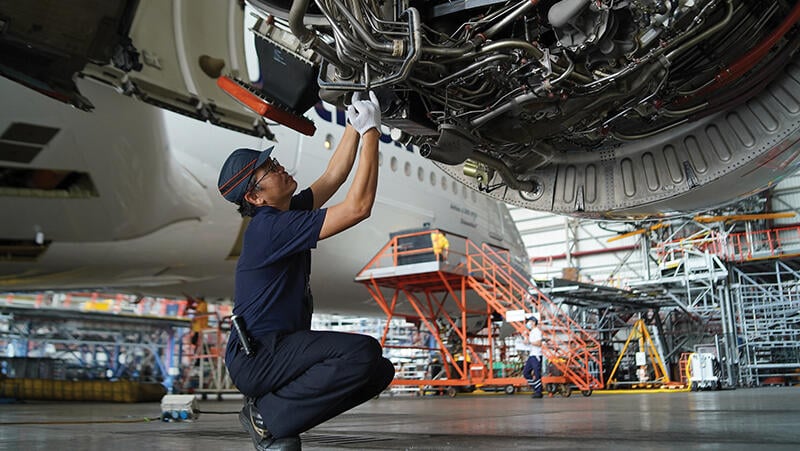
Lufthansa Technik expects a second widebody airframe maintenance facility in the Philippines to help meet rising regional demand.
Lufthansa Technik’s growth and diversification efforts are overcoming a softening commercial aftermarket, helping the company’s bold push to grow revenues 50% within seven years stay on track.
“Our midterm ambition for Lufthansa Technik (LHT) remains unchanged,” Lufthansa Group CEO Carsten Spohr said on the company’s half-year earnings call in early August. “By 2030, we intend to achieve €10 billion [$11.4 billion] in revenue and €1 billion in profit. We remain confident in delivering what we promised shareholders.”
The group’s aftermarket arm is doing its part. Company revenues topped €8 billion in 2025 and are on pace to beat that figure this year. Third-party work made up 78% of sales in the first half of the year. Both results represent improvements over 2024’s comparable figures and reflect the group’s strategy shift.
Following 2020’s economic downturn and related air travel slump from the COVID-19 pandemic, Lufthansa explored divesting a minority stake in LHT to help strengthen the group’s balance sheet. But several years of exploration ended without a deal.
In 2024, the group changed course, identifying LHT as one of the “pearls in our portfolio,” Marc-Dominic Nettesheim, Lufthansa Group head of investor relations, explained at the MWB Research German Select investor conference in late August. “Therefore, we decided to develop the company on our own as a 100% subsidiary.”
LHT announced its plan publicly in November 2023. Dubbed Ambition 2030—and later rolled into a broader group effort with the same name—the plan had as a key metric boosting revenue beyond pre-downturn levels.
Before the downturn, LHT’s best single revenue year was 2019, with €6.9 billion. Sales fell nearly 50% in 2020 as airlines conserved cash amid unprecedented uncertainty, prompting the group to explore a divestiture.
Air traffic rebounded quickly, but aircraft and engine manufacturers struggled to restore their production pace. Demand for MRO surged as airlines facing delivery shortfalls turned to older aircraft, helping Lufthansa Group’s MRO pearl grow more valuable.
The surge also drove a wave of traditional growth involving facilities and business lines. Recent examples include a new component maintenance facility near Porto, Portugal. LHT broke ground in June, with an eye toward opening in mid-2028.
In August, LHT Philippines began work on an MRO facility at Clark International Airport. Also set to open in 2028, the site would be LHT’s second widebody aircraft MRO location in the country, joining its shop at Ninoy Aquino International Airport in Manila. LHT expects the expansion to help meet rising demand in the fast-growing air travel market.
A new engine shop in Calgary, Alberta, is under construction and set to open in 2027. The facility, which will focus on CFM International Leap-1Bs and include a test cell, already has two customers—WestJet and Flair Airlines. A temporary facility at Calgary International Airport began servicing WestJet engines earlier this year.
In April, LHT expanded its long-established collaboration with Woodward, becoming the component supplier’s first Elite Licensed Repair Service Facility provider on Leap fuel controls, valves and actuators. The ramp-up includes adding required tooling and test equipment, and is expected to take about a year.
LHT’s expansion extends beyond its civil aviation forte. Its defense business remains small, employing fewer than 5% of its 23,000-strong workforce. But efforts to support several major programs, combined with demand fueled by the Russia-Ukraine war and shifting European defense strategies, are expected to drive growth.
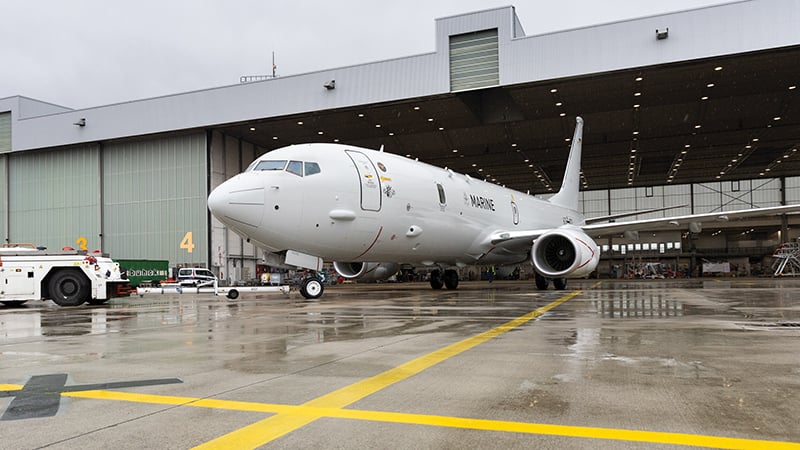
Among the recent agreements is a deal with Boeing to support the German Navy’s P-8A Poseidon maritime patrol aircraft. The multiyear pact includes airframe maintenance, CFM56-7B engine support, access to 737 component pools and technical training to support a planned fleet of eight. Deliveries began last November and are slated to continue through 2028.
LHT also is heavily involved in Germany’s Pegasus signals intelligence aircraft program. The company serves as a prime subcontractor, procuring and modifying the Bombardier Global 6000 platform and integrating Hensoldt-supplied reconnaissance systems. In late August, LHT added crew training to its Pegasus task list, winning a German Defense Ministry contract.
“Our investments follow a clear objective,” LHT Chief Financial Officer Christian Leifeld said. “We want to grow profitably and create additional capacity where our customers will need it in the future.
“At the same time, we are continuing to advance our technological capabilities, whether in Europe, Asia, the Americas or the growing defense sector.”
LHT’s transition from possible cash-generation candidate to key asset has come on CEO Sören Stark’s watch. Stark’s five-year term ends in early 2027. LHT has tapped Chief Operating Officer Harald Gloy as his successor, who has held leadership roles in logistics and corporate strategy as well as at the company’s components business.
Gloy’s stint atop LHT may start amid stiffening macroeconomic headwinds. While not enough to trigger an industry-wide aftermarket downturn, any notable slowdowns—even regional disruptions—will affect LHT, which says it touches one out of every five aircraft in the global commercial fleet.
“We obviously see airlines around the world lowering the flight hours per aircraft and also per fleet,” Spohr said on the August earnings call. “Many of our contracts . . . are directly affected by that. Companies are delaying checks [to conserve cash]. Pretty much every airline in the world has seen a decline in earnings. That short term weighs on Lufthansa Technik.”
While airlines are removing some capacity and new deliveries are slowly accelerating and bumping older aircraft from the fleet, aftermarket demand remains generally strong. In the lucrative engine MRO space, dominant current-generation platforms, including the Leap and Pratt & Whitney PW1000G geared turbofan, are just starting to see initial heavy shop visits. Many of their predecessors, the CFM56 and IAE V2500, have been overhauled once or not at all.
“I think the long-term perspectives of Lufthansa Technik [and] the whole MRO industry are rather positive,” Spohr said. “There’s airplanes being flown longer because of the supply chain issues . . . and [they] need maintenance.”
LHT provides more of that than any company except GE Aerospace. Given the unit’s growth—annual revenue rose 17% from 2023 to 2025, and will be up again this year—its appeal to investors is surely on the rise as well.
Meanwhile, Lufthansa’s flagship airline is battling to meet cost-reduction and profitability targets. Rising fuel costs may wipe out €1.5 billion in profit improvements it was on target to deliver in 2026, executives said on the August earnings call.
Could LHT’s appeal be used to help ease the group’s larger financial crunch? Possibly—but not anytime soon. “Currently we’re not preparing specifically for this,” Nettesheim said at the MWB conference. “We want to increase the value of the company first, and then we take it from there.”

Related Content