This article is published in Aviation Week & Space Technology and is free to read until Nov 04, 2026. If you want to read more articles from this publication, please click the link to subscribe.

Cyprus Airways' CEO Thanos Pascalis
CEO Thanos Pascalis talks with James Pozzi about how disruptions in the Middle East and Pratt & Whitney geared turbofan engine challenges are altering the airline’s fleet and maintenance planning.
What does Cyprus Airways look for when selecting a maintenance partner?
Maintenance is very important to an airline’s well-being, accounting for 11-14% of total costs. Now, following the COVID-19 pandemic, maintenance costs have been steadily rising, and events for new-generation narrowbody engines have hit $10 million, while an auxiliary power unit (APU) performance restoration is near $1 million. Before COVID, we did an APU performance restoration for $350,000. Of course, workscopes can vary, but the increases are still evident. When choosing maintenance partners, we focus on reliability, price and the ability to work with a provider who appreciates our business. Increasingly, we see companies not appreciating the timescales we must work to and the burdens placed on airlines.
Cyprus Airways experienced significant operational disruption in 2024. What happened, and how did the airline recover?
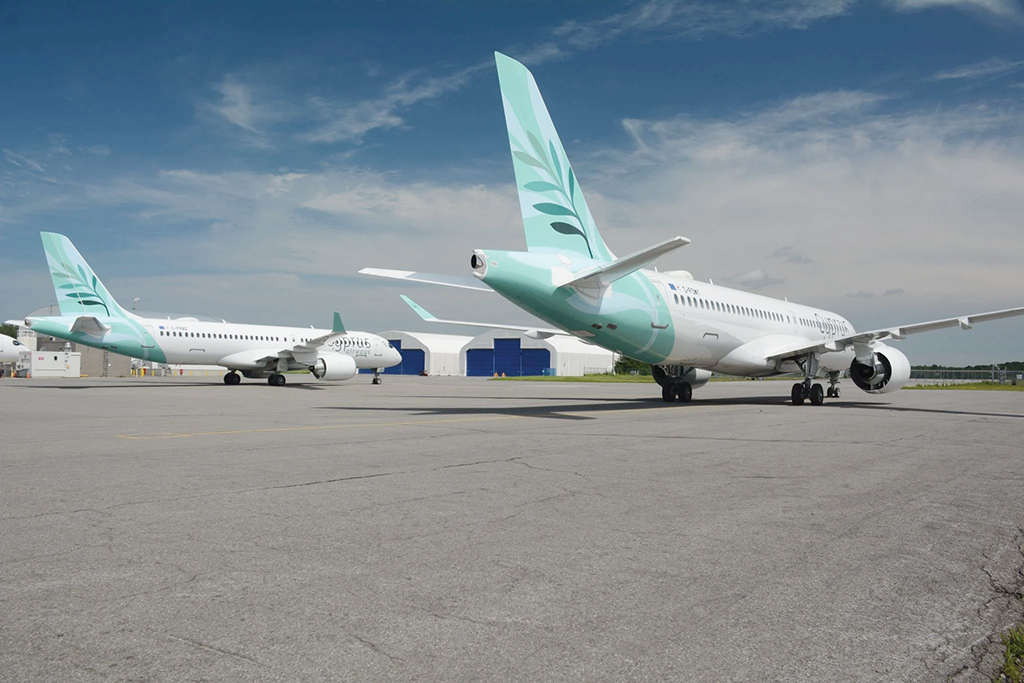
One significant event was the grounding of our first Airbus A220 due to well-publicized engine issues with the Pratt & Whitney PW1500G [geared turbofan (GTF)]. The second was the nondelivery of another two aircraft that were supposed to be delivered in 2024. Our first aircraft was grounded in April, which meant our summer schedule was in disarray. In total, more than 1,500 flights had to be canceled. To reduce this in the short term, we had to turn to [aircraft, crew, maintenance and insurance] wet-lease carriers to bring in the necessary capacity, and our on-time performance reduced to 65%, which is abysmal for airline operations. The first plan was to move from an A320 fleet to an all-A220 fleet after the first grounding, but that went out the window. We had to stabilize the fleet and schedule, get punctuality back on track and move toward profitability. In 2025, we flew around 4,500 flights with zero cancellations. We were 80% on time, including all causes such as [air traffic control (ATC)] and weather. If we remove ATC, we were 92% on time, with dispatch reliability of 99.8%.
How did the outbreak of the Middle East conflict affect Cyprus Airways’ operation?
This is something we had to live with for several months, and in some cases, we’re still living with it. We had situations where the airspace, the ramp, the airport and so on were closed, and the situation could change in a matter of hours. At one time, you had the airspace closed; another time, you had the airport closed, or both. It was a very difficult situation to deal with. We had to cancel our flights to Dubai, Tel Aviv and Beirut, very important routes for the airline, and being a small airline, it affected a huge part of our network. One of our biggest challenges was insurance. We had to deal with a situation where the insurance companies allowed us to fly, but they charged us for it. We reached the point where a single flight to Dubai could cost you an extra $30,000, which is about $350 per passenger per flight. We also operated seven repatriation flights, and we’re proud to say that five were for the government of Cyprus, and two were on behalf of the government of Belgium.
Are fleet decisions increasingly dependent on engine availability rather than aircraft availability?
I believe that is the new reality. Even with our next phase of fleet growth, which was to get A320neos, we had to make sure we got two aircraft with engines on track and without the powdered metal issues associated with the GTF. Effectively, the engines dictated which airframe we got and what aircraft we got. Now the engine and airframe are tied together. You can’t divorce them. Operators must look at the engine and airframe together and ensure they have what they need to proceed to the next step.
How have you approached the decision to add two A320neos instead of the originally planned A220s?
Early next year, we’ll get the two A320neo aircraft, but the reality is that any decision we make about the fleet would not be perfect. The A220s obviously have engine issues. If you took A320ceos for another six years, it would be too long to be flying an aircraft that burns more fuel. It isn’t just the fuel; you’re also paying for emissions in Europe. We ended up with two A320neos because we assured ourselves the aircraft were coming from a six-year check and that the engines were out of the shop and effectively in the best possible condition operationally. Obviously, we looked at both engine options—the GTF and the CFM Leap. The CFM leasing situation meant there were few aircraft on the market, so we opted for PW1000G. The fact that we already have a deal with Pratt for the other GTF engines helps, since we’re going to replicate it.
Are spare engines becoming more of a strategic asset?
Definitely. Engine values are high, and they hold their value. It’s part of the business now. If you looked at how things were 20 or 30 years ago, this was never really an issue. In the past, we had contracts with companies that would provide an engine when needed, and that was enough. Nowadays that’s not the case. We have looked at long-term lease arrangements, as realistically, there were few other options. The first lease on the A220s was 12 years, and they were new aircraft, so we’re going to have them for a fair amount of time. We believe we need the engines. With all our fleet flying now, we have one engine available on the ground, and another carrier has already asked us to lease it to them.
What are you seeing in terms of parts and cabin supply chain lead times?
We are trying to standardize the setups across our fleet because commonality is important. But the amount of work now needed to reconfigure an aircraft is significant. We went to Collins Aerospace and said we wanted to buy eight new rows of economy seats. They came back and said delivery for them would be in 2028. We initially thought they meant 2027, and it was an error. Eight rows of economy seats will take two years to deliver. How can you run a business in this situation? But it’s not just seats.
Regarding Part 145 maintenance, in my early years in the industry, I used to add one or two days when I sent an aircraft in for a C or D check. Now you must add weeks, maybe months. One six-year check we did at a facility in the Netherlands a few months ago took an extra 1.5 months. On the engine side, some repairs work well, and an engine comes out of the shop in 90 days, but this is not always the case. For example, we have had one engine in a shop for 18 months.
What lessons has Cyprus Airways learned from recent engine shortfalls, delays and GTF issues?
We must plan our fleet further in advance. When we say “way in advance,” we’re now talking about a year. We’re putting together our plan for next year and guarantee we’ll have the entire fleet flying as we do this year. It’s not an easy task because things can change and unexpected events may occur. You can get a bird strike or suddenly get deterioration in a part of the engine that you don’t expect. To Pratt’s credit, the engines are better. We even have a new experimental combustor on one of the engines, which is doing better. That’s good, but that doesn’t mean we can forget what happened before. We also appreciate that the industry must mature and we must all learn from the mistakes. We are already much better at flying the A220, understanding its quirks and how it operates, and we’ve become much better at developing our engine plan. It is part of the learning process, but it’s a difficult equation to balance: fuel, shop visit costs, time off wing and so on.
Which technologies has the airline utilized in recent years, and how has this helped your operations?
Here we have a two-tier approach. First, for engines, engine health monitoring has been evolving, providing much more detail and data with nearly no time delay. This will ensure engines stay on wing for longer. Second, for airframes, our reliability programs encompass the OEM approach and the latest best practices. Here we also engage our crews, who participate in providing additional data.
Fact File
About Cyprus Airways
Headquarters: Larnaca, Cyprus
History: The carrier was launched in 2017 and operates flights across Europe and to the Middle East. The airline employs more than 100 staff.
Fleet: Cyprus Airways operates a leased fleet of four Airbus A220s and two A320-200 aircraft. The airline expects to add two new A320neos in 2027 after revising its fleet strategy and dropping plans for future A220 orders.
Maintenance: Cyprus Airways uses several MRO providers, including fellow Cyprus-based company Bird Aviation, which performs base maintenance on its A320 aircraft.

Related Content