This article is published in Aviation Week & Space Technology and is free to read until Oct 18, 2026. If you want to read more articles from this publication, please click the link to subscribe.

MAB Engineering Plans Measured MRO Capability Rebuild

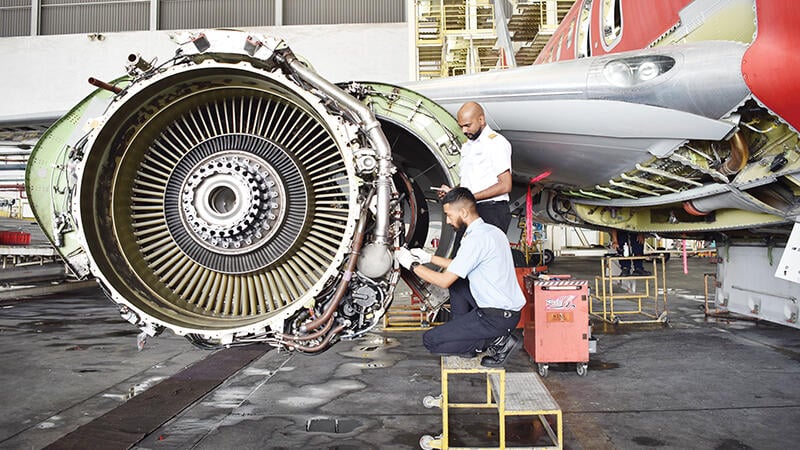
MAB Engineering Services aircraft maintenance engineers performing inspection and servicing work on a turbofan

MAB plans improved maintenance procedures, productivity and turnaround times and reduced rework.

Credit: MAB Engineering

MAB Engineering Services is targeting a measured expansion of its MRO capabilities the next 1-2 years as it looks to increase its presence in the third-party MRO market.

The MRO business of Malaysia Aviation Group plans to focus on building airframe and selected component repair capability in that time frame, reflecting Malaysia’s broader national strategy to grow as an aftermarket hub in the Asia-Pacific region.

One route toward reaching this will be through MAB Engineering’s recently announced agreement with Boeing to expand access to customers and technical resources while strengthening its support for the OEM’s aircraft platforms. The companies signed a five-year strategic partnership in February at the Singapore Airshow.

“The agreement provides MAB Engineering with access to Boeing’s global MRO network, technical resources and customer ecosystem, enabling us to pursue opportunities that would otherwise be more challenging to access independently,” Nasaruddin Bakar, president and group CEO of Malaysia Aviation Group, tells Inside MRO.

He adds that the partnership will also support further Boeing platform maintenance capabilities while strengthening the company’s credibility with operators seeking OEM-approved maintenance services.

The expansion forms part of longer-term efforts by MAB Engineering to establish itself as a third-party provider within next-generation aircraft platforms while continuing to maintain Malaysia Aviation Group’s fleet.

For airframe maintenance, MAB Engineering has added capability for newer-generation aircraft, such as expanded support for Airbus A330neo and Boeing 737 MAX aircraft in addition to already holding maintenance capability for Airbus A350 aircraft.

Nasaruddin says the expansion of airframe maintenance and selective growth of its component repair services will only occur in areas where MAB Engineering sees “sufficient market demand plus strategic value.” He expects the company to remain primarily a competitive regional MRO provider in the next five years, while selectively expanding into higher-value segments where it sees clear market demand and sustainable profitability.

“Rather than pursuing broad expansion, the approach is to build capabilities where MAB Engineering can deliver sustainable value, supported by the right investments in people, technology and facilities,” Nasaruddin says. “The immediate opportunity lies in obtaining greater demand within the Asia-Pacific region.”

He also sees a stronger OEM ecosystem as key to boosting Malaysia’s competitiveness. “Greater OEM presence and localized support would improve spare parts availability, decrease turnaround times and reinforce the overall MRO value chain,” he says.

Nasaruddin adds that building a stronger business environment with helpful policies, investments and a stronger overall ecosystem could also aid Malaysia’s long-term aerospace ambitions and establish it as a competitive regional MRO hub. The government has outlined its ambitions to capture 20-25% of the Asia-Pacific MRO market by 2030, with estimated revenues by then of $60 billion.

A return to full engine overhaul is not on the company’s agenda in the near term. Instead, Nasaruddin says its engine strategy will center on developing certain off-wing engine capabilities, particularly around CFM International and GE Aerospace programs given the substantial number of 737s operated by Malaysia Aviation Group carriers.

MAB Engineering has also added MRO capacity by developing a new hangar at Subang,, Malaysia, doubling its maintenance lines to four from two. The Hangar 4 facility—replacing the older Hangar 1 location—can accommodate one widebody line for A330-200 and A330-300 aircraft, one narrowbody line for the 737-800 and 737 MAX 8, and two simultaneous lines for ATR 72 turboprop aircraft.

Nasaruddin identifies skilled labor as the biggest constraint on the company’s ability to grow the business—not physical infrastructure. “Additional hangar capacity can always be developed, but without sufficient licensed aircraft engineers and competent technicians, that capacity cannot be fully utilized,” he says.

While MAB Engineering plans to continue recruiting technical staff, it is also focused on driving productivity improvements within its existing workforce. Further investment in digital strategies will also play a key role. The company has adopted radio frequency identification technology to improve asset tracking and processing procedures. It has also rolled out AMOS Mobile with iPads.

James Pozzi

As Aviation Week's MRO Editor EMEA, James Pozzi covers the latest industry news from the European region and beyond. He also writes in-depth features on the commercial aftermarket for Inside MRO.