This article is published in Aviation Week & Space Technology and is free to read until Nov 21, 2026. If you want to read more articles from this publication, please click the link to subscribe.
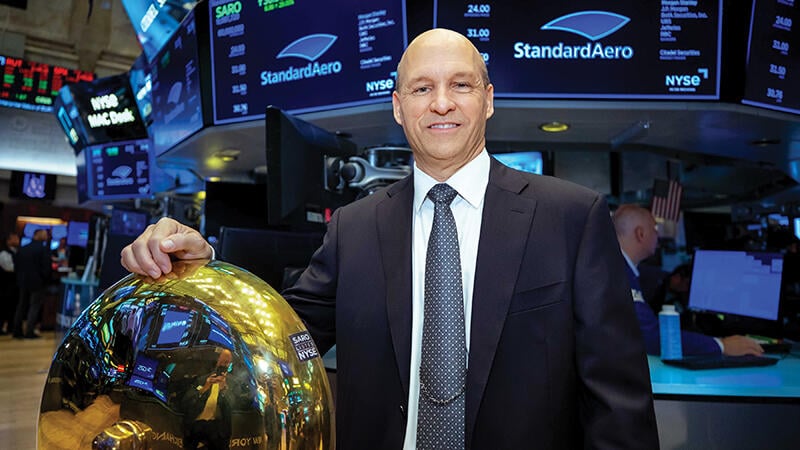
Russell Ford.
Russell Ford retired as StandardAero CEO on Sept. 30, but before doing so, he spoke with Executive Editor Lee Ann Shay about his career in aerospace, private equity and engine maintenance as well as his successor Paul McElhinney. Ford remains executive chairman of the board
Looking back and looking forward, what things really stand out to you?
One of the benefits of having a long career in the aerospace industry is that you have the opportunity to see its cycles. I began my career in the aerospace industry in 1981, when commercial air traffic was still transforming due to deregulation. As a pilot, I learned to fly with a Jeppesen map book and a compass because GPS didn’t exist. I was working at Lockheed Martin when it introduced the first stealth aircraft. In the 1990s, I lived through the aerospace industry consolidating from 26 prime contractors to six.
I’ve seen the introduction of advanced materials in aircraft engines. The aerospace industry has always pushed the envelope in materials science, which has made it one of the most impactful industries.
The Apple iPhone is a direct result of the aerospace industry and the Apollo space program in the late 1960s, when there was a need to navigate in space without a stationary reference point, and the only way to do that and not miss the Moon by 1,000 mi. was to develop an integrated circuit so that you could do calculations in real time onboard. Every integrated circuit that existed on the planet for the first five years in the late ’60s to the early ’70s was owned by NASA. The outcome of that work accelerated the development of electronics and computers and anything that uses an integrated circuit by 15-20 years, meaning we would have had integrated circuits eventually, but we would have had them 20 years later. This means today you wouldn’t have the iPhone 17; you’d have the iPhone 1.
Is there anything in aviation, particularly engines, that stands out to you?
If you turn the clock back to the 1950s, many aircraft companies in the world could have built a supersonic aircraft. That was not the hard part. But what’s happened subsequently is the development of very fuel-efficient engines. Until the early 2000s, there was no technology in aerospace that allowed an aircraft to fly supersonic without the use of afterburners. It wasn’t until Pratt & Whitney’s F119 engine on the [Lockheed Martin] F-22 that provided the ability to fly faster than Mach 1 without the use of afterburners. That was a significant advancement for military engines. It’s finding a crossover into the commercial arena now with Boom Supersonic developing the Overture aircraft, which will be the modern-day version of the Concorde from the 1970s. That hopefully will allow for supersonic commercial aircraft.
Second, materials science has always been the gating factor toward advancement to the next generation of technology in aircraft and engines, and it will continue to be.
The third thing you’ll see is continued focus on optimization. In the 1990s, optimization came from the introduction of Lean and Six Sigma, which trace their roots to Toyota and Motorola. The next step is artificial intelligence (AI), which is not as spooky as a lot of people think it is. AI is simply another optimization technique. When I was designing helicopters as a young engineer, I used a drafting board and a calculator. Computational fluid dynamics didn’t exist, and now that can all be done with computing power in a very efficient way. You can run a million simulations in a matter of seconds. I think you’ll see AI become the next optimization technique, similar to what Lean and Six Sigma were 25 years ago.
The final thing that I think you’re going to see is a continued maturity of the aerospace ecosystem. There are three pieces to it: OEMs that design aircraft and engines, operators who fly the aircraft and maintenance in the middle. What’s happened is that maintenance piece has started to move faster and more toward the middle, which is the MRO piece. The reason is that the OEMs’ design cycle—from engine to the next-generation engine to the next next-generation engine—has sped up with the use of things like computational fluid dynamics. OEMs have to apply their engineering and production capacity toward new engines and move to the next one. They need the infrastructure that MROs like StandardAero bring. Similarly, most airlines before deregulation operated big maintenance groups associated with them. But now there are only three or four big airlines left that still do any type of engine maintenance. All of that work moved into the MROs because airlines simply don’t have the balance sheet to maintain engines.
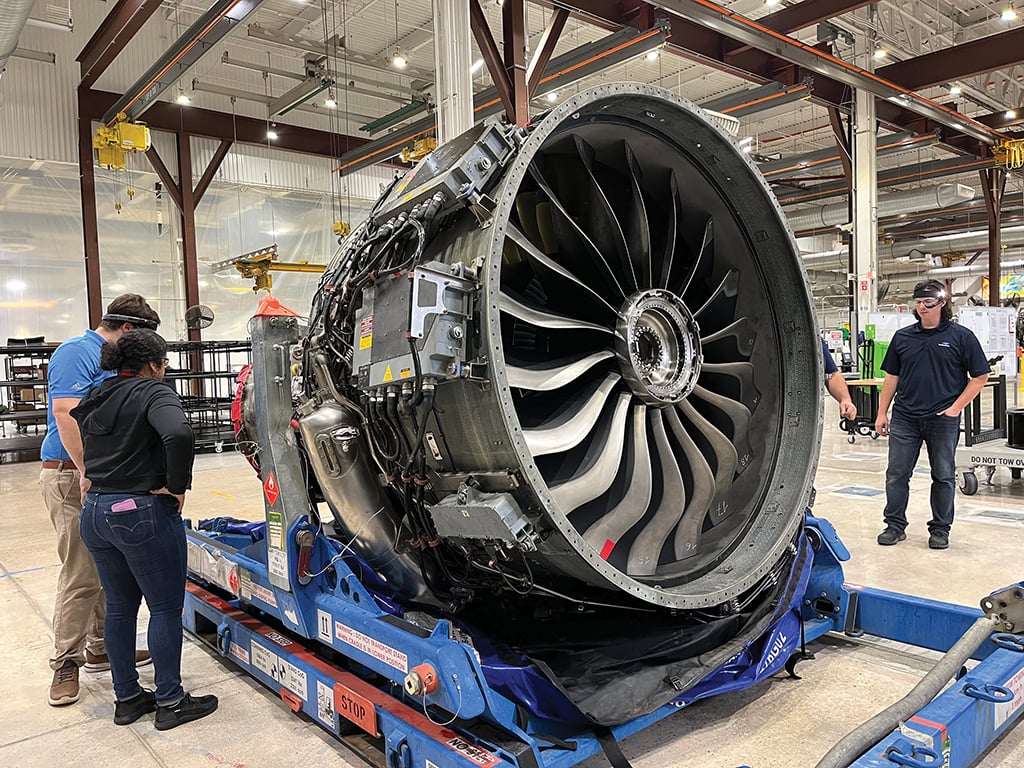
StandardAero is certified to maintain 40 different engine platforms. We have economies of scale that a company that is only working on two or three engines can never achieve. Aircraft engines’ lives can span 40-plus years—the revenue stream for engine maintenance is a very long cycle, and it’s very sticky. The maintenance piece is just continuing to grow and gain strength, because passenger demand is going up, and has gone up for 40 years faster than GDP. That means you’re going to need all the new aircraft and all the new engines that can be produced, plus all the ones that are flying, to keep up with the demand. So the maintenance requirements are only going to get bigger.
Private equity has increasingly invested in engine MRO, as evidenced by StandardAero. Will this squeeze independents?
Of my 45 career years, 23 of those years were spent in the rough-and-tumble world of private equity. I’ve worked for six private equity companies, so I understand that particular animal in the zoo pretty well. I’ve had six tigers, so I know how tigers work. Private equity is very efficient at finding places to deploy money that will grow. That’s different than venture capital, which is much more speculative. Private equity tends to invest in companies that have been around for a while. They have a product, customers, a balance sheet and cash. They’re not just the latest mousetrap. Private equity operates on a very high clock speed, much faster than big public companies. Private equity likes engine maintenance because almost half of the total MRO dollars go into it. The engine is really important because that’s where all the intellectual property (IP) is. Nothing else on an aircraft operates at 2,000F. There is a lot of IP in those coatings, assemblies and cooling techniques.
What do you think about electric engines and electric vertical-takeoff-and-landing (eVTOL) development?
Technology for different propulsion systems is alive and well. We’ve come a long way in the last 20 years, simply fueled by the automotive industry. Electric-powered aircraft will require different tooling and materials, but they are still going to require engine maintenance.
There is a future for eVTOLs, but I think autonomous drones are going to move a little slower because of liability issues.
Are there other technologies you’re excited about?
There will always be advances in materials technology. Composite matrix materials like ceramic composites didn’t exist 20 years ago. You’ll see more applications of new materials because in order to create more fuel-efficient engines, you typically need to run engines hotter and at higher pressures, so higher bypass ratios.
Because of this, the MRO industry is going to have to move forward at the same rate as those materials are being introduced into new engines. What’s needed from our perspective is repair development. We have to continue to develop repairs for those newer materials that are not as well understood as materials we’ve been using for the last 30 years, so once again, it comes back to materials science. The cost of ownership gets unrealistic if every time you touch it, you have to put all-new stuff in it. That would be like owning a car and each time you wanted to change the oil, you had to put a new engine in it. You can’t do that.
You will remain on the board as executive chairman. How will your role change in this position?
Any good CEO will tell you that it’s like being a pilot: You have to keep one eye on the dashboard and one eye out the front windscreen to make sure everything is working properly. You’re looking close and looking far away simultaneously.
I’m fundamentally changing from being an operator to being more of a strategist. Instead of thinking about what’s happening today or tomorrow, I’ll be thinking about the next 10 years, because many aerospace and engine investments have long cycles.
Other than strategy, I think another thing that will occupy a fair amount of time is workforce development, making sure that we’ve got young people in the pipeline. StandardAero created a big intern program. We have 300 interns and co-op students around our company at any given time—that was the mechanism that got me into the aerospace industry as a co-op student. We spent a lot of time trying to develop those programs and making sure people know that they are here.
What role did you have in Paul McElhinney’s selection as the new CEO?
I’ve known Paul for many years. Paul worked at aerospace giant GE, specifically in its MRO business, for decades. When I came to StandardAero, Paul was one of my biggest customers. Years later, when we changed ownership to the Carlyle Group, we had the opportunity to rebuild the board with people we would need for our five-year strategic plan. That’s a failure mode of a lot of companies—they don’t build the board correctly. They find people they like, but they may not have the specific domain knowledge that’s needed.
You should do exactly what the Carlyle team did: They looked at our five-year plan and asked, ‘What are the key growth drivers? Let’s build a board that has that specific experience.’ For example, we had a growth vector into the military, so we recruited a former three-star general from the U.S. Air Force, Lt. Gen. (ret.) Wendy Masiello, who was responsible for the Defense Contract Management Agency. We also wanted to expand our investments in next-gen narrowbody aircraft engines, so we recruited Paul, who could advise us on how to properly prepare a bid for the CFM International Leap. We wanted to expand in Europe, so we recruited Stefan Weingartner, former MTU Maintenance president and CEO.
Fast forward, Paul has been very influential in the strategy that we have set to grow the company. In the 13 years I’ve been with the company, we have quadrupled its size—and this wasn’t a small company. There’s a strategy for how you do that. Having Paul on our board since 2019 was very fortunate because we could move him into the CEO role with virtually zero loss of productivity and complete continuity of the strategy. He’s been party to every major strategy decision we’ve made for the last seven years, so he not only understands the industry and domain knowledge of MRO businesses, but he also understands the company well.
We will double or triple the company again under his leadership. He has exactly the right experiences to lead the executive team to that level.
It sounds like the leadership transition was smooth.
I’m probably the largest individual owner of StandardAero stock outside of the public institutions, so I have a very specific reason to make sure that the management team and the leadership have good continuity. I am very confident in trusting my own future and my family’s well-being to Paul’s leadership. I know him beyond a business leader. He’s a very honest, ethical, genuine, business-smart person.

Related Content