This article is published in Aviation Week & Space Technology and is free to read until Nov 18, 2026. If you want to read more articles from this publication, please click the link to subscribe.
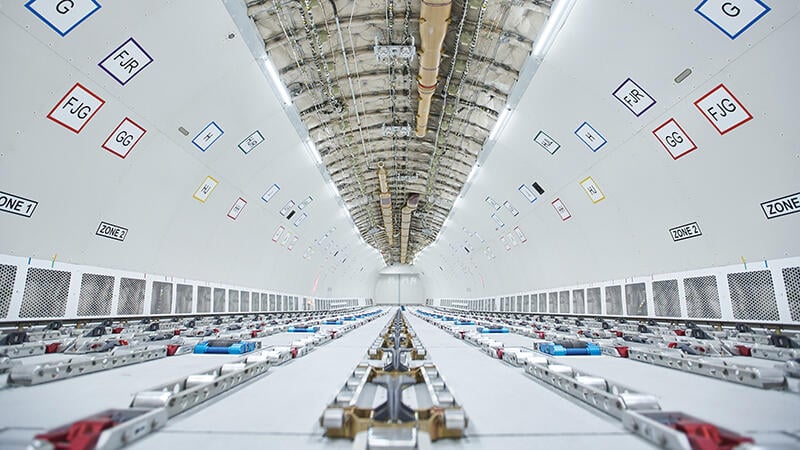
ST Engineering says cargo conversions remain a key area of demand.
As the age of the global fleet ticks up due to new aircraft shortages, MRO providers are enjoying a surge in maintenance demand from airlines eager to keep older aircraft in service longer. A twin benefit, for those offering a range of engineering services, is full books of modification work as operators seek cabin refreshes and connectivity access to keep passenger offerings up to date.
The aircraft modification market will be worth almost $100 billion over the next 10 years, according to Aviation Week’s 2026 Commercial Fleet & MRO Forecast. About a third of demand is projected to come from Asia, with Europe and then North America as the next biggest markets for modification work.
The data covers five categories of modification: Interiors are estimated to account for 36% of the 2026-35 market, inflight entertainment and connectivity for 28%, avionics for 20%, passenger-to-freighter (P2F) conversions for 9% and painting for 7%.
Few MRO companies are active across all five categories but most agree that the wider market is strong and remains a vital driver of revenue growth.
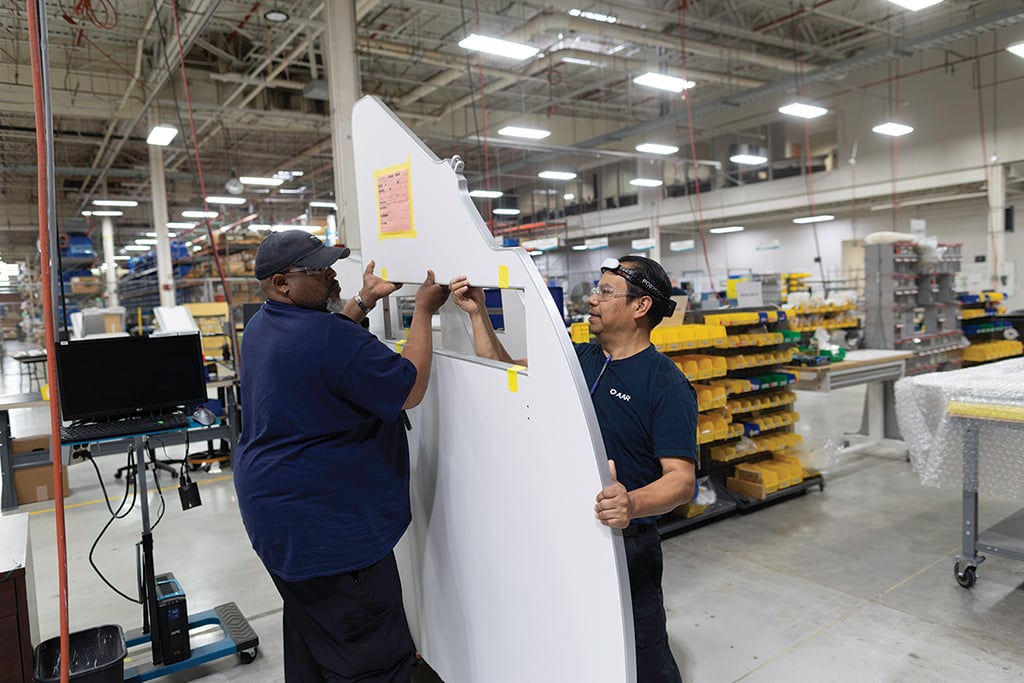
“Aircraft modifications are a core component of AAR Engineering Services’ business and long-term growth strategy,” notes Jim Leech, AAR’s director of proposal and business development for engineering services. As evidence, he points to AAR’s acquisition in April of Aircraft Reconfig Technologies, which specializes in passenger aircraft reconfiguration. AAR’s purchase brought it FAA Organization Designation Authorization privileges and in-house cabin monument manufacturing capabilities.
Having in-house capabilities is important, says Tan Yen Ping, senior vice president and head of cabin interiors and engineering solutions at ST Engineering, who describes modifications as an “integral” part of the life-cycle solutions offered by the Singapore-based company.
“This strengthens our customer relationships, creates higher-value and recurring aftermarket opportunities and differentiates ST Engineering through our integrated expertise in design, certification, manufacturing and MRO,” she says.
Another reason to offer modifications is that they can evolve alongside standard maintenance operations, allowing MRO providers to use their experience to branch into new products and services. “Many innovations originate from operational challenges we encounter every day in MRO or in our customers’ operations,” says Joern Dahmen, senior director of special engineering services at Lufthansa Technik (LHT).
He cites a developing market for aerodynamic modifications such as LHT’s AeroShark surface treatment, which offers airlines small fuel efficiency gains without major investment in new fleet or engine assets. “New analytical capabilities, including machine learning and advanced [computational fluid dynamics] simulations, are helping to identify drag-related inefficiencies and support more targeted performance improvements,” he says. “Whether it is cabin modifications, AeroShark or MedEvac solutions, these offerings demonstrate how engineering and maintenance expertise can evolve into scalable customer solutions beyond traditional MRO services.”
NEW CABINS
Interiors are the biggest part of the modification market. Airlines are expected to spend roughly $35 billion over the next 10 years to keep their cabins attractive to customers and responsive to changing travel trends. This might translate to cabin densification programs to maximize capacity during a period of tight aircraft supply or enhancement of business class and economy-plus options to tap into rising demand for higher-margin premium products.
South America’s Abra Group pursues modifications across narrow- and widebody cabins according to the markets it serves as owner of full-service carrier Avianca, Brazilian low-cost carrier Gol and the aircraft, crew, maintenance and insurance provider Wamos Air.
“Our strategy reflects demand across different customer segments,” an Abra spokesperson says. “Maintaining an accessible base product remains fundamental in Latin America, while we are also seeing strong demand for greater comfort, flexibility and premium services.”
This investment includes high-speed Wi-Fi and premium seating in Avianca’s Airbus A320neos as well as lie-flat seating and upgraded inflight entertainment (IFE) options on long-haul routes.
Avianca has maintenance facilities in Colombia and Central America, and the group can also use Gol Aerotech in Brazil for maintenance and modification work.
At AAR, meanwhile, Leech has seen operators invest in refreshed cabins, premium seating and denser layouts as airlines seek to wring more value out of aircraft they might have planned to phase out. “Demand for cabin modifications has increased significantly as airlines extend the service life of existing fleets and look for alternatives to delayed aircraft deliveries,” he says.
Other MRO providers also note that midlife and older aircraft are driving demand for interior modifications as airlines keep them in service longer.
“Airlines are investing in cabin retrofits, premium seating concepts and connectivity and IFE upgrades to enhance the passenger experience and differentiate their product without waiting for new aircraft deliveries,” says Dahmen at LHT, who highlights cabin modernization as one of the hottest parts of the modification market. “Fleet life extensions, delayed aircraft deliveries, evolving passenger expectations and airlines’ focus on product differentiation are key drivers.”
Another impetus is growing demand for widebody services, as the global widebody fleet is forecast to grow almost twofold over the next 20 years. Widebody modifications are a particularly attractive market, both because of the scale of work on offer compared with narrowbody refits and the extra investment airlines must make to keep passengers and crew happy on long flights. Widebodies also offer the greatest possibilities for product differentiation, particularly in the premium segments of the aircraft.
Leech reports that widebody operators continue to invest in upgraded crew rest facilities that improve aircraft utilization and support extended-range operations. He also notes that even relatively small improvements in passenger experience or operational efficiency can create substantial value over long-haul operations.
“We have seen growing interest in widebody cabin modernization programs, particularly those involving premium seating, connectivity enhancements, cabin densification and interior refresh initiatives,” he says.
Aviation Week forecasts that more than a third of global spending on interior modifications over the next 10 years will be spread across three widebody aircraft types: the Boeing 777-300ER and 787-9 and the Airbus A350-900.
“Growing widebody operations are expected to drive demand for widebody modifications, as [Airbus] A330, A350 [and Boeing] 777 and 787 fleets reach the cabin refresh stage and airlines continue to invest in premium passenger experience,” says Ping at ST Engineering, while Dahmen reports particularly strong demand for 787 cabin work.
AAR also expects sustained demand for widebody modifications. “Many first-generation 787s and A350s are entering the stage of their life cycle where cabin refreshes and technology upgrades become increasingly attractive, creating additional opportunities for the modification market,” Leech says.
CONNECTIVITY UPGRADES
IFE and inflight connectivity (IFC) upgrades are often performed alongside cabin upgrades as airlines tap into new low-Earth-orbit (LEO) satellite constellations such as Starlink to offer uninterrupted internet connectivity. Just five years ago, most IFC antennas in the global fleet could not communicate with LEO satellites. Connectivity penetration was highest on narrowbody routes within Europe and the U.S., where airlines could ensure a constant connection to ground-based transmitters.
“IFE upgrades remain one of the fastest-growing segments of the retrofit market,” Leech says. “Airlines increasingly view connectivity as a competitive differentiator and are upgrading legacy IFE systems while integrating high-speed broadband solutions. The growing adoption of [LEO] satellite technologies is further driving demand for cabin connectivity and related modifications.”
LEO-capable antennas provide snappier social media scrolling and website loading for passengers on equipped aircraft. Incoming technology will feature multibeam antennas that communicate with different satellite orbits simultaneously. These new electronically scanned array (ESA) antennas will offer a blended customer experience, with latency-sensitive tasks routed through LEO and less sensitive actions, like video streaming, pushed up to higher-orbit connections.
For now, some airlines are using hybrid solutions of traditional and ESA antennas to achieve multi-orbit communications. Valour Consultancy reports that by the end of 2025, more than 700 commercial aircraft were using LEO-only or multi-orbit connectivity, and it projects that most of the global fleet will offer IFC by 2030.
Aviation Week forecasts that IFE and IFC modifications will be worth $27 billion over the next 10 years; Asia is expected to account for about $10 billion. Traditionally, IFC penetration was deepest among U.S. and European carriers, although Asia’s network airlines have been catching up fast.
“IFE and IFC upgrades are also increasingly part of the broader cabin investment, as airlines use connectivity and onboard experience as differentiators,” Ping says.
While avionics modifications are often driven by regulatory requirements, they still account for a large portion of the market and will be worth roughly $19 billion over the next decade, according to Aviation Week data.
“Demand for avionics modifications continues to be driven by regulatory requirements, operational efficiency and the increasing digitalization of airline operations,” Dahmen says.
Leech agrees, adding that like other areas of the modification market, avionics are benefiting from the demands of an aging fleet. “As aircraft remain in service longer, operators must modernize aging avionics systems to maintain reliability and comply with evolving airspace requirements,” he says.
CARGO CONVERSIONS
Aviation Week forecasts the P2F conversion market will be worth $8.6 billion over the next 10 years, two-thirds of which will be for widebody conversions, where spending is expected to remain elevated over the next five years. Narrowbody conversion demand, in contrast, is projected to decline over the same period, following over-ordering in the early 2020s and the return of belly freight capacity after the COVID-19 pandemic as passenger demand roared back.
“While the cargo market has normalized following pandemic-driven peaks, operators continue to seek cost-effective ways to extend aircraft utility through freighter conversions and related modifications,” Leech says.
Widebody conversion demand remains high due to a shortage of new aircraft, an aging existing fleet built around the Boeing 767-300, 777-200 and 747-400 platforms, and the growth of intercontinental e-commerce.
To meet this demand, ST Engineering offers A330-300 and -200 freighter conversions through its Elbe Flugzeugwerke joint venture with Airbus, which also provides A320/A321 conversions.
Airbus and Boeing forecast 2,600-2,900 freighter deliveries over the next 20 years, and ST Engineering’s Ping expects P2F models to comprise a “significant part” of that supply.
“Cargo conversions remain a key area of demand, supported by long-term air cargo growth and the need for dedicated freighter capacity,” she says.
ONGOING CHALLENGES
While older aircraft generate demand for numerous types of modifications, aircraft production is ramping up at Airbus and Boeing, raising questions about how the market will fare once retirements accelerate and new aircraft grow their share of the active fleet. Modification providers, however, appear relatively unconcerned.
“Even as OEM production ramps up, we do not expect demand for modifications to slow down significantly,” Dahmen says. “Fleet renewal and fleet modernization are not mutually exclusive. Airlines will continue looking for ways to enhance passenger experience, improve fuel efficiency and maximize the value of existing assets throughout their life cycle.”
At AAR, Leech points out that even some of the most modern aircraft—such as the A320neo, A350 and 787 families—are approaching an age where upgrades to cabins and IFE become worthwhile.
“While increased new-aircraft production will eventually provide operators with more fleet renewal options, we expect modification demand to remain strong for the foreseeable future,” he says. “Even relatively new platforms are beginning to undergo modernization programs as operators update interiors and onboard technology to current standards.”
Another potential headwind stems from fewer lease transitions as airlines seek to hold on to aircraft by extending leases and delaying phase-out dates—dampening demand generated by the interior and system changes required by onward lessees. Again, though, the market appears fairly unaffected.
“While some transition-related work may decline, this is largely offset by retrofit and modernization projects,” Dahmen says. “As a result, we have not seen a significant decline in modification demand due to fewer aircraft transitions.”
AAR also has few concerns about lease transitions. “Airlines extending leases often choose to reinvest in cabin upgrades to maintain passenger appeal, improve operating economics and align aircraft with evolving brand standards,” Leech says. “In many cases, airlines are prioritizing targeted modernization projects that deliver immediate value rather than waiting for fleet replacement or transition opportunities. As a result, modification demand has remained resilient despite changing fleet transition dynamics.”
A much bigger concern remains the supply chain, which is causing problems similar to those suffered by the MRO market regarding parts availability, turnaround times and scheduling.
“The biggest challenge has generally not been demand but component availability,” Dahmen says. “Lead times for seats and selected avionics components have at times increased significantly. LHT has responded through closer supplier collaboration, earlier procurement and engineering-driven mitigation measures.”
Leech agrees, noting that “supply chain challenges have impacted virtually every segment of the aircraft modification industry.” He blames extended lead times for seats, monuments, electronic systems, connectivity equipment and certain certification-critical components for complicating planning and execution.
Meanwhile, the head of the world’s largest aircraft lessor has suggested that airlines themselves are contributing to delivery delays with their demanding interior specifications.
“Airlines are overcomplicating seats. The customization levels are so high,” AerCap CEO Aengus Kelly told CNBC in September, noting that a delayed seat certification could push out a new aircraft delivery by a year. “If it’s good enough, it’ll do,” he added.
Lead time challenges are easing, though, Ping says, as customers adjust to structural changes in the supply chain.
“The situation has improved somewhat as airlines and integrators move earlier in the planning cycle to secure required components and kits, helping to provide better visibility and mitigate potential schedule disruptions,” she says. “At the same time, we continue to help customers manage such constraints by leveraging our in-house capabilities, including 3D printing and thermoforming, to produce select cabin and interior parts where appropriate.”
LHT also touts its in-house fabrication capabilities for helping to keep modifications on track, such as using additive manufacturing to produce difficult-to-source parts. Recent examples include 3D-printed 787 window dimmer buttons, economy-class armrest covers and replacements for discontinued premium economy components.
AAR, meanwhile, has helped itself through the acquisition of Aircraft Reconfig Technologies’ in-house monument manufacturing capability, which has reduced its reliance on external suppliers.
“Nevertheless, industrywide challenges in specialty cabin equipment and electronic systems continue to require proactive planning and close supplier collaboration,” Leech says.

Related Content