This article is published in Aviation Week & Space Technology and is free to read until Aug 13, 2026. If you want to read more articles from this publication, please click the link to subscribe.
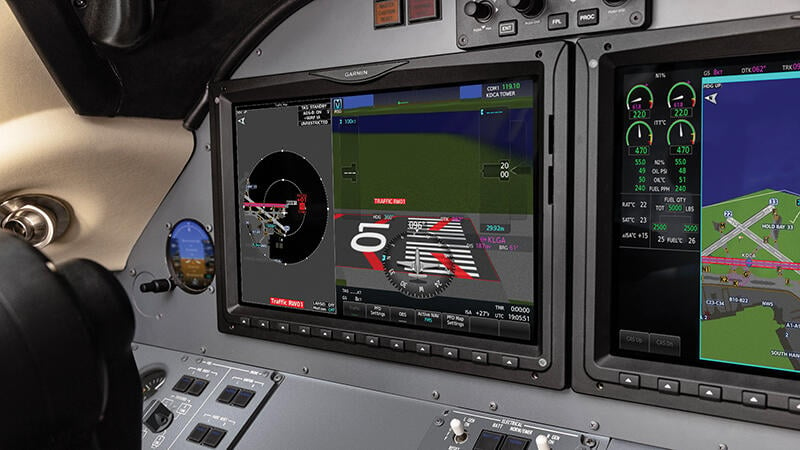
Garmin's ROA technology highlights the runway and includes caution and warning annunciations on the primary flight display.
In recent years, runway incursions have caused high-profile accidents and near-collisions. The collision of an Air Canada CRJ900 regional jet with an emergency vehicle while landing at New York’s LaGuardia Airport in March is just the latest case.
Fortunately, onboard systems designed to reduce runway incursion risks are coming online. To enable this, runway surface alerting (SURF-A) systems use Automatic Dependent Surveillance-Broadcast (ADS-B) traffic information in tandem with airport databases and ground-based traffic surveillance systems to warn aircrew about possible conflicts with other aircraft or ground vehicles occupying or crossing a runway or taxiway. SURF-A effectively gives pilots an additional pair of eyes.
Joshua Ng, director at Alton Aviation Consultancy in Singapore, says adopters will need to work with avionics OEMs or supplemental type certificate (STC) holders to integrate the systems into the aircraft’s existing avionics. “Typically, this requires the installation of ADS-B In systems on the aircraft, along with the enabling software changes for runway occupancy alerting such as visual and aural signals,” he says. “In certain cases, where the ADS-B In/Out systems are already installed, software changes only are needed.”
TCAS OPTION
Aviation Communication and Surveillance Systems (ACSS), a joint venture between Acron Aviation and Thales, integrates advanced runway surface alerting software directly into its T³CAS traffic and collision avoidance system and TCAS 3000SP computer platforms. Under the joint venture, Acron Aviation is the hardware manufacturer and ACSS is the surveillance technology and software developer.
TCAS 3000SP is a stand-alone unit, while the T³CAS is an integrated suite combining TCAS with the Terrain Awareness and Warning System (TAWS) and transponder, ACSS Product Manager Cam Morast explains. These avionics are available as standard line-fit options on new Boeing and Airbus aircraft, he says. “For aircraft already hosting our TCAS 3000SP or T³CAS products, [our] SURF-A is designed as a software-only application upgrade with no additional hardware required,” he notes.
For older fleets, Morast says Acron Aviation offers the TCAS 3000SP as a streamlined STC retrofit path to upgrade any aircraft equipped with a TCAS II system to full ADS-B In and SURF-A. Acron Aviation T³CAS has been engineered with enhanced robustness to mitigate the specific risks of GPS spoofing and jamming in modern flight environments, he adds.
Acron Aviation’s road map for implementation of its runway incursion avoidance system is moving forward as a two-step process. As Morast describes, the first step will add safety capabilities, including taxiway takeoff/landing alerting and runway overrun protection. These specific safety features are expected to be available starting in midyear on all new Airbus aircraft equipped with the T³CAS product.
The second step adds Acron Aviation’s SURF-A system, which includes ADS-B In. That phase is slated for availability in 2028 for new Airbus deliveries and in 2030 on all new Boeing aircraft delivered with the TCAS 3000SP computer.
Morast points out that Acron Aviation also has a proprietary retrofit SURF-A system under development for the TCAS 3000SP for installation on a wide variety of aircraft via an ACSS STC.
“While our receivers can also process ground radar data received by the aircraft through traffic information service-broadcast, we currently prioritize direct ADS-B In data for flight crew situational awareness and alerting to ensure the highest possible level of accuracy and integrity,” he says.
Asked about accommodating aircraft with displays that do not support advanced ADS-B In—the situation with most older aircraft—Morast notes that Acron Aviation offers its ADS-B Guidance Display. “This is an economical, high-resolution 3-in. display, which can be easily installed into existing cockpit panels to support SafeRoute+ applications,” he says.
SafeRoute+ offers a suite of ADS-B In applications that reduce runway incursion risk while facilitating more efficient en route and arrival operations. It is also a product of the Acron Aviation-Thales joint venture.
SMART X ADD-ON
Honeywell Aerospace’s SURF-A is undergoing flight tests with the FAA and aiming for initial certification in July. The system uses own-ship data, including GPS position, ADS-B In, a high-precision runway database and advanced analytics to identify other aircraft on or near the runway that could cause an incursion within the next 30 sec.
Thea Feyereisen, distinguished fellow at Honeywell Aerospace, identifies three main threat areas identified with runway safety: runway incursions, excursions and wrong surface operation. Runway incursions are being addressed with SURF-A as an add-on to Honeywell’s Smart X, she notes, while excursions and wrong surface operations are handled by Enhanced Ground Proximity Warning System (EGPWS) functions that were initially introduced under Honey-well’s Runway Awareness Alerting System.
“These are [now] branded under the Smart Runway/Smart Landing name, or collectively, Smart X,” Feyereisen explains. “Smart X provides visual text and aural alerts, improving pilot situation awareness, including runway ID, runway distance remaining, unstable approaches, inadvertent takeoff or landing attempts on a taxiway, or a runway too short for the aircraft type.”
She stresses that while Smart X improves position awareness on the ground, it does not address potential collision threats on the runway. “Adding SURF-A will,” she notes.
According to Feyereisen, initial certification for Honeywell’s SURF-A function will be for a software upgrade to the EGPWS MKV-A, a stand-alone box that provides TAWS and runway awareness advisory system functions.
“The EGPWS MKV-A will have a wired connection to the Honeywell TPA-100 traffic computer, which contains the ADS-B In component,” Feyereisen says. The TPA-100 is Honey-well’s latest traffic computer and provides TCAS and ADS-B In/Out functions, she says. However, she also notes that Honeywell SURF-A will be compatible with any traffic computer that follows the industry-standard format for ADS-B data.
“EGPWS provides direct aural and text situation awareness messages and alerts to mitigate runway safety events,” she says. “As examples, there is ‘On Taxiway’ if an aircraft is moving at greater than 40 kt. on a taxiway, or ‘Too High’ if it is too far above the vertical glidepath for a stable approach.”
She adds that Honeywell’s SURF-A will introduce four new alerts: Traffic on Runway, Traffic on Final, Traffic Intersecting Runway and Traffic Behind.
BUSINESS AVIATION PRODUCTS
Garmin’s Runway Occupancy Awareness (ROA) product is software-only for both forward and retrofit of general and business aircraft equipped with compatible Garmin ADS-B In/Out transponders. That includes select Garmin integrated flight decks such as the G1000 NXi and G5000. Textron Aviation received the initial FAA certification on the G1000 NXi-equipped Cessna Caravan in August 2024. That was closely followed by Garmin’s G5000 STC for the Cessna Citation Excel, XLS, XLS+ and XLS Gen2 as well as other certifications.
“We have received a lot of interest from the commercial transport market and are currently looking at multiple solutions to offer ROA,” says Scott McCurley, Garmin aviation marketing manager.
ROA uses ADS-B traffic information to alert pilots of potential runway incursions caused by nearby airborne aircraft, aircraft on the ground and ground vehicles. McCurley says it is the first certified software product to utilize Surface Indications and Alert technology.
“ROA technology analyzes aircraft GPS and ADS-B traffic information relevant to the airport’s runways and taxiways to assess and alert the aircrew of a possible runway incursion or collision,” he says. “It provides caution and warning annunciations on the pilot’s primary flight display, and highlights the runway in yellow or red, depending on the level of threat, on Garmin’s Synthetic Vision Technology. It also provides similar caution and warning annunciations on the SafeTaxi map displayed simultaneously on the multifunction window.”
Both visual and aural alerts are provided to the flight crew based on the potential hazard, ranging from no immediate collision hazard to a warning-level alert where a collision risk could occur within 15 sec., he adds. Indications and alerts to the flight crew include any traffic landing, taking off, stopped or taxiing on the intended runway as well as traffic on approach to or crossing that runway and any traffic on the runway where the aircraft is holding.