Pratt Speeds GTF AOG Recovery Through Robotic Innovations
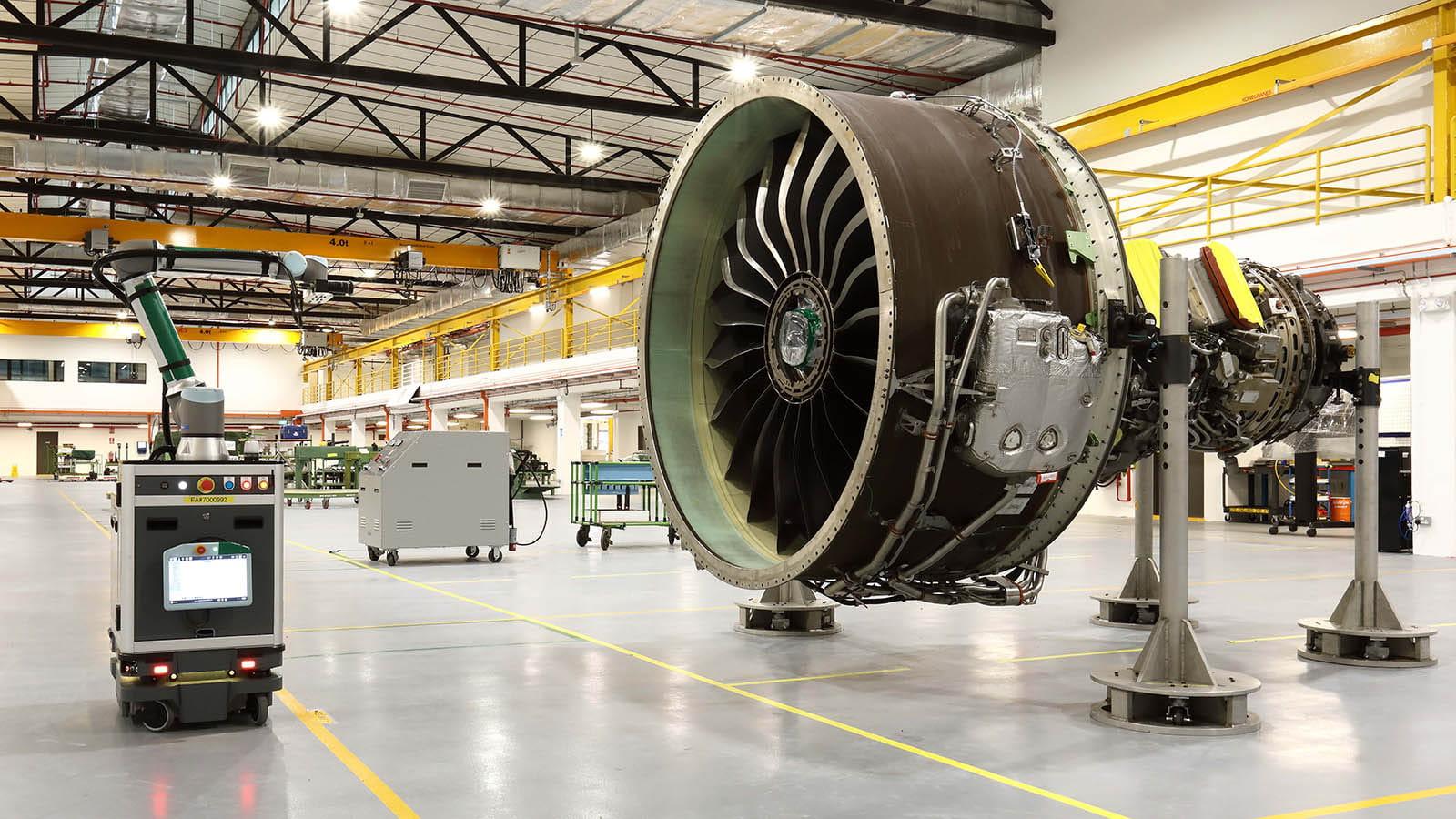
A camera-equipped robot inspects and documents an engine as it checks into the Eagle Services Asia facility ahead of disassembly.
SINGAPORE—Robotic and automated engine assembly technologies pioneered in Singapore are being introduced throughout Pratt & Whitney’s maintenance, repair and overhaul network as the engine-maker steps up efforts to cut the number of grounded PW1100G-powered Airbus A320neos.
The growing use of automation and the addition of a new disassembly facility in 2024 has underpinned a 40% increase in MRO output over a single year at Pratt & Whitney’s Eagle Services Asia (ESA) unit, says Gilbert Sim, director of Aftermarket Operations and Technology Transformation at the RTX business.
Developed by Singapore Technology Accelerator (SAT), a Pratt & Whitney innovation center set up in collaboration with the Singapore Economic Development Board (EDB), the advanced robotic systems continue to be introduced at ESA alongside a raft of other MRO innovations. These include new automated inspection processes, as well as efficiency improvements through connected factory and digital twin concepts.
Incubated at SAT, the ideas have been piloted at the Eagle Services Asia facilities over the past four years and are now being scaled to the other 17 active sites in Pratt’s geared turbofan (GTF) MRO network. The Singapore facility alone currently accounts for more than 20% of the entire network’s MRO engine returns. “We contribute the highest output, not just globally, but even in Asia Pacific, where primarily our customers that we are serving are all primarily the Asia Pacific operators,” Sim says.
ESA, a joint venture between Pratt and SIA Engineering Company, has been servicing the 30,000 lb.-thrust PW1100G GTF version since 2019. Although ESA also services PW4000-series widebody engines, the GTF now forms around 70% of the site’s work and is expected to continue to grow as the fleet size increases, Sim says.
The key robotic innovations include the use of a “receive in check” co-operative robot—or cobot—which automatically photographs engine arriving for processing before disassembly. “The cobot collects data using a standardized process with great accuracy, and has resulted in a 90% reduction in man-hours,” Sim says. Once sufficient data has been collected, ESA is studying a follow-on development phase which will explore the use of artificial intelligence (AI) to analyze the images.
Most of the larger robotic innovations are deployed in the company’s Eagle 1 inspections and assembly facility. These include an automated high-pressure (HP) compressor integrated bladed rotor disk inspection system which has cut inspection times by 54%. The system still requires human verification of the inspection, but ESA is discussing potential acceptance of the robotic analysis with regulatory authorities. “There is still work involved to raise comfort levels,” Sim says.
Another cobot is also expected to be used in future to scan completed engines before redelivery to operators, ESA says.
Larger robotic systems have been developed for automated HP core stacking, parts assembly and low pressure (LP) module assembly. The core stack automation cell, dubbed Athena, has cut processing time for the compressor intermediate case, heat shield and diffuser case by 43%, with a concurrent 72% reduction in labor-hours—mostly due to savings in lifting and hoisting.
Known as the trailblazer within ESA, Athena sits alongside a second major robotic system called Alfred which is used for automated stacking of the HP compressor assembly. “This has completed more than 200 modules with a 100% pass rate,” Sim says. Alfred has cut process time by 50% and labor-hours by 87.5%.
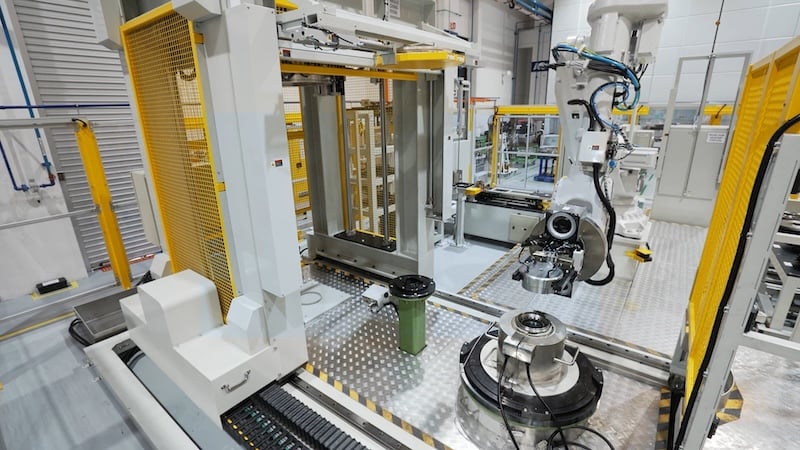
Another automated system dubbed Artemis is used for HP compressor and turbine component assembly, with reductions of 28% and 64% for processing and labor-hours respectively. An additional system, called Atlas, has also been developed for LP compressor module assembly, targeting a 20% process time reduction and a significant cut of 78% in labor-hours. Atlas is nearing the end of acceptance tests and could be cut in to the assembly flow process as early as the end of February, according to ESA.
Further areas expected to be automated may include LP turbine module stacking, Sim says.


Related Content