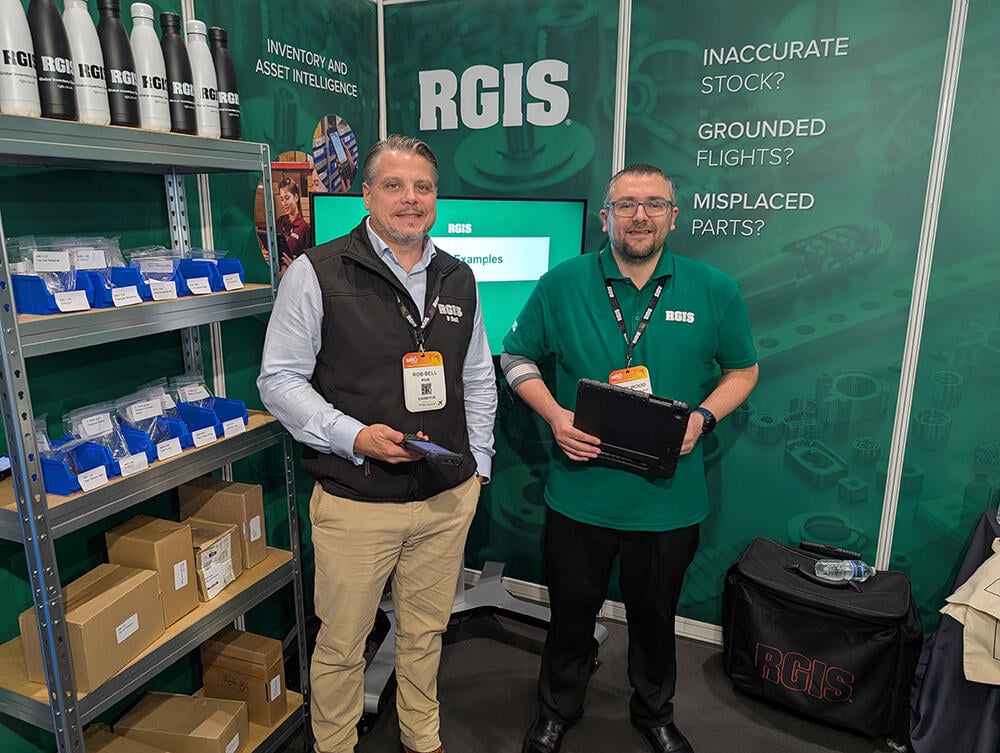
Rob Bell, sales and accounts director at RGIS (left), demonstrates RGIS Vision at MRO Europe 2025.
MRO organizations are increasingly turning to automation to stabilize parts visibility. Inventory management specialist RGIS claims that a major carrier has reported a 98.9% inventory accuracy rate after deploying its RGIS Vision optical character recognition technology across four warehouses.
RGIS says its teams uncovered more than 2,000 parts not recorded in the airline’s system, along with over 900 components classified as outdated, prompting a reassessment of their serviceability and stock status. The company also states that the project was completed 46% faster than the airline’s previous inventory provider, highlighting the operational gains tied to automated data capture.
The results signify a growing shift in the MRO sector toward digitized parts verification, as operators confront rising costs linked to data errors, misplaced stock and outdated components.
“The gains largely stem from eliminating repeated manual steps where errors typically accumulate—first when staff write down part numbers, then again when those numbers are keyed into a system,” explains Rob Bell, sales and accounts director at RGIS.
RGIS Vision was launched in April 2024 and, since then, the company’s existing RM3 inventory scanners have been upgraded by adding a universal optical character recognition (OCR) layer. This upgrade allows the scanners to read more than just barcodes, dramatically expanding what the device can capture.
The artificial intelligence-driven technology utilizes OCR to read alphanumeric part codes directly from components and storage locations, replacing traditional pen-and-paper counts and removing large portions of manual data entry from inventory workflows. Once the OCR technology reads alphanumeric identifiers on parts and packaging, it connects them to a customer’s product master file.
“It allows you to replace the barcode with an alphanumeric code, which is what a lot of the warehouse stockholding systems in the aerospace sector are more based on,” says Bell.
In the MRO sector, Bell also finds that barcodes are often not used or missing, and many stock-taking operations still rely on paper-based counting. “RGIS Vision allows our auditors to use accurate digital code recognition, reducing the time taken for the stock take and improving data quality, accuracy and efficiency,” he adds.
Captured data is instantly digitized and can be uploaded directly back into the customer’s inventory platform or delivered in a digital report.
Bell notes that the OCR engine has been developed internally in partnership with a German software specialist known for its automatic number plate recognition camera systems. “As long as it’s legible, essentially our software can read it,” he says, adding that the software will not accept partial matches, minimizing the risk of false positives. A deep-search function can offer weighted suggestions if an item is difficult to read, but the system prioritizes certainty over speed.
Additionally, Bell says the system is designed to integrate with existing MRO processes, from consignment stock models to perpetual inventory checks. The technology can operate as a real-time or closed system, depending on how often an operator wants updates.
Security remains a focal point, particularly given recent cyber incidents affecting major aerospace organizations. Bell stresses that RGIS runs its own protected servers in Manchester and Birmingham in the UK and complies with relevant ISO standards. “It’s all internal and secure within our own servers,” he says.

Related Content