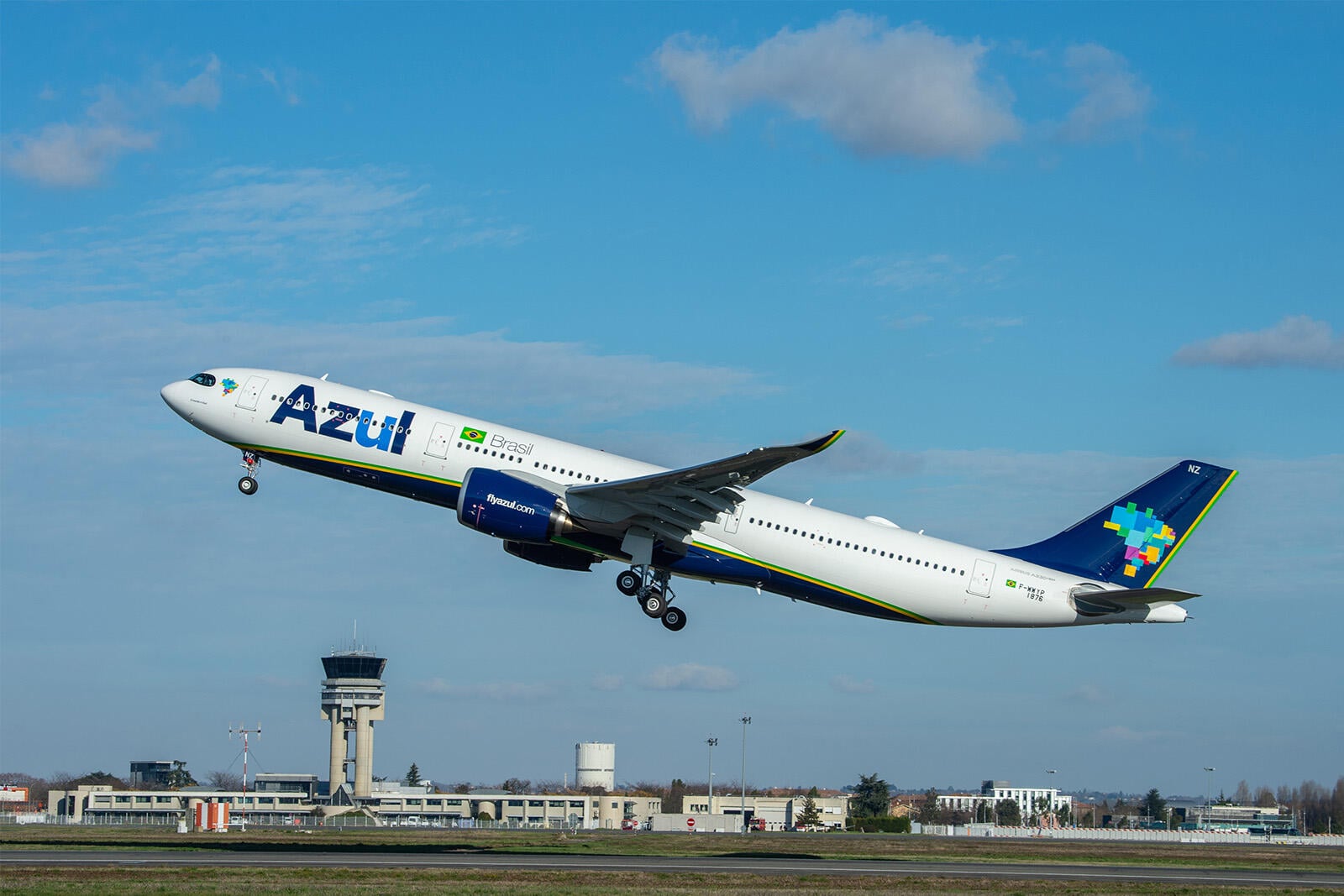
Brazilian carrier Azul, which made significant strides in the use of machine learning for maintenance planning before entering Chapter 11, is hoping to resume this project after exiting the court-led restructuring.
Azul filed for Chapter 11 in May 2025 and exited the process on schedule on Feb. 20, after securing $850 million in new investments, including $100 million from United Airlines and a $100 million commitment from American Airlines. Aviation Week’s Fleet Discovery database shows Azul has 140 active aircraft, with eight parked and 38 in storage.
Speaking with Aviation Week ahead of the Chapter 11 exit, Azul director of planning and revenue André Américo shared the artificial intelligence (AI) maintenance gains his team achieved before the turnaround process began.
“Instead of being aware that an AOG [aircraft on ground] was about to happen one or two days in advance, we were able to push that window back to two or three weeks before,” Américo says. “We were able to significantly reduce the groundings driven by component failures, aging or other reasons.”
Azul got to the point where it was able to predict and prevent 150 events per month, resulting in fewer cancellations, greater aircraft availability and network-planning stability. Together with Azul’s exploration of AI in schedule and revenue management, this initiative has generated a staggering $6 million in weekly gains.
The airline’s machine learning deep dive began in early 2025 and maintenance was one of the first targets. Work halted around May 2025, because the team needed to focus on the restructuring and maintenance was going through a leadership transition. “We paused it for eight months or so,” Américo says. “I expect to resume it by early March.”
Most of the work has already been done. The maintenance exploration began with an “initial sprint,” digitizing handwritten and manual-input logs, translating maintenance codes into specific language and gathering data with no upfront assumptions.
“We wanted to get more visibility on what was going on with our reliability, both in terms of components and in terms of fleets,” Américo says. “The ability to use language models to crawl through the remarks of each aircraft and component log helps a lot in this diagnosis as well ... Anybody that’s not using it really should be considering it.”
The data revealed a bottom-up diagnosis for each aircraft type, including “nonobvious” insights that would have been impossible for a human to spot. “We were able to predict component failures in other kinds of components that were completely unrelated. So, if your air conditioning system goes out for one day, you should expect failure in this, this and this component a couple of weeks after,” Américo says.
Work began on forecasting future groundings, scheduling “prescriptive” maintenance and adjusting network plans accordingly. On one occasion, Américo was able to predict a specific tail number AOG, two weeks before. “I placed a bet on it, with maintenance and my team,” Américo says. “I wrote down the tail number on the glass, and it happened. We had to trust the data; nobody believed me at first.”
Azul launched this project at the “peak” of the engine supply chain issues. “We used data to prevent good engines from being on bad tails. If you have good engines on a tail that is expected to be AOG, you are basically throwing away two engines that were—and still are—very valuable. That allowed us to shuffle the engine serial numbers among the fleet, so we could allocate them to the best-performing tails.”
Post-Chapter 11, Américo wants to reduce aircraft downtime by exploring “hidden trade-offs” between scheduled maintenance and AOGs, using data to plan more efficiently and minimize aircraft downtime. “Every time I ground an aircraft for scheduled maintenance, I lose aircraft time. Every time an aircraft is AOG, I lose aircraft time as well. What is the perfect balance?” he says. “That’s what I have in mind for the next steps.”
Américo sees potential to use more aircraft- and component-manufacturer data in Azul’s processes, and he also sees scope to better combine predictive maintenance with revenue management, making sure the aircraft are deployed where they are needed most. “Having work in parallel among different departments enables me to find the best global solutions, and not only the best solutions within the silo,” he says.
He encourages other companies to explore the benefits of AI, even if departments are currently segregated. “I’m 100% sure that both [technology supplier] AE Studio and our recent AI implementation has helped us to destroy the silos that existed in Azul. We are working in a more collaborative way because of this technology,” he says. “I honestly wouldn’t wait until the silos are resolved to start.”
Azul partnered with California-based technology firm AE Studio for the AI project, which spanned predictive maintenance, network planning, adaptive pricing and flight-level profit forecasting. AE Studio partner and Chief Operating Officer Greg Buckner says Azul was the company’s first airline customer. This work has triggered “deep conversations” with other airlines globally.
Buckner adds that Azul’s AI rollout was helped by the airline’s cross-department approach, strong management engagement and a willingness to learn, optimize and make mistakes. “Sharing insights enables a much richer intelligence across the board,” he tells Aviation Week. “That’s how you get to that $6 million a week.”

Related Content