ORLANDO, Florida—Aviation Communication & Surveillance Systems (ACSS), Airborne Maintenance & Engineering Services and Innovative Aerosystems (IA) are teaming up to develop an ADS-B In retrofit package for the Boeing 757 and 767.
Unveiled at Aviation Week’s MRO Americas, the retrofit package combines ACSS’s ADS-B In technology with IA’s flat-panel displays. For aircraft without the displays, an entire package—including an Acron Aviation TCAS3000 traffic collision avoidance system (TCAS)—will be available. Aircraft with the IA displays need to add only the TCAS3000 or just the ACSS ADS-B In if they are already Acron TCAS-equipped. Acron is a joint venture partner in ACSS along with Thales.
“The impetus for this program was to provide Boeing 757 and 767 operators with a practical, low-cost solution to meet upcoming regulatory mandates without the high capital expenditure of a full flight deck overhaul,” ACSS Program Manager Cam Morast told Aviation Week. “By leveraging the combined expertise of ACSS, Airborne, and Innovative Aerosystems, we’ve created a streamlined retrofit path that prioritizes both compliance and long-term utility.”
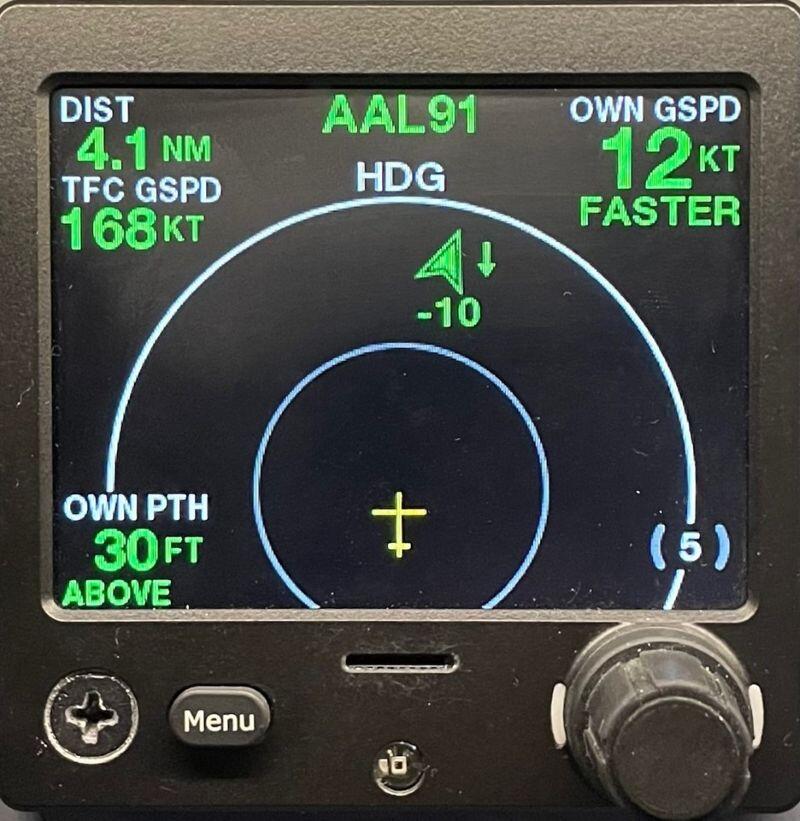
ADS-B In with Cockpit Display of Traffic Information (CDTI) provides pilots with added situational awareness of surrounding traffic beyond primary flight displays and TCAS, and without relying on air traffic controllers. U.S. lawmakers are working on a broad ADS-B In mandate with displays in response to January 2025’s mid-air collision between a PSA Airlines regional jet and U.S. Army helicopter near Washington, D.C.
ACSS supplies American Airlines with ADS-B In and CDTI line-fit and retrofit packages as part of a commitment linked to FAA trials. While the trials demonstrated measurable benefits, the FAA has been slow to embrace broader use of ADS-B In. The January 2025 accident has shifted the landscape, setting the stage for broad upgrades across the air transport fleet.
“Beyond simply meeting a mandate, this integration of ACSS’ SafeRoute+ and Innovative Aerosystems’ full display solution significantly elevates flight deck safety by providing crews with advanced situational awareness and runway alerting, while also offering ADS-B In operational capabilities that modernize these essential airframes for the next generation of global airspace,” Morast said.
The packages are expected to be available in about a year, the companies said. The launch customers will come from Airborne parent company Air Transport Services Group (ATSG), which also owns ABX Air, Air Transport International, and Omni Air International.
“At ATSG, our strategy is built around integrating leasing, operations, and technical capabilities to deliver real value for our customers who are looking for solutions that go beyond individual components. They need integrated capabilities that can be executed efficiently and at scale,” ATSG Chief Commercial Strategy Officer Todd France said. “Airborne’s technical expertise, combined with ATSG’s broader platform, allows us to deliver programs like this in a way that reduces complexity, minimizes downtime, and creates immediate and long-term value.”
The program “focuses on integrating ADS-B In capabilities into existing flight deck environments with minimal disruption,” added IA VP of Business Development Mike Glover. “By leveraging flexible display architectures, we’re enabling a solution that can be deployed across a wide range of 757 and 767 configurations while supporting advanced traffic awareness and spacing applications.”

Related Content