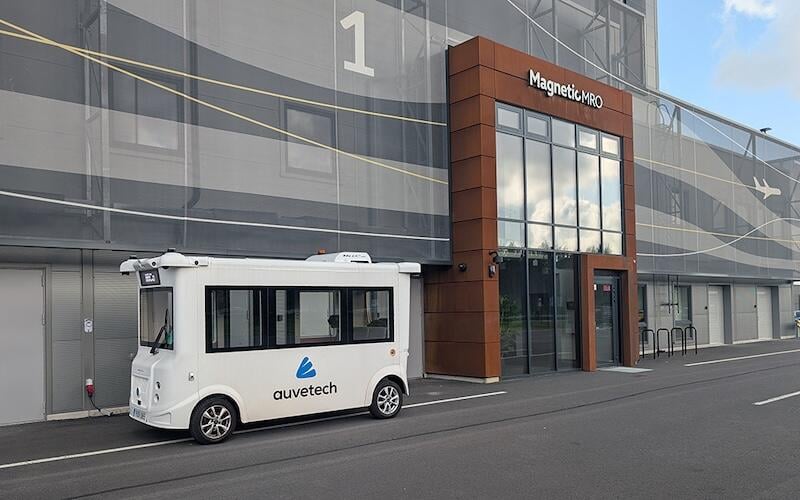
Magnetic's Talinn hangar.
TALLINN, Estonia — Magnetic MRO says its new H11 hangar here has performed better than expected since opening in January as the Estonian MRO provider positions engine maintenance as a key area of future growth.
Marko Männiste, managing director of Magnetic MRO, says H11 had already made a meaningful contribution to the company’s operational and financial performance while increasing maintenance capacity and flexibility.
“H11 has performed better than initially expected since we opened,” Männiste tells Aviation Week. “As with any new facility, we continue to fine-tune workflows and infrastructure, but H11 became productive quickly and supported a strong start to the year.”
The new hangar provides three bays for Airbus A320-family and Boeing 737-family heavy maintenance.
Unlike Magnetic’s older Hangar 04, H11 uses segregated bays, allowing individual areas to be isolated when aircraft are moved or work is being carried out. The design also incorporates floor heating and automated climate controls intended to improve efficiency during Estonia’s winter conditions.
During Aviation Week’s recent tour of the facility, Magnetic highlighted the use of RFID-based tooling controls and automated systems for managing tools and consumables. The company is also using autonomous vehicles to move equipment and materials between its maintenance facilities, with plans intended to minimize unnecessary movements.
The expansion is taking place alongside a growing focus on engine MRO.
Magnetic Group CEO Risto Mäeots believes engine maintenance will be a key contributor to future growth as airlines look to extend fleet lives and manage operating costs.
“We see a clear opportunity to strengthen our engine capabilities and expand our position in this growing part of the aviation aftermarket,” notes Mäeots. He adds that combining technical expertise with material support and asset management allows Magnetic to support customers across a broader part of the engine lifecycle.
The company’s Tallinn engine shop is currently heavily focused on CFM International CFM56 work. Magnetic has invested in a new balancing machine, allowing work previously sent to external providers to be performed in-house and potentially reducing turnaround times. The approach remains selective, with Magnetic continuing to outsource certain specialist module work where investment in additional capability does not make economic sense.
Material availability remains a consideration for engine turnaround times. “Material availability has caused delays on a limited number of engines, but so far the impact on our overall turnaround times has been manageable,” adds Filip Stanisic, managing director of Magnetic Engines.
The company manages the risk by ordering material in advance and working with suppliers to secure critical parts. Stanisic warned that if supply constraints persist, pressure on turnaround times across the industry could increase, with delays potentially moving from days to weeks.
Magnetic is also developing its next-generation engine capability. According to Stanisic, the company has established its initial CFM Leap capability and is expanding it incrementally, with technical competence, tooling and processes being developed together.
Pratt & Whitney Geared Turbofan capability, however, is not currently part of Magnetic’s near-term development plans.
“Our focus is on strengthening and expanding our CFM Leap capability,” says Stanisic.

Related Content