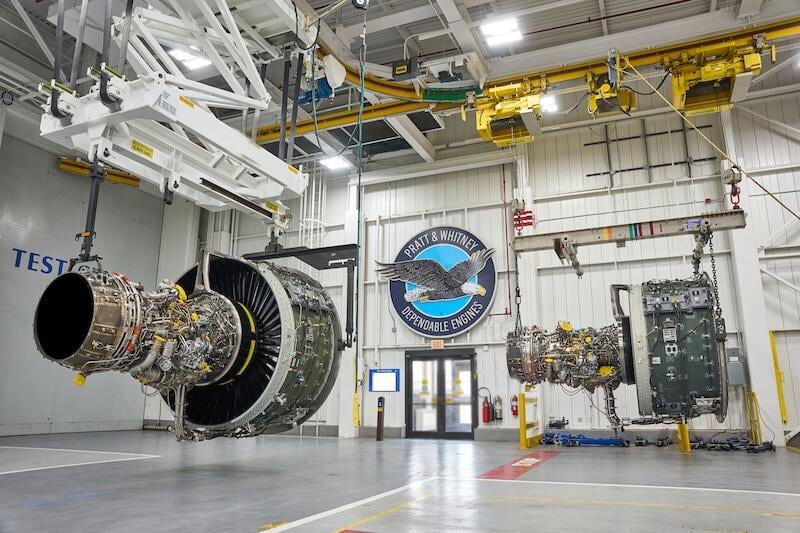
A two-hour flight on a Pratt & Whitney Geared Turbofan (GTF) engine can generate millions of data points, and the company is finding new ways to put that information to work across its maintenance operations.
Forecasting exactly when an engine will require intervention, however, remains difficult.
Keren Rambow, Pratt’s vice president of GTF aftermarket and transformation, says the company is moving beyond traditional engine-condition monitoring by using both snapshot and full-flight operational data, particularly across the GTF fleet, to identify issues earlier and support maintenance planning.
“The industry has moved beyond periodic engine condition snapshots and maintenance forecasts based primarily on fleet averages,” Rambow tells Aviation Week. “Today's systems can collect data throughout a flight, compare an individual engine's behavior with its own history and the wider fleet, detect subtle changes and provide earlier warning of potential maintenance needs.”
A two-hour GTF flight can generate approximately 4 million data points—about 40% more than the IAE V2500 engine—giving engine-health specialists considerably more insight into how individual engines are performing in service, Rambow says.
Pratt & Whitney's Advanced Diagnostics and Engine Monitoring and EngineWise capabilities currently support analysis of more than 10,000 engines across approximately 140 customers, according to Rambow. The company is also using environmental factors, aircraft operating behavior and advances in machine learning and artificial intelligence (AI) to gain additional insight into engine condition.
The application of that data is also expanding beyond identifying potential deterioration.
“Engine-health information can now support shop visit timing, work scope development, inventory allocation, maintenance capacity planning and future product improvements,” Rambow says.
She adds that engine-health data can also inform product design, inspection development, repair strategy and shop flow, with a life-cycle digital thread connecting information from engine design and manufacturing through operation and maintenance.
While greater data availability can provide earlier warning, Rambow acknowledges challenges in turning engine health data into reliable maintenance actions.
“The biggest challenge is separating genuine deterioration from normal operating variation,” she says.
Engine parameters can change with weather, mission length, altitude, thrust setting, engine age and recent maintenance. An unusual trend could indicate a developing problem, Rambow notes, but it could also result from a sensor issue, configuration change or benign operating condition.
Operators must therefore contend with both false positives and false negatives. Acting too early can trigger unnecessary removals and disruption, while acting too late can allow a condition to worsen.
“Even when deterioration exists, predicting the exact rate of progression is difficult,” Rambow says. “Remaining useful life should therefore be treated as a range with uncertainty, not a precise countdown.”
That uncertainty affects how predictive information is used by maintenance planners. Rather than providing a definitive maintenance date, the data gives operators an earlier indication of potential risk and more time to prepare for the required work.
The prediction itself is only part of the process, Rambow notes. “An alert has limited value unless it can be converted into an approved maintenance task and supported by available parts, people, tooling and shop capacity,” she says. “Therefore, predictive maintenance is not just about analytics; it's also about execution.”
Engineering judgment remains central to that execution, Rambow says. Engineers assess whether an analytical finding is physically credible, weigh factors such as recent maintenance, component configuration and inspection history, and determine whether the appropriate response is continued monitoring, troubleshooting, inspection, repair, component removal or a shop visit.
“The industry has learned that predictive maintenance is strongest when deterioration produces a measurable and understood signature,” Rambow explains. “Recent in-service events have also shown that identifying deterioration is easier than predicting exactly how fast it will progress.”
Physical inspection is not merely a way to confirm a prediction but can be how an emerging issue is first understood, Rambow adds. “The industry has also learned that accurate prediction does not guarantee operational success,” she says. “If spare engines, parts, repair capacity or maintenance slots are unavailable, the system may predict a disruption without preventing it.”

Related Content