Korean Air Expanding In-House Fleet Maintenance And Parts Ecosystem
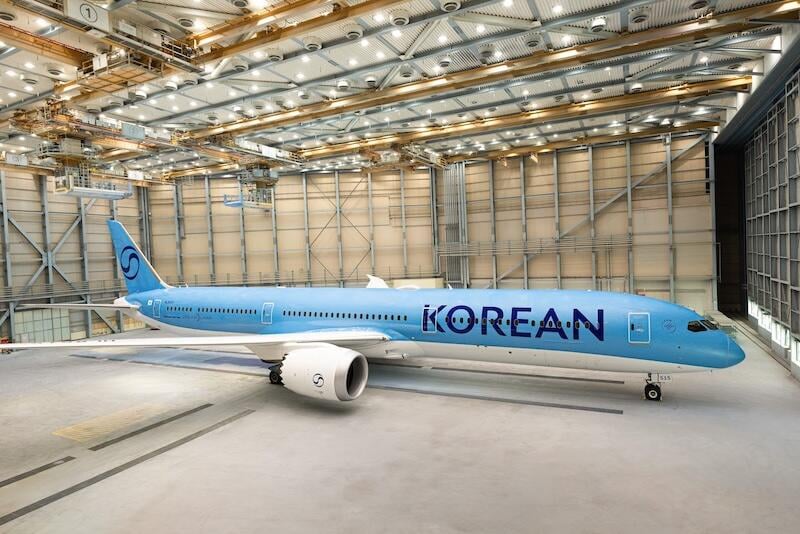
A Korean Air Boeing 787 with GEnx engines.
Korean Air is expanding its engine maintenance capability from six to 12 engine types as global maintenance, repair and overhaul (MRO) demand and critical parts shortages put pressure on the aftermarket.
The airline says early durability issues with certain new-generation engines have driven a surge in MRO demand and created severe bottlenecks in the supply of critical parts. Its complex fleet, which uses engines from several OEMs, adds to the challenge of securing spare engines and repairable material.
“Because Korean Air operates a complex fleet utilizing engines from multiple major OEMs—including Rolls-Royce, GE, Pratt & Whitney, and CFM—expanding our service capability from six to twelve engine types adds significant logistical complexity,” the airline states.
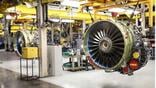
Korean Air is responding by bringing more maintenance capability in-house, with component repair, disassembly, assembly and testing consolidated at a single site. This approach is intended to reduce exposure to outsourced maintenance and associated aircraft-on-ground (AOG) risks and capital outflow.
The strategy includes two engine test cells. The first has a 150,000-lb. thrust capacity and supports widebody engines including the GE90, GEnx-1B/2B, CFM56 and PW4000, with the XWB eventually to be added. The second, with 62,000 lb. of thrust capacity, is dedicated to narrowbody engines including the PW1100G and LEAP-1A/1B.
Korean Air is also working with GE and Pratt & Whitney on internal heavy maintenance programs and workforce training, including personnel transitioning from Asiana Airlines. At the same time, it is enhancing its used serviceable material circulation ecosystem to support parts procurement.
The airline identifies the shortage of highly experienced maintenance technicians as another constraint alongside parts availability.
Geography is another element of Korean Air's strategy. The airline sees its location at Incheon International Airport as providing access to a major logistics hub in Northeast Asia, while its cargo network helps it source spare engines and critical parts from global partners. It is targeting a 70% share of third-party engine maintenance by 2030.

Related Content