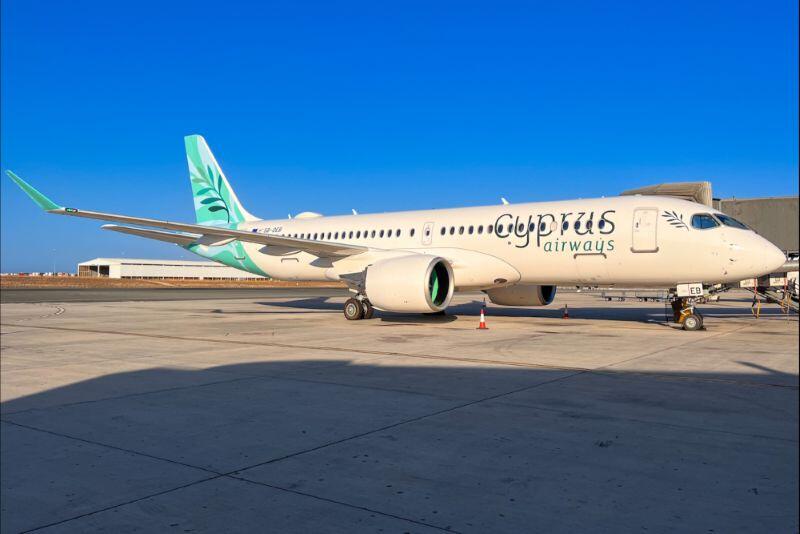
Cyprus Airways Airbus A220.
Cyprus Airways’ CEO said the availability of engine assets has become a key driver of its fleet decisions following severe disruptions to the airline’s operations two years ago due to Pratt & Whitney geared turbofan (GTF) engine issues.
Speaking at Aviation Week’s Engine Leasing, Trading & Finance Europe conference in London, Cyprus Airways CEO Thanos Pascalis said availability of engine assets is a primary driver in the airline’s fleet planning and even overrides airframe availability now.
“Effectively, the engines dictated which airframe we get and what aircraft we get,” Pascalis said. “You can’t separate the engine from the airframe anymore. Instead, you must look at engines and airframes together and make sure you have what you need to go to the next step. It is a new reality, that is for sure.”
The Larnaca-based carrier had planned to transition from an Airbus A320ceo fleet to an all-A220 fleet equipped with PW1500 engines. However, this changed following the grounding of its first A220 in April 2024, the non-delivery of two aircraft scheduled for that year, and broader industry supply chain disruptions. Subsequently, the airline revised its fleet strategy and dropped plans for future A220 orders.
According to Pascalis, the disruptions of 2024 left the airline’s busy summer period “in disarray,” with more than 1,500 flights canceled in total and on-time performance dropping to 65%. To reduce this in the short term, he said Cyprus Airways turned to ACMI wet-lease carriers and brought in the necessary capacity. The operational problems were additionally compounded by a failed web system transition, which left the carrier without a working app, loyalty program or CRM (crew resource management) system during the same period.
Pascalis said the airline built a recovery plan centered on growing fleet stability, schedule reliability and a return to profitability. Last year, Pascalis said Cyprus Airways operated around 4,500 flights with 100% completion and no cancellations, while on-time performance improved to 80% for all scenarios, but stood at 92% excluding air traffic capacity delays.
Cyprus Airways plans to add two A320neos to its current fleet of six aircraft next year. “Those aircraft were selected only after we [the airline] were satisfied with the condition and maintenance status of their engines,” Pascalis said. He conceded that none of the available fleet options for Cyprus were perfect, as A220s have faced GTF-related durability challenges, A320ceos carry higher fuel burn and emissions costs, and A320neos require examination due to ongoing engine concerns with the PW1100G.
For Cyprus Airways, spare engines have moved from being an operational backstop to a strategic asset, with Pascalis confirming that the airline has four A220s and two spare engines.
Due to the carrier’s spare-unit levels, engine leasing opportunities have also been integrated into the carrier’s strategy, as airlines see limited availability on certain programs. Pascalis said Cyprus Airways has secured long-term arrangements for its A220 spare engines and already views those assets as valuable after another carrier approached it to lease one of its available engines.
Pascalis also cited MRO capacity constraints as a key challenge, with airlines now forced to plan their maintenance needs much further in advance than in the past. “Nowadays, you have to plan way in advance; you have to book in advance; you have to make sure you have a huge margin of safety,” he said.
As a GTF operator, Pascalis said that Cyprus Airways faces operational complexity due to engine inspection rules. In some cases, borescope inspections must be performed every 75 hours. For the airline, that equals about a week of flying.
In addition, the engine program is experienced in long engine repair shop turnaround times. Pascalis said some warranty-related engine repairs were completed in about 90 days, while one engine remained in the shop for 18 months. He added that the airline had reached an agreement with Pratt after an 8- to 9-month process and received compensation, though not at the level it had sought.

Related Content