Fast 5: APOC Aviation’s New CCO Eyes Diversification Opportunities

Apoc Aviation CCO Craig Skilton.
Craig Skilton was appointed chief commercial officer at APOC Aviation on June 17. He spoke with Aviation Week about the company’s shift toward nose-to-tail support and its diversification into new aircraft platforms.
In your new role, you’re shifting from overseeing APOC Aviation’s components business to focusing on the company’s broader business development and strategy. What are your key focuses for the company in the near term?
I’ve essentially gone from managing the airframe division to having to learn a little bit more about engines, a little bit more about landing gears—our two other divisions at APOC. But also within that, being accountable for our marketing and business development activities as well, so it’s been quite the change. There’s been a lot to learn along the way.
APOC is well known for specializing in parts supply, but in recent years, the company has introduced more end-to-end solutions. How are your capability offerings evolving to better serve the aftermarket?
APOC has recently changed its branding, aiming to be the intuitive partner of choice. The idea is that across, for example, an [Airbus] A320 fleet, we can genuinely provide a solution from nose to tail. That encompasses airframe support on components exchanges. We have a pool of nacelles and we’re really ramping up full support on that, but we also do coverage on engines. That’s whole assets and components as well. And the same thing on landing gears as well—whole asset sale exchange or loan. In previous years, we might have one division focusing on one asset type. We’re trying to join that up a little bit and offer a true service to a customer, end to end. The aim is to do that across more fleets.
We’ve recently been looking at our investment strategy as well, and we’re looking at how we can diversify and provide more of a service across the new-gen platforms, but also into widebodies.
APOC recently introduced a focus on Airbus A320 family components stocked for exchange. Could you tell me a bit more about the strategy behind that offering?
Our warehouse is in the heart of Europe. Previously, the model was to sell and sell quickly. Now we’re looking to truly understand the demand from some of the operators we’re working with, and rather than selling, we’re holding that material for exchange and loan. That includes A320 material, but it also includes A320neo material. Some of the acquisitions that we’ve done recently have a really strong crossover into the Neo family and Neo applicability. So, in theory, for some of those high-cost, high-rotation items, we should, at almost all times, have a unit on the shelf to support an exchange, and that’s really been a strong play we’ve been making with operators in and around Europe.
We’ve trebled our airline customer base in the last 12 months. That’s been a dedicated push on providing that service to the end user, rather than through a third party. We’ve done both in parallel. We’ve increased the customer base and then made sure that the stock is there to support them.
APOC has been quite active in acquiring airframes and engines over the last year. What does your teardown pipeline look like right now and which disassembly partners are you working with?
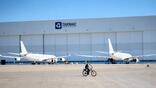
Currently, we’ve got an A320 and A321 going through teardown. The A320 is a younger model. That’s the one with a lot of crossover into Neo. So that’s going on at Tarmac Aerosave at the moment. We’ve got an A321 cargo [teardown] going on at Magnetic MRO in Tallinn. [The] A321 is an area for us where we hold assets, especially across the landing gears, so that was a strategic one for us—landing gears and airframe.
On the engine side, we’ve recently torn down two [IAE] V2500s. That material is available, and the team is focusing on those. We’ve also done a [GE Aerospace] CF34-10, which is a bit of a new play for us into the Embraer market. So we’ve got one, and in theory another engine to follow shortly after for material on the Embraer side as well.
Landing gear continues to flourish and has had a really good year. That’s across the A320. We’re looking at A330 and [Boeing] 777 new-gen landing gears at the moment. We’re also looking at a Neo gear. Landing gear remains our most comprehensive department and is the one that really has assets in a lot of those key markets. The aim is to grow some of those out and scale what we’re doing, but also expand into new platforms, too.
We’ve recently seen some interesting developments that may impact the global parts market, such as competition for the Spirit Airlines fleet post-shutdown and industry efforts to open up China’s USM market. Which recent developments in this market have caught your attention and why?
Having a strong foothold in the A320 market, we’re certainly checking what’s going on, and sometimes that changes every day. We’re trying to assess what’s going on, especially around Spirit and some of those other things. I think for us, the pivot into Neo is quite a critical one, and we do have A320 operators that we still need to service. But I think being able to service the Neo market as well derisks what we’re doing with any Spirit activity.
We’re looking into China as well. It wasn’t that long ago that we hired a regional sales director in China, and he’s actively exploring that market for us. [The focus] was initially on landing gears, but now it’s company-wide, so that’s been a strategic play as well that we’ve been looking into alongside the efforts that we’ve already got in the Middle East and Asia.
For us, maybe it’s not the trends so much, but trying to counteract all the different trends and the things that are going on. What we’ve done successfully in Europe, we’re trying to make sure that we can do successfully in other regions now, and like I said before, a little bit of diversification on some of our concentrated assets into one family.

Related Content