This article is published in Aviation Week MRO part of Aviation Week Intelligence Network (AWIN), and is complimentary through Jun 19, 2026. For information on becoming an AWIN Member to access more content like this, click here.
LYON—Lufthansa Technik and Airbus have entered a technical collaboration to extend the planned application of AeroShark riblet films, designed for better fuel efficiency, to the A330ceo’s wing and empennage.
Lufthansa Technik has been marketing the AeroShark retrofit—for improved aerodynamics and reduced fuel consumption—on Boeing widebody types since the late 2010s and had started working, on its own, on the A330ceo. So far, the area considered for film coverage on Airbus and Boeing aircraft had been limited to the fuselage and nacelles. Airbus’ cooperation and expanding to other areas of the aircraft mean the technology is gaining significant momentum.
The project focuses on technical feasibility. Lufthansa Technik will hold the supplemental type certificate it has applied for with the European Union Aviation Safety Agency, the company said, and Airbus will provide aircraft type data and safety assessments. The two companies intend to implement the technology on the wing, as well as horizontal and vertical stabilizers.
“From a technical perspective, the certification program will comprehensively assess the impact of riblet application on flight dynamics, lightning strike protection, structural loads, maintenance aspects and all relevant aircraft systems, including flight control, autopilot and navigation systems,” Lufthansa Technik said. It had been working separately with partner BASF Coatings on the fuselage and engine nacelles. The combined modifications may cut fuel consumption by more than 2% on an in-service A330ceo flying long-haul missions, Lufthansa Technik said.
The company is ruling out AeroShark application to newly built aircraft on the production line. “We cannot apply the AeroShark film to freshly applied paint because the solvents in the paint interact with the film differently than intended,” a spokesperson said. “For applying the riblets, fully cured, outgassed paint is still a requirement at present.”
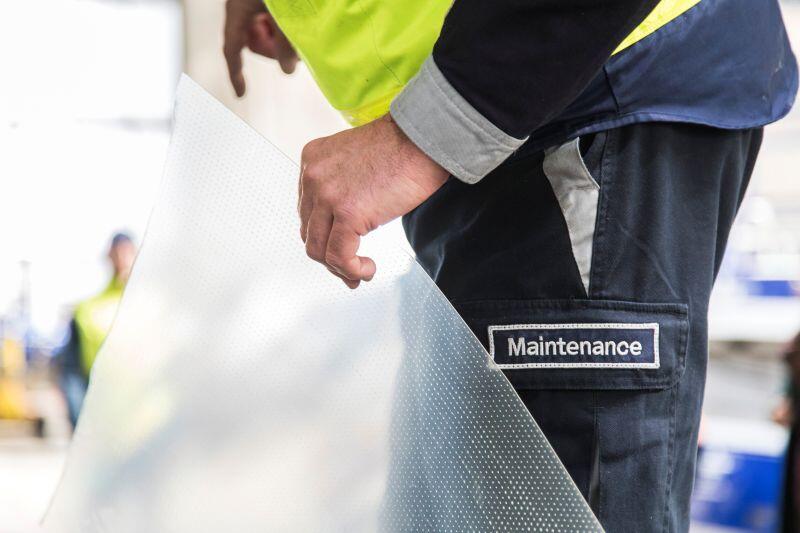
AeroShark relies on prism-shaped riblets. Air friction creates turbulence on the aircraft’s surface and riblets move that turbulence 50 micrometers away, effectively reducing drag and therefore improving fuel efficiency. On a 777-300ER, the film covers 950 m2 (10,200 ft.2) and adds 150 kg (330 lb.). The fuel efficiency improvement and return on investment are comparable to an engine upgrade.
AeroShark films have been applied to 30 Boeing 777s of several airlines and one Lufthansa Boeing 747. As of April, those aircraft had accumulated some 350,000 flight hr., saving 20,600 metric tons of fuel, Lufthansa said.