This article is published in Aviation Week & Space Technology and is free to read until Sep 13, 2026. If you want to read more articles from this publication, please click the link to subscribe.
U.S. Adapts Hypersonic Weapon Strategy To Meet New Priorities

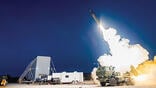
Facing competition from startups offering lower-cost hypersonic weapons, Lockheed unveiled a competing design in June for a hypersonic glide vehicle.
Hypersonic weapons move very fast, but not always in a straight line. So it goes as the Pentagon’s roughly eight-year-old race to field its first maneuvering hypersonic weapons enters a critical new phase.
U.S. military weapon development strategy is on the cusp of a fundamental turning point, transitioning to a focus on volume and affordability. At the same time, the country’s once-creaking hypersonic test infrastructure is nearing a breakthrough in capacity for cadence and the scope of testing.
- Common Hypersonic Glide Body fielding is delayed further
- Testing capacity surges with six-year, $7 billion spending plan
The original hypersonic weapons plan the Pentagon adopted in 2018 appeared straightforward. To erase China’s surprise lead, the U.S. planned three major technology development thrusts:
• First, adapt a 1970s-era, Sandia National Laboratories-designed common hypersonic glide body (CHGB) to deploy as the Air Force’s air-launched Hypersonic Conventional Strike Weapon (HCSW) in 2022, the Army’s ground-launched Long-Range Hypersonic Weapon (LRHW) in 2023 and the Navy’s surface- and sub-surface-launched Conventional Prompt Strike (CPS) missile in 2025.
• Second, field the more advanced Lockheed Martin AGM-183A Air-Launched Rapid Response Weapon (ARRW) with the Air Force in 2023.
• Finally, continue maturing scramjet technology to deliver the Air Force’s Hypersonic Attack Cruise Missile (HACM) and then the Navy’s Hypersonic Air-Launched Offensive anti-surface Strike Weapon (HALO) in the second half of the 2020s.
Much as war plans seldom survive first contact with the enemy, advanced defense technologies rarely work out as conceived.
The Air Force was first to disrupt the original plan by canceling the HCSW in 2020. A few years after diverting that funding to the ARRW program, the service paused that effort, too, even though it was ready to enter production.
The Army and Navy versions of the CHGB effector continued to enjoy internal support despite the HCSW’s demise, but both programs failed to deliver on time. The LRHW, also known as the Dark Eagle missile, is more than two years behind schedule and still has not achieved the fielding milestone. The Navy has pushed back fielding plans for the CPS variant. Both projects struggle with testing failures and production snags.
The HACM remains on track to enter service at the end of this decade, while the Navy’s HALO has been recast from a plan to develop a hypersonic cruise missile into a high-supersonic, air-launched ballistic missile now called the Multi-mission Affordable Capacity Effector (MACE).
At a broader level, a new group of Pentagon technology executives has broken fundamentally from the department’s original technology development strategy. The array of first-generation hypersonic weapon projects—from the LRHW and ARRW to the HCSW and HALO—moved forward based on exquisite, advanced technologies led by the defense industry’s largest contractors, including Lockheed, Northrop Grumman and RTX. As a result, unit prices soared into the tens of millions for the hypersonic glide vehicles, limiting production orders to dozens per year.
The Pentagon’s latest Future Years Defense Program (FYDP), released in April, breaks from that approach. In a series of major programmatic decisions, U.S. military officials revealed plans to order about 10,000 maneuverable hypersonic missiles by fiscal 2031. This strategy leverages new entrants to the industry and simpler designs. The goal is to produce thousands of missiles per year, instead of dozens, with unit prices in the hundreds of thousands to single-digit millions rather than tens of millions.
The Navy’s CPS and the Air Force’s HACM emerged unscathed in the new strategy, but LRHW and HALO procurement plans are now unrecognizable from what they were only a year ago. The Army alone plans to buy 500 LRHW missiles in fiscal 2029 and 1,000 each the next two years. The move suggests a shift in favor of the simpler and vastly cheaper Castelion Blackbeard missile. In response, Lockheed unveiled the competing low-cost hypersonic glide body in June. Despite touting a lower lost, Lockheed’s concept showed off advanced features closer to the high lift-to-drag shape of the newer ARRW rather than the conically shaped CHGB.
The Navy was not ready to break away from the long-term CPS procurement plan in the FYDP, but it was prepared to ditch the scramjet-powered HALO missile. In its place, the service unveiled details of the new MACE program, with a goal to buy 4,000 Mach 4+ ballistic missiles through fiscal 2031 to arm carrier-based Boeing F/A-18E/F fighters. Castelion’s air-launched Blackbeard variant appears well-placed to compete for that order, too, after the company worked with the Office of Naval Research to develop exactly such a weapon for the Navy’s fleet.
The Air Force also flip-flopped on the ARRW program. Two years since pausing production after completing a five-year operational prototyping program with mixed results, new service leadership has again braced the air-launched missile with an efficient hypersonic shape. The Air Force now plans to buy more than 900 AGM-183As over the FYDP period.
Underlying the shift in development strategy is a change in the Pentagon’s approach to hypersonic testing.
When the hypersonic weapon push kicked off eight years ago, testing capacity in the U.S. was limited. The hypersonic testing heydays of the 1960s had long passed, and with it the country’s capacity to support hundreds of hypersonic ground and flight tests per year. In the two decades before 2018, the U.S. had slowed to a rate of testing quarterly and sometimes only semiannually.
The situation placed a difficult burden on program managers for the LRHW, CPS, ARRW and HACM. Advanced new technologies needed to be flight-qualified to usher those programs into production. With only a few hypersonic tests scheduled per year, however, program managers had little incentive to complicate already challenging test cards for the baseline weapon by introducing new technologies. So qualification tests for improvements and new capabilities often moved to the back of the queue, further straining the progression of those programs.
Pentagon officials set out to solve that problem in 2022. The military opened a new, parallel track of hypersonic flight testing. The program—the Multi-Service Advanced Capability Hypersonics Test Bed (MACH-TB), awarded in 2022 to Leidos subsidiary Dynetics by the Naval Surface Warfare Center, Crane Division—achieved its first success in 2023 with the launch of a Dynetics-designed, low-cost hypersonic glide body. Rather than enter flight testing as a future weapon, the vehicle functions only as a testbed for new technologies.
The Pentagon now plans to spend more than $7 billion on the follow-on MACH-TB 2.0 program in fiscal 2026-31.
The pace of U.S. hypersonic flight testing is finally accelerating toward the 50-per-year rate target set two years ago by the Defense Department’s Test Resource Management Center. Yet details of tests are rare—including acknowledgment that they have taken place at all, in most cases. Despite the shroud of secrecy, the deployment of highly visible test assets, such as Stratolaunch’s Boeing 747 and Roc carrier aircraft or Rocket Lab’s Electron launch vehicle, makes some hypersonic test events trackable.
The majority of these visible tests are being conducted under the MACH-TB umbrella. Covering programs ranging from the Navy’s CPS and Army’s LRHW to weapons and research efforts by the Missile Defense Agency (MDA), Air Force and the Pentagon, MACH-TB also includes development of a modular experimental glide body for hypersonic tests.
Four years on, several companies are seeing the fruits of the Pentagon’s initiative, including Leidos itself. The company was awarded a $2.7 billion Army contract in May to transition from hypersonic weapon prototypes to production systems. Under this contract, Leidos is bringing together its previous work under the Thermal Protection Shield and CHGB programs to speed delivery timelines.
Meanwhile, hypersonic test company Stratolaunch is at the leading edge of the accelerating wave of testing, mainly due to the recent induction of a modified 747-400 carrier aircraft into its active fleet. The company acknowledged this year that it had successfully released its reusable Talon hypersonic test vehicle on an MDA mission (Flight Test Experiment Other-04) on March 6, and at the end of May, it conducted its first overseas deployment with the 747 to the Western Pacific island of Guam.
Although the company is not commenting on the latest tests, tracking data indicates that the 747 staged out of Guam’s A.B. Won Pat International Airport to conduct flights on June 17 and 23 over the Reagan Test Site. Spanning island facilities across the Kwajalein Atoll in the Marshall Islands, the site is regularly used to support the testing of very-long-range munitions, including the ARRW. The Air Force acknowledged the completion of the first end-to-end ARRW test over the site in 2024.
While the specific test vehicles used in either case have not been identified, it is likely that the Guam trials involved additional flights of Stratolaunch’s Talon testbed, with a potential landing recovery attempt at Andersen AFB on the island’s eastern coast. Together with Talon flights launched from the company’s Roc carrier aircraft, more than 12 hypersonic tests apparently have taken place at the Reagan, Vandenberg and White Sands test ranges since December 2024.
Ursa Major, the Colorado-based maker of the Talon’s Hadley liquid rocket engine, has provided additional insight into Stratolaunch’s activity. The propulsion system had completed 10 consecutive successful flights, “including multiple missions at sustained hypersonic speeds with Stratolaunch,” the company noted in April.
“Several of the 10 flights were conducted using previously flown Hadley engines, demonstrating reusability, durability, rapid turnaround and a path to significantly lower cost per flight,” Ursa Major said. The first powered vehicle, the Talon A1, was tested in March 2024 and deliberately ditched in the ocean. Since then, a second Talon, A2, has made several flights. A3 joined the flight program in February.
The tempo of suborbital hypersonic tests conducted by U.S.-New Zealand launch company Rocket Lab is also increasing, again mostly due to the MACH-TB program. The company has flown eight high-speed tests using the Hypersonic Accelerator Suborbital Test Electron (HASTE) version of its Electron rocket.
Following the first HASTE launch from the Mid-Atlantic Regional Spaceport at Wallops Island, Virginia, in June 2023, two more hypersonic tests were conducted in 2024. The flight rate increased slightly with three MACH-TB launches in 2025. Two hypersonic-related tests have been conducted in 2026. One test in February involved the deployment of a scramjet-powered vehicle built by Australian company Hypersonix Launch Systems under a Defense Innovation Unit contract.
Many more flights are scheduled. In March, the Defense Department ordered 20 additional HASTE rocket flights to take place over the next four years in a $190 million block buy deal for MACH-TB 2.0 missions. In addition, three suborbital hypersonic flights are scheduled for Anduril, while Dassault Aviation has also selected the HASTE vehicle for a suborbital launch of its 4-m-long (13-ft.) Vortex-D spaceplane demonstrator. This mission, provisionally targeted for 2028, will see the 1-metric-ton (2,200-lb.) vehicle launched to an altitude of around 100 km (62 mi.) before it is released for a test flight at Mach 10-12.