This article is published in Aviation Week & Space Technology and is free to read until Sep 13, 2026. If you want to read more articles from this publication, please click the link to subscribe.

U.S. Army’s Air Defense Focus Shifts

Patriot

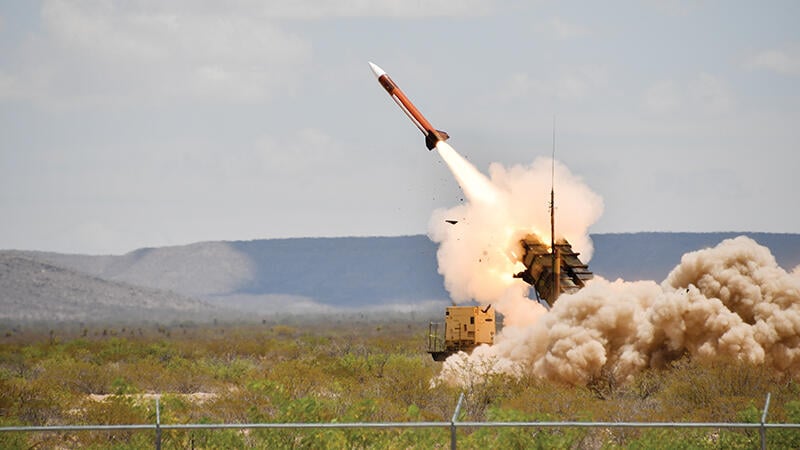
U.S. Army Patriot air defenses require their own defenses given the threats they face in the Middle East, service leaders argue.

Credit: Sgt. David Rincon/U.S. Army

The U.S. Army’s air defense community for years has been the service’s most deployed part, with high demand as the country’s forces faced increasing threats from above.

However, with Iran striking U.S. bases in the Middle East, the threat, demand and corresponding casualties have spiked, prompting a rethink of how the Army addresses the mission. This is as the service faces dramatically deteriorating stockpiles of key interceptors of systems such as the Patriot and Terminal High-Altitude Area Defense.

  • A more comprehensive strategy is sought
  • Greater numbers of cheaper interceptors are needed for counter-UAS

“The very first thing the soldier accepts is that they are the No. 1 target for the enemy,” says Chief Warrant Officer 5 Noel Del Real, command chief warrant officer of the 32nd Army Air and Missile Defense Command (AAMDC), which is tasked with air defense in the Middle East. “We know that the enemy has devised, has tried multiple times, to target U.S. air defenders. So once the soldiers accept that, they go into this high-vigilance, high-focus mode . . . and accept that they are the ones holding the line for the entire joint force.”

Over the past 14 months, the 32nd AAMDC has taken down more than 1,200 ballistic, cruise and drone threats as part of the Iran war, with 125 missiles during the 2025 Twelve-Day War. For leadership of the Army’s Space and Missile Defense Command (SMDC), this threat is driving a review of overall strategy. This includes shifting away from simply deploying an unprotected Patriot battery that operates in a vacuum and broadening the focus on different ways to take out launchers and intercept incoming threats.

“We need more of a comprehensive missile defeat strategy that focuses on interceptors, equally so on nonkinetic effects—both electronic warfare and directed energy,” SMDC Commander Lt. Gen. John Rafferty says.

The Army needs to connect its defensive fires directly with new offensive fires, such as the Precision Strike Missile or the Typhon Mid-Range Capability, for a better view of the threat.

This increased command and control is needed as Iran has shown the ability to connect its own offensive weapons—Shahed-type drones, ballistic missiles and cruise missiles—with new artificial-intelligence-based technologies for increasing capability, he argues.

“Watching all of our adversaries, they are advancing platforms and weapons across multiple domains,” he says. “It’s long-range fires, ballistic and cruise missiles, advancing them with increasing range, speed, lethality and maneuverability. And it’s not a huge leap every time. It’s an incremental change, and over time, that additive effect is really multiplicative in terms of the challenge that it presents to us.”

An example of the learning has been within the 10th AAMDC, which is largely charged with helping Ukraine with its air defenses in Europe while also deploying short-range air defense systems to the Middle East for a mission outside what it was initially trained to do, the command’s Chief Warrant Officer 5, Billy Gould, says.

For survivability, the greatest lessons learned over recent operations have to do with steps like increasing dispersion of fire control equipment. One such step is working with Raytheon to make cables up to three times longer to spread out equipment further. “So if one target gets hit, the rest of the fire control might not feel the effects, or at least [it will] minimize the effects,” Gould says.

The Patriot’s Engagement Control Station has been made adaptable to a Palletized Load System that allows operators to be employed on the ground with cover built around to protect those inside, he says.

Air defenders are also increasing the use of deception with decoy targets. This includes having personnel work with them to show a deceptive pattern of life, something that has been effective in Ukraine, Gould says.

The lengthening war with Iran has depleted stockpiles of interceptors markedly. The Center for Strategic and International Studies estimated in late July that the prewar stockpile of 2,330 Patriot interceptors had dropped to 759-827. While Army leaders avoid confirming such estimates, they roundly say increasing the number and type available is critical.

“I cannot add anything to the emphasis on magazine depth for currently fielded systems, or for the need for [a] cheaper and wide-ranging mix of interceptors,” Rafferty says. “That couldn’t be made more loud and clear from the highest levels of our government.”

The Army has started multiple competitions intended to modernize its radars and grow the stockpile. Brig. Gen. Robert J. Mikesh, capability program executive for offensive fires, highlighted four new competitions that the service is prioritizing: the Low-Cost Interceptor, Future Interceptor, Joint Forcible Entry Radar and Increment 4 of the Maneuver Short-Range Air Defense (M-Shorad) vehicle.

These contests come on top of ongoing competitions the Army sees as critical within its fires portfolio—both offensive and defensive. These are the Common Autonomous Multi-Domain Launcher, Low-Cost Containerized Munitions, a second interceptor for the Indirect Fire Protection Capability, Mobile Tactical Cannon, Next-Generation Short-Range Interceptor and Increment 4 of the Precision Strike Missile. Across these competitions, the Army sees a need to prioritize affordability, modularity and the ability to counter both high- and low-end threats, Mikesh says.

Brian Everstine

Brian Everstine is the Pentagon Editor for Aviation Week, based in Washington, D.C.