This article is published in Aerospace Daily & Defense Report part of Aviation Week Intelligence Network (AWIN), and is complimentary through Aug 24, 2026. For information on becoming an AWIN Member to access more content like this, click here.
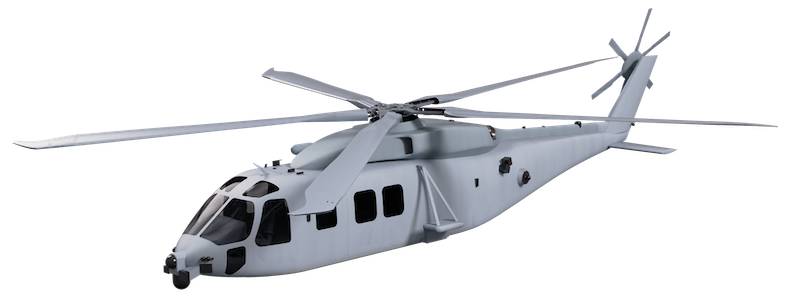
This conventional single main rotor design was one of two concepts proposed by Sikorsky for NGRC.
Sikorsky would commit to opening helicopter production facilities in Europe if its proposals for NATO’s Next Generation Rotorcraft Capability (NGRC) are selected by the partner nations.
In a July 16 announcement ahead of the Farnborough Airshow and the upcoming launch of the NGRC Concept Design phase by the NATO Support and Procurement Agency (NSPA), the airframer says it would develop, produce and conduct component manufacturing in Europe, although it does not say where these facilities would be located.
Sikorsky would also “partner with leading European aerospace firms, industry and suppliers as part of a robust, locally sourced NGRC production line,” it says.
The NGRC aims to replace around 1,000 medium helicopters of different types currently in service with NATO nations from the late 2030s and 2040s. Previous collaborations in the late 1980s were the genesis of what ultimately became the NATO Helicopter for the 1990s—now the NHIndustries NH90 developed by Airbus, Leonardo and Fokker.
Sikorsky is one of four airframers that have been approved to enter the Concept Design phase after passing a pre-qualification assessment at the end of 2025.
Other successful bidders include Airbus, Boeing and Leonardo. This phase, to be launched imminently, will develop a new set of detailed concept design solutions for the future rotorcraft based on a series of refined and harmonized requirements currently under development. When these are delivered back to NSPA by the bidders in mid-2027, they will be evaluated and scored based on a predefined weighting. NSPA, as contracting authority, will perform the evaluation of the proposals and will come back to the nations for their decisions. NGRC nations include France, Germany, Italy, the Netherlands, the UK and Canada. The U.S. and Spain are currently observers.
In an earlier concept stage, Sikorsky proposed two rotorcraft configurations: one conventional single main rotor and another based on the company’s X2 compound technology, which uses a coaxial main rotor and a pusher propellor for high-speed flight. X2 technology had previously been offered for the U.S. Army’s Future Long-Range Assault Aircraft, but was rejected by the service in favor of Bell’s tiltrotor design.
“We are committed to strengthening our strategic partnerships, expanding industrial capacity and deepening our long-term presence in Europe,” said Dennis Goege, Lockheed Martin’s chief executive for Europe. “Local production supports a highly skilled regional workforce, reinforces Europe’s defense industrial base and enhances NATO readiness,” he added. Sikorsky already has a production capability in Europe through its ownership of PZL-Mielec in Poland, which builds the S-70 Black Hawk.
Beyond Europe, Sikorsky says it is also pushing a global variant of its NGRC X2 proposal in Asia.