This article is published in Business Aviation & AAM Report part of Aviation Week Intelligence Network (AWIN), and is complimentary through Jul 24, 2026. For information on becoming an AWIN Member to access more content like this, click here.
ACNZ is aiming to fly the AC-2 AveniQ prototype 12 months from go-ahead, once the funding is in place.
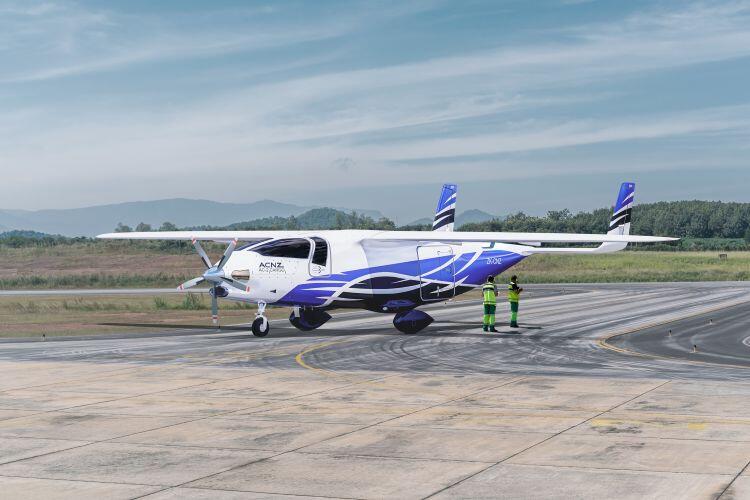
A New Zealand startup has launched plans to develop an all-composite competitor to the Cessna SkyCourier utility turboprop, building on the country's multi-billion-dollar yacht-making industry.
Auckland based Aviation Composites New Zealand (ACNZ) has launched efforts to raise funding to fly a prototype of the AC-2 AveniQ within 12–14 months of go ahead and to certify the autonomy ready regional cargo aircraft in three years. ACNZ was founded in 2017 by Lapo Ancillotti, an engineer who moved to New Zealand from Italy in 1993 to make racing yachts.
First to win the America's Cup yacht race three consecutive times in 2024, New Zealand has become a leader in yacht building, its industry surpassing NZ$3 billion ($2 billion) in annual revenues in 2023.
“New Zealand was really leading the innovation in composites,” Ancillotti says. “We were making racing yachts in 12 weeks, where the rest of the world needs 10 months. I have always been passionate about aircraft and early in 2000 saw the opportunity to link what we learned with yachts to aviation.”
The New Zealand team developed and certified a composite aerial application spray system for the Robinson R66 helicopter, and designed and produced a carbon fiber kitplane, the Furio, he says. “Then, we approached the AC-2, which we developed because in the cargo aircraft market, the fleet is getting very old.”
The AC-2 is designed to carry a 6,000 lb. payload for 400 nm at a cruise speed of 200 kt. on a single Pratt & Whitney Canada PT6 or GE Aerospace Catalyst turboprop. “We can do with one engine what the SkyCourier has two engines for, and this is fundamentally due to aerodynamics and composites,” Ancillotti says. With a wingspan of 22 m (72 ft.), the AC-2 is designed from the outset to be “future proof,” he says, capable of being adapted to electric propulsion or autonomous operation as markets evolve.
In addition to regional feeder cargo, the aircraft is suited for passenger, medical evacuation, firefighting, humanitarian and military missions, ACNZ says.
“We started the design two years ago and ran a pretty intense campaign of CFD [computational fluid dynamics],” Ancillotti says. “We developed the composites. The aircraft is going to be made in fewer than 200 parts. We are pretty specialized in integration, and composites allow integration pretty well.”
An investor with an interest in the regional cargo market funded design of the AC-2, which is ready to move to the prototype phase. “We can make the prototype in 12 months, and we have a three-year pathway to type certification,” Ancillotti says. ACNZ is planning Part 23 certification with the New Zealand Civil Aviation Authority.
ACNZ is looking to raise $10 million to build the prototype and a total of $33 million to take the AC 2 through certification. Detailed design is complete, and the next step, contingent on raising funding, is to release the construction drawings.
“In 12 months—14 months to be conservative—we will be in a position to prove the performance of the aircraft,” he says. The company plans to use a “different methodology” for the composite airframe, Ancillotti says, adding: “We have been probably the first in the world working on fiber orientation and weight distribution. It's very simple to make.”
Because of the potential for damage in the environment in which cargo feeders operate, “The aircraft is designed to be particularly resistant to local impacts,” he says. “We use a methodology for open-air repair without the need for any specialized tools. You don't need an autoclave. You can repair the aircraft overnight.”
This composite repair philosophy has been influenced by the team's experience in the yacht industry. “We come from an environment where boats need to be repaired overnight to race the following morning,” Ancillotti says. The cargo door, for example, is double-reinforced with solid carbon to prevent damage.
The AC-2 has been designed with the e-commerce market in mind and has a wider cargo cabin with more volume for packages than the SkyCourier, Ancillotti says. The aircraft can also accommodate three LD-3 cargo containers. The program is being structured to be relocatable, with certification and initial production in New Zealand, but the potential for eventual manufacture in the U.S. ACNZ forecasts a regional feeder cargo market for 500–800 aircraft over 10 years in the U.S. alone.
The aerospace industry in New Zealand is small but growing, Ancillotti says, thanks to the success of companies such as Rocket Lab, which has grown to a market capitalization of more than $40 billion since going public in 2021.