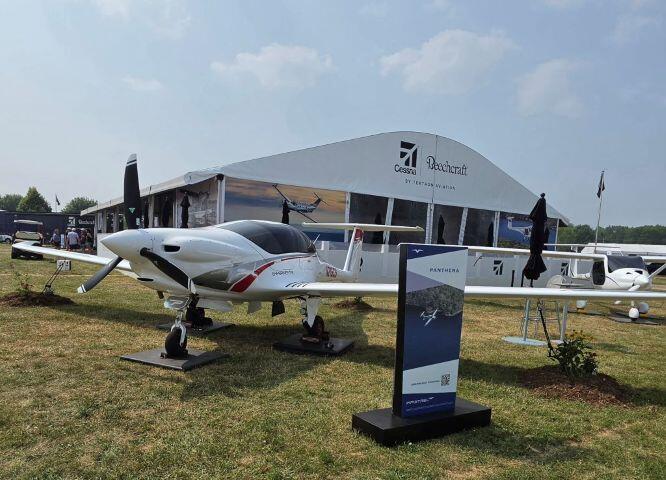
Textron Aviation’s exhibit at EAA AirVenture Oshkosh 2026.
Demand and order backlogs at Textron Aviation remain strong as the Wichita-based manufacturer reports improvements in its workforce and supply chain.
During the second quarter of 2026, Textron Aviation recorded $1.54 billion in revenue, up 1% from a year earlier, as it delivered 40 business jets, compared with 49 a year ago, and 44 commercial turboprops, compared with 34, parent company Textron reported.
The company also delivered 93 piston-engine aircraft during the quarter, including Pipistrel products, compared with 84 a year earlier.
Textron Aviation's backlog at the end of June totaled $8.03 billion, up from $8.00 billion at the end of March and $7.72 billion a year earlier. Higher revenue resulted from increased aftermarket parts and services revenue and higher aircraft pricing, offset by lower aircraft volume and an unfavorable product mix.
Quarterly profit totaled $165 million, down $5 million from the second quarter of 2025, “primarily due to an unfavorable impact from manufacturing inefficiencies and lower aircraft volume and mix, partially offset by lower warranty costs,” the company said.
Looking ahead, Textron Aviation is focusing on three priorities: investing in its workforce, improving factory execution and strengthening its supply chain, CEO Lisa Atherton said. “Customer demand remains very strong,” Atherton said during a presentation with analysts on the company's second-quarter earnings. “Simply put, people want our products, and we have multi-year backlogs in many areas. With that, we must become more efficient at meeting that demand.”
Attrition has improved, aided by the company's investment in its new Career and Learning Center, with turnover and hiring returning to more typical levels, Atherton said. However, the relatively new workforce needs additional time to gain experience across the manufacturing floor. About half of the workforce has fewer than five years of experience, she said. Atherton expects those gains in experience to improve productivity and efficiency in 2027.
Textron Aviation builds 21 or 22 aircraft models, creating manufacturing complexity. If a supplier fails to deliver an engine, spar or hydraulic component, less-experienced employees are less familiar with the workarounds, Atherton said. The company uses the Career and Learning Center to train supervisors.
Textron Aviation is also investing in factory capacity. “We have significantly increased production support as we prioritize engineering resources to improve producibility,” Atherton said. The company is targeting additional capacity in its landing gear, milling and paint operations, as well as production and process improvements on its King Air and light-jet production lines.
Externally, supply chain issues have improved as the company expands dual-sourcing initiatives to strengthen supplier resiliency and improve parts availability, Atherton said, “leaving us with a more finite set of issues. We remain actively engaged with these key suppliers.”

Related Content