This article is published in Air Transport World part of Aviation Week Intelligence Network (AWIN), and is complimentary through Jun 12, 2026. For information on becoming an AWIN Member to access more content like this, click here.
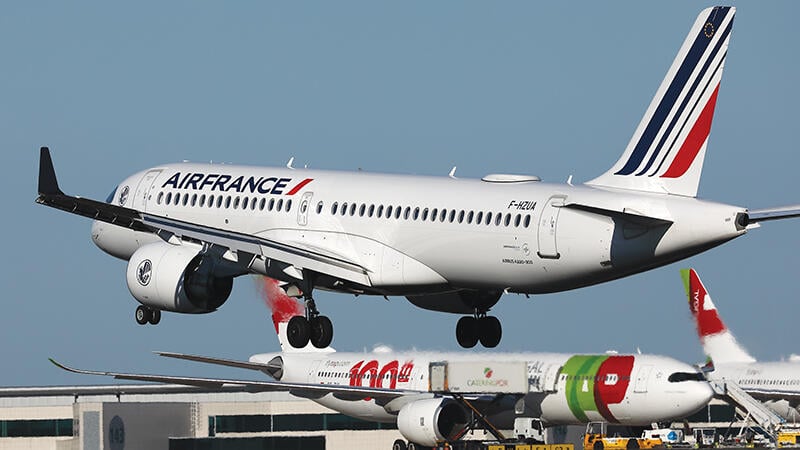
Air France-KLM is one of two major airline groups bidding for a stake in TAP Air Portugal, with Lufthansa Group the other.
For over a decade, Europe’s three major network carrier groups—Air France-KLM Group, International Airlines Group (IAG) and Lufthansa Group—have warned that European Union (EU) red tape was sapping their competitiveness. The question is whether the latest round of airline consolidation, a geopolitical wake-up call and a renewed EU focus on competitiveness will be enough to regain lost ground.
“Once again, we are meeting in interesting times,” Lufthansa Group CEO Carsten Spohr told delegates at the Airlines for Europe (A4E) Summit.
Against a bleak backdrop of the Iran war, Middle East volatility and surging fuel prices, Lufthansa has two key consolidation decisions looming this summer. The first is whether to increase its stake in Italian carrier ITA Airways from 41% to 90%. The second is how far it will go in the race to acquire 44.9% of TAP Air Portugal.
In early April, Lufthansa and Air France-KLM both submitted non-binding offers for TAP, which is pegged as one of Europe’s last great consolidation prizes. Later that month, the Portuguese government asked Air France-KLM and Lufthansa Group to submit binding bids as the planned privatization process of the carrier moved forward.
Air France-KLM and Lufthansa Group were already the only two in the running for a TAP stake, with bidding set at 44.9% for now, with another 5% reserved for TAP employees, and both groups quickly confirmed their enthusiasm.
The one major holdout was British Airways parent company International Airlines Group (IAG), which bowed out of the race earlier, prioritizing organic growth instead. “We need a route to full ownership in order to be able to manage and transform the business,” IAG said.
The lack of a path to full ownership of TAP has not deterred Air France-KLM and Lufthansa. Spohr has previously talked about the “great strategic importance” of TAP, which accounts for 24% of all Europe-Brazil capacity. For context, the next strongest European player is Air France at around 9%.
If Lufthansa were to secure TAP, it would build on ITA’s Latin American network and be a key defensive win for the Star Alliance. This matters because the alliance scoreboard in Europe is currently in a 1:1 deadlock, after ITA Airways and Scandinavian Airlines (SAS) swapped alliances to join their equity partners, with ITA moving to Star and SAS defecting to SkyTeam.
Air France-KLM is also keen to use TAP’s Lisbon home base as a Southern European hub, and will likely look to bring TAP into SkyTeam. “TAP is a natural fit within Air France-KLM’s multi-hub strategy,” Air France-KLM CEO Ben Smith said. One way or another, TAP’s future will be decided this year, if political will for the deal continues.
Beyond the TAP bid, Air France-KLM and Lufthansa each have significant consolidation projects this year. Air France-KLM is seeking EU regulatory clearance to increase its 19.9% SAS stake to 60.5%, with further movement expected in the second half of the year, and Lufthansa has two key ITA Airways milestones coming up.
As part of the January 2025 ITA deal, Lufthansa has the option to increase its 41% stake to 90% in June 2025, June 2026 or June 2027, followed by the final 10% in 2033. This option was not taken in 2025, but Lufthansa is seeking US Department of Justice clearance for sole control of ITA, ahead of this June’s decision.
Lufthansa is also working on US approval for ITA to join the Star Alliance A++ transatlantic joint venture between Lufthansa, United Airlines and Air Canada. For now, Lufthansa and ITA must act as competitors on the North Atlantic.
OIL CURVE BALL
However, all bets for 2026 were thrown off course in late February by the outbreak of the war in Iran, causing European airlines to revisit their short- to mid-term strategy. With the closure of the strategically important Strait of Hormuz, through which a fifth of the world’s oil and liquified gas sails, fuel prices have surged and there are also concerns about availability of jet fuel at some airports. At the start of the war, drone and missile attacks closed and disrupted operations at multiple Gulf airports. As of late March, Abu Dhabi, Dubai, Doha and Bahrain airports were among those targeted.
Spohr said the subsequent breakdown in Middle East connectivity was a “wake up call” for politicians and passengers, highlighting how many non-stop flights have been lost over the years between Europe and Southeast Asia. “I met a very senior person yesterday who said, ‘I need to go to Manila, and I realized I cannot get to Manila with any European carrier.’ We used to fly to Manila, Air France used to fly to Manila. It’s been cut off,” Spohr said.
Lufthansa used to fly direct to a double-digit number of destinations in Southeast Asia, but Spohr said Gulf competition made direct flights unviable, slimming those double-digit routes to just Singapore and Bangkok. In October, Kuala Lumpur will become Lufthansa’s first new Southeast Asia destination in more than 10 years.
“It’s Southeast Asia only. In Japan, we are strong. South Korea, we are strong. India is our number two market behind the US,” Spohr said. “It’s not about Asia, it’s about Southeast Asia, where—in our case—we are down to two [routes].”
Lufthansa responded by shifting its focus west, towards Canada, North and Latin America. This loops back to the strategic significance of TAP.
“It’s not that we [the large airline groups] are going to go bankrupt because of this,” Spohr said, “but we’re cutting off the eastern part of the globe. We’re cutting off the southern hemisphere, to a certain degree, which is going to be the fastest growing part of the globe for European markets, European consumers, European goods.”
LOSING SOVEREIGNTY
In the immediate aftermath of the Iran tensions, Lufthansa added 40 direct Asian frequencies, which were filled within days. “I think people are realizing we are losing sovereignty,” Spohr said. “The Americans would never allow dependence on others to be connected.”
Spohr accepts that Europe has different labor conditions compared with other parts of the world, but he said EU policy exacerbated this disadvantage. Regulatory costs among A4E members have risen at three times the pace of passenger growth over the past 10 years. Spohr sees this as “crazy” and “dangerous,” given the geopolitical environment and the role Europe wants to play over the coming decades.
“We have shifted traffic to hubs and airlines outside of Europe,” he said. “For 20 years, I’ve only been seeing things going one way, decreasing the competitiveness of Europe. Now people are starting to understand that they have reached the limits.”
Air France-KLM Group CEO Ben Smith is seeing a similar pattern. “600 [Gulf carrier] airplanes on the ground, and 100 of them that normally were going in and out of Europe,” Smith said. “Europe is dependent on Middle East/Gulf capacity. And this is a real wake up call, I believe, for Europe.”
Like Spohr, Smith sees European airlines being “weakened” by EU policy and the expensive operating environment. Combined with Gulf competition, this has led to a 7% drop in long-haul market share among European airlines since 2022.
“This is where I think consolidation is extremely important, because we need to be more competitive against the carriers outside of Europe,” Smith said. “Europe is too dependent, especially going eastbound.”
Since the Iran conflict broke out, Air France-KLM has also been adding capacity on existing Asian and African routes. “We would like to be able to do this year-round, irrespective of a crisis,” Smith said. “It’s just a recapture of customers that we believe should have been flying with Asian or European carriers on a non-stop basis.”
But the sharp increase in jet fuel costs and supply constraints could limit European airlines’ ability to keep adding Asian capacity. In April, Lufthansa advanced plans to close its regional affiliate, CityLine, and cancelled 120 daily departures that were loss-making or generating little revenue.
IAG CEO Luis Gallego said he was seeing “a different mood in Europe,” driven by fears over security and competitiveness. He highlighted the financial impact of EU passenger rights rules, sustainability measures, such as the EU emissions trading system (EU ETS), and sustainable aviation fuel (SAF) mandates, as well as high airport charges, steep taxes, inefficient air traffic management and air traffic control labor strikes. “At the end [of this], we are not competitive, and that’s the reason we cannot add more flights to other destinations,” Gallego said.
NEW EU AVIATION STRATEGY
Following the release of the 2025 Draghi report, slamming European competitiveness, the EU knows it needs to change.
“Global competition is intensifying,” EU commissioner for sustainable transport and tourism Apostolos Tzitzikostas said. “Other regions are investing heavily in the sector, expanding infrastructure, supporting their carriers and industries, and positioning themselves as global hubs. And, at the same time, European airlines operate under a more demanding regulatory framework and face higher structural costs. This combination risks weakening their position on international routes and undermining the competitiveness of our hubs.”
Tzitzikostas promised this would be addressed in the new EU aviation strategy, scheduled to be released this fall. “If we do not respond, the consequences are very clear,” Tzitzikostas said. “Traffic congestion, reduced connectivity, gradual erosion of Europe’s global position; we will not allow this to happen. So let me be very clear. Our mission is not to simply defend Europe’s leadership in aviation. It is to reinforce it. And to future-proof it.”
According to IATA director general Willie Walsh, 162 European airlines were launched over the past 10 years and 151 failed. In 2025, six airlines started up, but 12 failed. The problem is not the Gulf carriers, Walsh said. The problem, in his view, is that Europe has suppressed aviation, causing the “center of gravity” to move east, leaving European airlines fighting to maintain their positions.
“I strongly disagree with the [EU] Commissioner. There is no level playing field. There never has been a level playing field. There never will be a level playing field,” Walsh said. “What I hear coming from Europe is ‘we’ve made ourselves less efficient, and therefore the world must make itself less efficient.’ And the world is laughing. That’s not going to happen.”