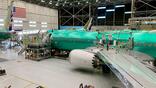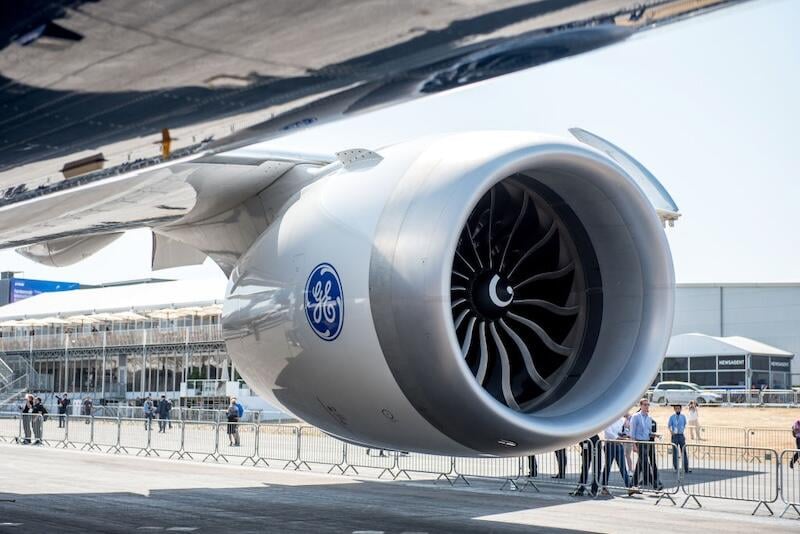
GE9X engine on a Boeing 777X.
GE Aerospace’s 8% third-quarter increase in engine deliveries included bumps in GEnx and GE9X handovers to support Boeing’s efforts to ramp up output on its two cornerstone widebody programs.
The engine manufacturer provided “more than 50” GEnx engines for 787s during the September quarter, GE Aerospace CFO Rahul Ghai said on an Oct. 20 earnings call. Unit deliveries increased each month during the quarter.
“Clearly [there is] more work to do here to stabilize at the rates that we achieved in September, along with the broader supply chain, for what Boeing needs to do in the future,” Ghai said.
Boeing is ramping up production of 787s—most of which are powered by GEnx engines—to 10 per month. Its year-to-date average through September was seven aircraft per month.
Back in May, Boeing CEO Kelly Ortberg pointed to fewer than expected engine deliveries as one source of reduced output in the first quarter. “We’ll need to see the engine recovery plan come to fruition before we can get to rate 10, and that’ll be late in the year,” Ortberg said at the time.
GE executives insist they have answered the bell.
“Boeing has more than 30 shipsets off/on wing, and the number of engines in Boeing inventory has grown over the last few months as the engine deliveries have outpaced the aircraft deliveries,” Ghai said. “We are confident we will continue to grow this and help Boeing get to rate 10 along with the rest of the supply chain here.”
On the 777-9, GE continues to deliver engines with the upgraded mid-seal as it pursues FAA approval on the change.
“I think that is just the ultimate proof point with respect to our confidence that we have begun not only production but also deliveries,” CEO Larry Culp said. “We continue to deliver engines to Boeing with the upgraded mid-seal and are working to achieve FAA certification by the end of 2026.”
“However, given the expected certification timing, we have assumed fewer units in the year,” he added.
Certifying the production-variant engine is one of the few major milestones left in the 777-9’s FAA certification program.
Topping Boeing’s to-do list is earning extended overseas operations (ETOPS) approval via a series of test flights.
Meanwhile, deliveries of CFM International Leap-1A and Leap-1B engines to Airbus and Boeing, respectively, continue apace to support ramp-ups on the A320neo and 737 MAX production lines. GE boosted Leap deliveries by 26% year over year, Culp said.
GE grew Commercial Engines & Services (CE&S) original equipment sales 38% last quarter, while aftermarket revenue rose 17%.
Maintenance, repair and overhaul (MRO) demand remains steady across the board among narrowbodies and widebodies as well as current-generation and legacy platforms.
“The overall demand for widebody shop visits remains really strong,” Ghai said. “The work scopes ... continue to grow as well, especially on the GE90 as they’re transitioning from first to second shop visit, which is to be expected, just given the fact that 70% of the GE90 fleet has not seen a second shop visit.”
CFM56 demand continues to support a projected 2,400 shop visits in 2027, continuing a peak plateau that has seen more overhauls than GE and CFM joint-venture partner Safran expected not long ago.
Work scopes also remain steady. “A lot of what we are seeing ... is driven by life-limited parts, which need to get replaced at this point in their life cycle,” Ghai said. “Given a lack of used material in the market, just given lower retirement [rates], we’re not seeing any change to CFM56 work scopes either.”
The strong quarter and outlook led GE to boost its full-year guidance, with total revenues now projected to grow 19-20%, up from the high teens previously. Its CE&S unit will be up in the low 20% range, the company said.
GE posted adjusted revenue of $13.3 billion, up 18% year over year. Its adjusted earnings per share of $2.3 billion were up 36%.

Related Content