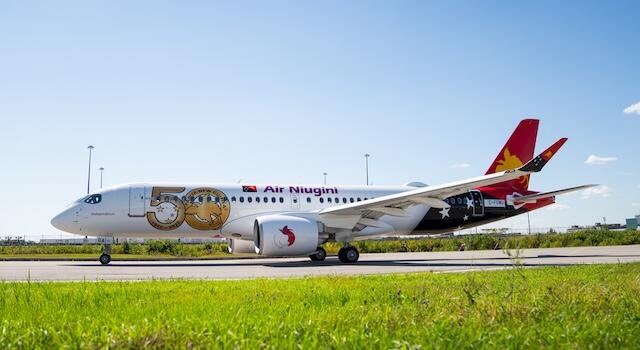
Air Niugini has marked the first stage in a major re-fleeting exercise with the inaugural service of its first Airbus A220-300.
The Papua New Guinea flag-carrier is buying eight A220-100s from Airbus and will lease three examples of the larger A220-300 model from Azorra.
The second and third aircraft are scheduled to arrive by the end of 2025, with the entire new fleet in service by 2028. In Air Niugini service, the A220s will replace the carrier’s nine long-serving Fokker 70 and 100s.
The inaugural flight, on October 4, departed Jacksons Airport in the country’s capital, Port Moresby, for Lae, recreating the airline’s first flight in November 1973, which used a Douglas DC-3. The Port Moresby – Lae sector is one of Air Niugini’s busiest and profitable routes, the airline said.
The A220 returned to Port Moresby before later operating a round trip to Kavieng. Air Niugini intends that the new A220-300s will serve domestic destinations during the day, then switch to shorter international sectors at night, for example, supplementing the airline’s two Boeing 767-300s on services to Singapore.
“This is a proud moment not only for Air Niugini but for the entire country,” deputy prime minister and member of parliament for Lae, John Rosso, said as the first flight departed. “The Marape-Rosso Government remains committed to improving essential services for our people—including air services that connect our communities, support business, and promote national unity.”
Minister for state-owned enterprises, William Duma, noted that the country’s government has pledged K3 billion ($715 million) investment for Air Niugini’s fleet renewal program.
The airline currently operates a mixed fleet comprising three Boeing 737-800s, two 767-300ERs, five Fokker 100s, four Fokker 70s, and 10 De Havilland Canada Dash 8s, according to the CAPA fleet database.
Air Niugini has described the A220 as a game-changer for the company’s domestic and regional operations, particularly with respect to its fuel efficiency and capability to operate on shorter runways. The latter virtue makes it well-suited to Papua New Guinea’s challenging terrain and weather conditions. Its range also makes it suitable not only for domestic operations, but international flights.
The introduction of the A220 fleet will allow the airline to gradually phase out its aging Fokker aircraft, improving operational efficiency while reducing emissions. The company says that the new small narrowbody jets will also replace the leased Boeing 737-800s.

Related Content