This article is published in Aviation Week & Space Technology and is free to read until May 20, 2026. If you want to read more articles from this publication, please click the link to subscribe.
The Aerospace Maintenance Competition has grown so large that it is now planning international expansion.
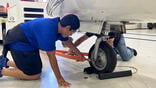
Those who have roamed the show floor at Aviation Week’s MRO Americas event are familiar with its massive scale: Last year’s show comprised 1,000 exhibitors and 17,000 attendees from nearly 100 countries. In one corner of the exhibit hall, the energy, noise and excitement are palpable—this is where teams from across the globe are competing live in what is colloquially known as the MRO Olympics.
The Aerospace Maintenance Competition (AMC) was formally incorporated with MRO Americas in 2016. That year in Dallas, 51 global teams from airlines, MROs, aviation maintenance technician (AMT) schools and branches of the military competed in 24 events to prove their technical skills.
This year, 90 teams will compete at the AMC in Orlando, Florida, in 29 maintenance events—the most the competition has ever featured. The AMC sold out within two weeks, and as of March, there was a double-digit waitlist of teams hoping to compete. Crystal Maguire, vice president of operations at the Aerospace Maintenance Council, which runs the AMC, says one of the biggest milestones for the event was when the organizers realized it had reached maximum capacity.
“We got to a point where [we had to start turning people away because] we only have this much time and this much space,” she tells Inside MRO. “[We] put together a schedule where we maxed out every minute . . . because if we stop and take a break or let people catch their breath, we go past closing time of the floor.”
The AMC has grown so large that it has begun hosting a second competition at Verticon. Next year, organizers plan to expand to Aviation Week’s MRO Asia-Pacific; they are seeking sponsors now to help launch that international expansion.
Ken MacTiernan, vice president of the Aerospace Maintenance Council, recalls some standout stories from his time with the AMC.
“The first year, I was able to get the U.S. Army to come—they were [Boeing AH-64] Apache mechanics,” he says. The team had such a good experience that they wanted to participate again the following year, but their command had changed, and they were told the Army was not willing to spend money to fly them out for the AMC. MacTiernan put the mechanics in touch with Southwest Airlines to cover the cost of their flights, and the team took vacation time and paid for their own hotel stay.
At that point, their command started to wonder how it would come across if the team actually won without U.S. Army support, “so they called the guys back and said, ‘We changed our minds,’” MacTiernan says. “ ‘If you want to go, we’ll pay the way, and you can go as the [U.S.] Army.’” The team said: “‘Thanks, but no thanks. We’ve already got everything arranged, and we’re going as Team Apache.’ ”
Another year, United Airlines’ vice president of maintenance was so impressed by the performance of Yolanda Gong, then a student competitor for West Los Angeles College, that he stopped midconversation with Aerospace Maintenance Council President John Goglia, turned to a colleague, pointed to Gong and said, “Hire her,” MacTiernan recalls. Gong, who is now a United Airlines AMT, later returned to the AMC as a member of the airline’s all-women team, Chix Fix.
MacTiernan says the AMC has received ongoing support from such companies as Southwest Airlines, Snap-on and American Airlines since the beginning. For instance, American Airlines sponsors student teams and provides 2.7 million miles to AMT schools to fly student competitors to the competition venue. All three companies have employees on the Aerospace Maintenance Council board, and they sponsor events at the competition.
THE AIRLINE PERSPECTIVE
The intent for American Airlines is not just to serve the company’s needs, but to promote the greater MRO industry, says Mark Miner, vice president of technical services. “Certainly, we all have a vested interest in it being an important part of the pipeline for talent, but we also want to do that as good stewards in the industry as a whole, so [we are] working closely with the other folks on the council to make sure that we set the competition up to be fair, but also get a great cross-section of the different aviation schools and entities in the competition,” he says.
This year, American is sponsoring two events: one in which competitors will troubleshoot the electrical harness of an inoperable logo light, and another in which they will remove and replace a McDonnell Douglas MD-80 auxiliary power unit combustion chamber O-ring packing.
The airline is also sponsoring student teams from the Pittsburgh Institute of Aeronautics, Tulsa Tech and West Los Angeles College. Miner says sponsored student teams have the opportunity to prepare for the competition by working with American’s own AMC teams, and standout students from all schools at the AMC are able to interview with the airline once they complete their airframe and powerplant certification.
One big benefit of the competition is that it brings industry peers together and provides “the opportunity to meet the emerging talent across all the different schools . . . to see what their strengths are but also provide feedback to them,” Miner says. “A lot of times, we’ll host events just for those team members to come and meet the American leadership team and ask questions about what it’s like to work at American and what the opportunities are across our system, regardless of [geographic location].”
American is also working to prepare its own AMC teams to perform well in the competition. In previous years, the airline sent “many more teams,” Miner says, but due to the AMC’s high demand and space constraints, it now sends two teams focused on line and base maintenance.
Tim Sills, technical crew chief of American’s maintenance base in Tulsa, Oklahoma, is the team’s coach. He has been with the airline for more than 41 years, competed on an American team that took second place in the AMC in 2010 and has been an AMC team leader for the airline for the last decade.
The first year he led one of American’s AMC teams, Sills says he handpicked competitors to create a team that took second place out of 87 teams by a mere 92 sec. With openings now narrowed to two teams, the process has become very competitive. A questionnaire is sent out to the airline’s entire TechOps staff, and applications are reviewed by a group of five experts. This year, they received more than 150 applications for 16 team slots, Sills says.
One of the selected competitors this year for American’s line maintenance team is Albert Padilla, Jr., who works as a technical crew chief at the airline’s Houston base. It will be his second year participating in the competition, and after his team finished 13th last year, he says he is very motivated to win. “There’s a lot of undue stress that we want to unwind this year and do way better than we did last year,” he says.
Padilla has his sights set on leaving United Airlines’ teams in the dust, particularly since this year is American’s centennial. United’s Render Safe event, which involves the removal and installation of a Boeing 767-322 L1/R1 door escape slide pack, was “probably one of the most contentious events of 2025,” Padilla says. “A lot of teams had difficulty with the event, so there’s a lot of focus on that. Our goal is to beat the United team at their own event.”
American’s teams began practicing in January. They will have a total of nine training weekends ahead of the AMC, which typically entail flying to Tulsa on a Friday night and staying to practice for four days. Padilla says the line maintenance team has adopted a system in which two people familiarize themselves with a two-person event and other team members observe and provide tips and tricks.
“We’re bringing both teams and getting feedback on both sides, so it’s a little bit competitive, but it’s also refining the process and really standardizing our methods,” he says. Padilla notes that American’s team members are specializing in particular events, and each competitor will be responsible for around six events. The teams also have alternates in case a competitor must bow out.
Beyond seeing American’s own teams performing well, Sills says one of the best parts about the AMC is seeing student competitors succeed—and sometimes even beat experienced AMTs. He notes that, because the Aerospace Maintenance Council is a nonprofit, the money it raises goes toward funding scholarships for students who might struggle to pay for licensing or tools. “In my case, that’s the future that’s going to replace me when I leave here,” he says. “I think a lot of people don’t understand the [objective of the] AMC itself . . . is to help promote the students and the younger generation of the industry and help them out any way they can.”
AMC NEWCOMER
In just its second year competing in the AMC, Epic Flight Academy is sending two student teams from its campuses at Cincinnati/Northern Kentucky International Airport (CVG) and New Smyrna Beach Airport (EVB) in Florida. Epic opened its first aircraft mechanic school in late 2020 at EVB, and its CVG location opened in 2024.
Mike Azarian graduated from the first class of Epic’s aircraft mechanic program in 2023. After working a few years at JetBlue Airways, he returned to the school to become an instructor. As an AMC coach, he brought Epic’s first team to the competition last year; it placed sixth overall out of more than 41 student teams.
This year, Azarian is coaching the EVB team and hoping to build on the good performance in 2025. “I’d like the team to perform as well as they did last year,” he says. “That’s definitely the goal. But I’m excited to experience it with another group of people that I didn’t get to go with last year. It’s going to be a whole different experience, and I expect that they’re going to have as much fun, the excitement is going to grow in our school, and we can get a larger group to participate next year.”
By the end of its practice period, Epic’s EVB team will have narrowed a group of 22 students down to six competitors. Azarian says the team includes students with a range of experience, including some engineers, former military members and a commercially rated pilot.
“I always tell the people when they come and try out [that] I don’t pick [based on] seniority,” Azarian says. I pick [based on] ability to understand process and performance, . . . dedication [and] team participation. They’ve got to work well with each other. I keep an open mind. As soon as anybody says they want to participate, it’s what they make of it.”
The team holds 2-hr. practices twice a week and is building its own training equipment to mimic AMC events. When Azarian spoke with Inside MRO, the EVB team had built about 12 trainers to use for practice. Competitors have also met with last year’s team to walk through events, and the EVB team is brainstorming and collaborating with the all-women CVG team.
Rather than having competitors specialize in specific events, Azarian says he wants team members to be well-rounded “because we don’t really know our team number or what the order of the events is going to be until a couple of days before the competition occurs.”
For instance, Epic’s team number changed the day before the AMC last year, “so we had to switch everything around again,” Azarian says. “You never know what’s going to happen. It’s aviation. You can go in with one mindset and come across a whole different discrepancy, a problem that you never anticipated happening, so this event’s no different than going out to the flight line and working on the aircraft.”
While Azarian wants students to be prepared for anything, he also wants the experience to be positive. “I tell them, ‘Don’t get frustrated, don’t get upset,’ when they’re there to have fun,” he says.
Epic’s teams are not currently sponsored by any airlines. “We’re just doing it on our own,” Azarian says. “We get investors [that will provide a] certain amount of money, and then we put the logo on the back of our shirt. Fortunately, this year, [the AMC] is only an hour away from our campus. Last year, we had to go to Atlanta, so the expenses will be a little bit less demanding this year.”