This article is published in Aviation Week & Space Technology and is free to read until May 16, 2026. If you want to read more articles from this publication, please click the link to subscribe.

Intensified Labor Competition Drives New MRO Workforce Strategies
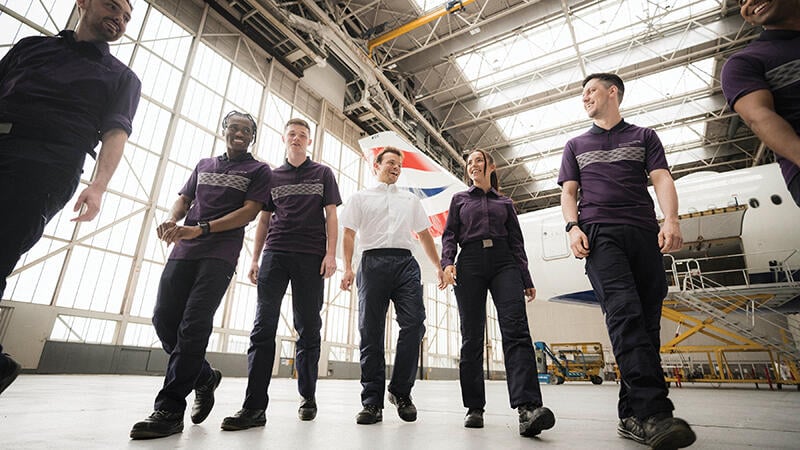
British Airways MRO trainees

International recruiting and educational partnerships are increasing as MRO providers compete for qualified talent.

Credit: British Airways

MRO providers are increasing capacity to meet growing maintenance demand, but despite efficiencies achieved through technology adoption, they still require higher head counts to complete more work.

Many aftermarket specialists are expanding their staffs. For example:

  • AAR Corp. is adding 200 more workers to support Boeing 737 heavy checks for Alaska Airlines in Oklahoma City.
  • AFI KLM E&M plans to recruit more than 1,000 permanent employees by the end of 2027.
  • Aeroman is adding 16 maintenance lines, which it says will require an additional 1,500 workers.
  • Joramco plans to double in size by the end of 2028, and it has doubled the size of its Joramco Academy training arm to about 350 students to prepare.

In addition, in the face of the MRO industry’s talent shortage, aftermarket companies are reevaluating previously tried and tested methods of recruiting, training and retaining workforce in favor of newer, more innovative approaches to put new workers on the hangar floor more quickly—and entice them to stay once they are there.

According to Mike Reporto, group president at Launch Technical Workforce Solutions, one new approach is a shift to skill-based hiring from experience-based hiring. Instead of focusing on how many years of experience a candidate has during the hiring process, companies prioritize testing of aptitude and technical abilities.

“It’s good for the mechanics, because they’re testing in the higher levels, which typically generates a higher pay rate, where it [was previously] always tenure-based,” Reporto says. “You would get a raise after you work a period of time. So we’re seeing mechanics come out of school with higher-paying opportunities.”

Pay itself is a factor that is starting to change as competition intensifies for qualified talent. “Like any market where something is in demand, it can then start dictating its price and conditions,” says William Finden, CEO at aviation and aerospace recruiting firm Oaklands Global.

“For a long time, in my opinion, [aviation maintenance engineers] were underpaid versus the value they add and the skills, experience and qualifications they need,” he says. “Now, it’s kind of turned on its head, and engineers are going: ‘I know what I’m worth. I know I’m in demand, and therefore, I’m going to take my pick of opportunities.’”

Finden says this has resulted in companies such as Oaklands pro-actively headhunting candidates and presenting them with the best opportunities, which include not just pay, but also benefits, shift patterns, aircraft types and company reputation. “It’s much more of an executive-search-style methodology now than it ever used to be,” he adds.

Airlines have historically been able to offer the highest pay to aviation maintenance technicians (AMT), creating steep competition for third-party MROs. Now, Finden says, the expectation of higher pay across the board is creating further pressure for MROs.

“What they’ve seen over the last 12-36 months is that their profit margins have been diminished because the airlines don’t want to pay more for the maintenance, but the engineers need more money,” he says. “If [engineers] don’t get more money, they’re going. So either [MROs are] kind of defaulting on contracts or walking away from contracts with airlines, or they’re having to pay their engineers more. Unless the airlines are accepting that and negotiating higher costs to go to the engineers, I think that we’re going to see more MROs really struggle.”

To deal with this conundrum, some MROs are developing more flexible benefits focused on shift flexibility, work-life balance, training and advancement pathways to entice workers. Finden and Reporto both cite examples of companies offering different shift patterns to accommodate different lifestyles, such as offering four 10-hr. shifts in a week or having employees work seven days on and seven days off.

“A few years ago, if you joined an airline, you knew you were going to the third shift overnight,” Reporto says. “That was always a turnoff, and that was always the feedback you would get, especially from new students. You’re starting to see customers become more accommodating to that younger workforce.”

INVESTMENT IN TRAINING

While higher wages and more flexible work schedules might be enough to get a new AMT in the door, aftermarket companies are increasingly recognizing the value of providing development opportunities that will keep them there in the long term.

Aviation Institute of Maintenance
Safran has partnered with the Aviation Institute of Maintenance to grow<\/p>its talent pipeline. Credit: Safran

“One of the big things that I have seen from premier MROs is they’re . . . sharing clear advancement pathways for their employees so they know how they can progress, not just in terms of wage, but in terms of title,” Reporto says. He adds that companies are becoming more willing to invest in employee training, ranging from helping AMTs get their licensing and general familiarization training—which is often expensive—to offering leadership and supervisor training that paves the way for climbing the corporate ladder.

In the U.S., Safran has seen competition grow as experienced MRO staff continue to retire, and so it has turned more of its attention to staff development programs.

“Younger generations are looking closely at career development opportunities, workplace culture and long-term stability when choosing employers,” says Stephanie Hanes, director of talent at Safran USA. “These dynamics have reinforced the importance of building stronger and earlier talent pipelines.” The company has built a global network of more than 80 industrial schools that offer immersive, hands-on training, both at Safran sites and at partner training centers.

Safran’s mentorship program has begun focusing on developing employee soft skills, and it recently launched a management development program tailored for its North American talent. The company is also working on a new emerging leaders development program for the region to foster employee progression.

At FL Technics, the approach from the beginning focuses on long-term career development and clear growth opportunities, according to Juozas Lapeika, deputy CEO for base maintenance. “We actively invest in continuous learning and skill development, helping our team members become fully licensed aviation professionals,” he says. “This structured support, combined with full Part 66 and type trainings, motivates young people who value visible career progression and professional growth.”

While MROs such as FL Technics “dedicate significant resources” to training and career development programs, “some competitors prefer to attract already-trained specialists from other organizations instead of building their own talent pipelines,” Lapeika says. “This approach creates an imbalance in the industry, where a few companies carry the responsibility and cost of workforce development, while others benefit from ready--made professionals.

Aims Community College
Aims Community College’s recently launched AMT program partners with Frontier Airlines. Credit: Aims Community College

“However, we are encouraged to see that clients (airlines) are recognizing the importance of sustainable talent development,” he continues. “Responsible airlines increasingly include requirements in their tenders that MRO providers must operate in-house training academies. We believe this is a positive shift for the entire aviation maintenance ecosystem. In the long term, such standards will help create a stronger, more skilled and self--sufficient workforce across the industry.”

Like FL Technics, Joramco is investing significantly in its own training programs. The Jordanian MRO recently graduated the first cohort of students from its Structured On-the-Job Training program, which provides European Union Aviation Safety Agency type ratings for various aircraft.

“We are now one of the—if not the only—airframe MROs in the region that’s doing specific on-the-job training,” Fraser Currie, chief strategy and commercial officer at Joramco parent company DAE Engineering, said during Aviation Week’s MRO Middle East conference in February. “We’re bringing talent in from other companies. Sometimes it’s a company sending people; sometimes it’s an individual . . . because some companies are finding that they have the talent, but the talent isn’t getting enough exposure to all the tasks they need to complete the logbook to move on in their career.”

Joramco has also partnered with the University of Jordan to begin offering a bachelor’s degree program in aeronautical engineering and maintenance, and it recently signed a memorandum of understanding with the College of Advanced Vocational Training in Jordan to develop a training program in carbon-fiber composite technology.

These types of corporate-academic partnerships are becoming increasingly common as aftermarket companies seek to develop workforce pipelines. Most MROs have established some level of collaboration with technical schools near where they operate, but now these partnerships are starting to go international.

INTERNATIONAL COLLABORATION

In January, another Middle Eastern MRO, Saudia Technic, began a partnership with a U.S. school to prepare young people for careers in MRO. Saudia Technic sent 40 young men and women to Tulsa, Oklahoma, to study under Spartan College of Aeronautics and Technology’s FAA Part 147 AMT program. The program is part of Saudi Arabia’s Vision 2030 initiative to invest billions in the country’s aviation ecosystem, and it is utilizing the Education Ministry’s Wa’ed Scholarship Program that allows Saudi students to study abroad.

Last year, Korea Aerospace University established a similar partnership with U.S. Aviation Academy, which is based in the Dallas-Fort Worth area. The partnership established a one-year program under which South Korean students spend six months training in their country before traveling to U.S. Aviation Academy to complete six months of practical training.

Companies are also looking at ways to attract talent from abroad. Hong Kong and Japan have recently approved visa programs aimed at alleviating skill shortages in sectors such as MRO, allowing qualified AMTs to work at companies in both countries.

British Airways invested $2 million in a new workforce initiative in late 2024 that enrolls students from select Aviation Institute of Maintenance (AIM) campuses in a five-year training program that provides direct pathways to careers at the airline. Cadets will undergo onboarding at British Airways’ London Heathrow Airport base and three years of training in the UK before eventually moving on to jobs at some of the airline’s U.S. stations.

AIM also has a long-standing training partnership with Saudia Technic, and has now trained more than 100 of the company’s technicians to take FAA examinations. Launch’s Reporto, who is on AIM’s Advisory Board, notes that the school is focusing on ways to help technicians from other countries, such as Mexico, become qualified by the FAA to work in the U.S.

“What we’re starting to see is the schools trying to figure out, ‘How do I partner with an MRO? How do I partner with a Launch to create value, to help these people, once they come to the U.S., capitalize on their experience and get them immediately tested for their [FAA airframe and powerplant licenses], so that they can plug in and sign off on work?’” he says.

In this vein, Reporto notes that Launch recently piloted an aviation-specific, 13-week English as a Second Language course “that’s been an absolute game changer for us.”

Aviation Education Hangar
Butler Tech recently opened a $15 million Aviation Education Hangar at Middletown Regional Airport outside Cincinnati. Credit: Butler Tech

AIM is working with companies such as Safran as well. “Our partnership with the Aviation Institute of Maintenance is helping to build a robust talent pipeline,” Hanes says. “Through this collaboration, Safran supports student scholarships, participates in employer spotlight events and increases aerospace career awareness by incorporating Safran branding within AIM classrooms. Additionally, our Safran Helicopter Engines team has hosted campus site tours and conducted on-site interviews, leading to job offers for several students.”

GROWING SCHOOL PROGRAMS

While AIM is a well-established academic institution in the U.S. MRO sector, it is certainly not the only player growing its workforce pipeline. In the past couple of years, some Part 147 schools have opened new, expanded facilities, and other programs have sprung up across the country. These seek to meet MRO workforce pipeline needs in underserved areas, alleviate strained capacity in regions where established schools have long waitlists and provide earlier career pathways for high school students.

Last year, Hawaiian Airlines partnered with the Pearl Harbor Aviation Museum and Honolulu Community College to launch two new MRO--focused training programs in Hawaii. Aims Community College in Colorado opened a new AMT program in January, and St. Cloud Technical and Community College in Minnesota plans to launch an AMT program this fall.

In the Chicago suburbs, Harper College will soon open a new AMT program once FAA approval is finalized. Chicago’s Olive-Harvey College recently partnered with the nonprofit AeroStar Avion Institute to create a one-year pipeline program in which students can prepare for the FAA General Exam. Wichita’s WSU Tech will open a $45 million expansion to its National Center for Aviation Training next year, and Ohio’s Butler Tech, which offers a high school vocational training program, opened a new Aviation Center in February.

At Aims Community College, the new program is intended to build a larger talent pipeline, “given that the landscape in northern Colorado only had one or two current AMT programs producing way fewer technicians than were desperately needed,” says Michael Sasso, the school’s chief of aircraft maintenance.

The college has invested more than $20 million in a new 60,000-ft.2 Aircraft Maintenance Training Center at Northern Colorado Regional Airport, including the acquisition of seven aircraft and other training and test equipment. Although Spartan College has a campus in nearby Broomfield, Sasso says Spartan was at capacity with about 300 students, so Aims had “a pretty easy time filling the initial slots,” starting with 40 students in the first cohort. Aims plans to add 75 more students each semester throughout 2026-27.

From the start, Sasso says, Aims’ AMT program sought an industry partner to provide a career pathway program for students, which it found in Frontier Airlines. The program will select 5-10 students each semester who will train to qualify for positions with the airline—an opportunity that also includes a $25,000 signing bonus in exchange for a minimum three-year employment commitment.

“For an in-state student who invests roughly $42,000 in this program, that $25,000 bonus can pay back more than half of what they invested in their education,” Sasso says. “If you start to add in things like scholarships and grants, it leads a student to almost be debt-free when they walk out the door here.”

Spartan College students
International school collaborations are providing opportunities for students from abroad to prepare for FAA certification in the U.S. Credit: Spartan College of Aeronautics and Technology 

Sasso hopes Aims can secure other industry partners to provide more career opportunities for students. For instance, he notes that rumored expansions of both Southwest Airlines and United Airlines in the Denver area could lead to more airline partners for the school.

Aims is also ramping up three high school-focused Choose Aerospace programs in the area to help feed enrollment. The first is slated to start in the fall, and two more are expected to launch in 2027 at local high schools.

One Ohio high school AMT program seeing growing success is Butler Tech. The school first launched its aviation program for high school students in 2019, and last year it invested $15 million in its new Aviation Education Hangar, which opened at Middletown Regional Airport in February.

Students can now enroll in the three-year program in 10th grade, when they take classes focused on the fundamentals of flight, aviation maintenance and engineering, and aircraft systems and design. After their first year, students choose a focus area and begin preparing for FAA written tests, the cost of which the school covers. Butler Tech offers pilot and maintenance pathway programs now, and it plans to add an engineering pathway next year.

Adam Snoddy, principal of the Butler Tech Aviation Center, says extremely high demand for the program drove the expansion, and it continues to grow enrollment. “We’re 75 students at this point, with 25 per grade level, and we expect to essentially double that number over the next 2-3 years as our current groups graduate,” he says.

Ohio is home to many high school MRO training programs, fueled by the state’s prominent aerospace and defense industry and its culture as the historic birthplace of aviation. “I think the state of Ohio has done a pretty good job, especially in recent years, of recognizing that career tech programming in general is a very valuable source of education for a lot of kids who might very well be capable of going to college but might not have the interest in doing so,” Snoddy says. “They would rather do something with their hands, get into the workforce sooner, things like that.

“By pushing programming like this into the high school level, students can be more skilled and certified before they graduate, which means they’re completing things that, if they did them after high school, would come with a significant tuition cost,” Snoddy adds, noting that Butler Tech is tuition-free.

The school has received substantial support from local and state governments because of its potential as a “major workforce development driver,” Snoddy says. “Of Ohio’s 132 state legislators, we’ve already had about 15 of them through this facility in the last three or four months,” he notes.

Now the school is hoping to increase partnerships with aviation industry companies. It also wants to add adult education aviation maintenance programming and help military veterans transition to civilian careers. However, Snoddy emphasizes the continued importance of getting students interested in MRO careers at a younger age.

“We have students every year that come into the program whose natural entry point to the word ‘aviation’ is flying a plane,” he says. “It’s just kind of the mental default for where it starts. But then they get in and see the full scope of the industry, and maybe they’re more attuned to working with their hands. They’re maybe not as interested [in college], but they’re ready to do something that’s high-skill, get to work, go ahead and start a career, make some money, and they suddenly get more intrigued by the maintenance side.”

Snoddy notes that broader awareness of MRO and technical careers is crucial across the board. “You can work with your hands,” he says. “You can have a steady, reliable career in an industry that is never going to go away [and] is clearly in demand right now, because it’s a steadily growing industry with an obvious worker shortage.”

However, Finden at Oaklands Global cautions that companies should still be prepared to offer more money to acquire and keep talent.

“The whole world of careers has changed,” Finden says. “So many people now can work from home, and there are so many more opportunities available that don’t require [people] to be in an office or a hangar five days a week, and we’ve got to compete with that.”

Finden notes that younger generations no longer hold the same views about staying at one company for most of their career and working their way up the ladder. “I think the mindset now is: ‘It’s a job. If I want to progress, I will move companies,’” he says. “We’ve got to understand that if [working conditions are not] that attractive and we can’t adjust it, there’s only so much we can do apart from paying them more, which obviously means that the end user, the person flying on the plane, needs to pay more for a ticket.”

Lindsay Bjerregaard

Lindsay Bjerregaard is managing editor for Aviation Week’s MRO portfolio. Her coverage focuses on MRO technology, workforce, and product and service news for MRO Digest, Inside MRO and Aviation Week Marketplace.