This article is published in Aviation Week & Space Technology and is free to read until Jul 10, 2026. If you want to read more articles from this publication, please click the link to subscribe.
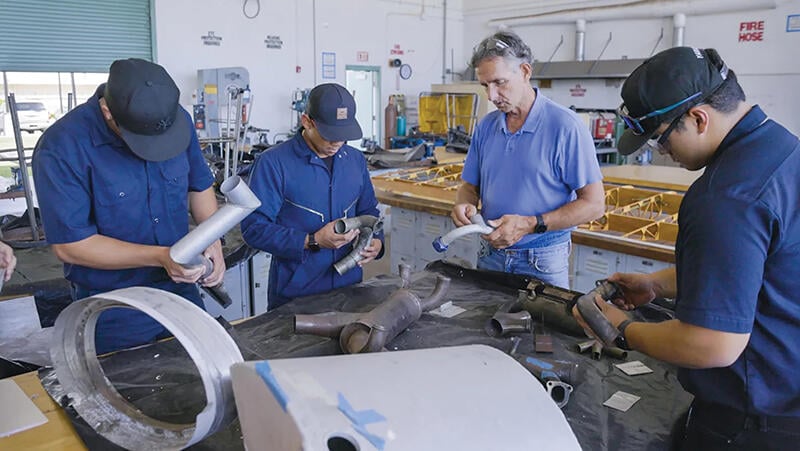
Hawaiian Airlines launched a Maintenance Technician Development Program with Honolulu Community College last year.
In recent years, U.S. aviation industry stakeholders have been introducing aftermarket career paths to younger ages and launching Part 147 training programs to get ahead of the projected maintenance technician shortage. Some of the latest statistics suggest these efforts are making headway.
Last year’s Pipeline Report from the Aviation Technician Education Council (ATEC) and Oliver Wyman shows that in 2024, the FAA issued more than 9,000 new mechanic certificates. Enrollment in aviation maintenance technician schools increased by 9.5% from the prior year.
Despite this growth, the report found that the student load factor—the ratio of available program seats to enrolled students—was only 64%, while 55% of the schools surveyed had an enrollment waitlist.
The report attributes much of this to students dropping out of Part 147 schools during their studies, leaving seats open in later cohorts. During the recent ATEC Annual Conference in Portland, Oregon, educators and employers addressed the factors affecting student retention and shared strategies to boost interest in MRO careers.
Suzanne Markle, president and CEO of the Pittsburgh Institute of Aeronautics (PIA), said the student load factor findings stem partly from the “fall factor,” since most students want to begin classes at that time of year.
“A lot of times at PIA, our fall class is way over capacity,” Markle said. Because of this, the school is looking at strategies to maximize enrollment at other times of year. For instance, PIA talks to students about the benefits of starting in smaller class sizes, such as more one-on-one attention from instructors. It is also considering incentives like scholarships with applicable start dates at other times of year.
The report noted several barriers that might dissuade students from completing the exams required to obtain FAA airframe and powerplant (A&P) licenses, including fear of testing, high test costs and difficulty finding designated mechanic examiners to proctor oral and practical exams.
Deja Hubbard, director of talent acquisition and outreach at Alaska Airlines, said one factor on which she is focused is helping pipeline students complete Part 147 programs. “I’d like to look at testing rates,” she said. “We know that’s a big risk—students coming to school and choosing not to test. So how do we come up with plans to help mitigate the issues that we see in the report?”
Markle said PIA’s mission is to have 100% of graduates obtain A&P certification, maximizing their employment options. “Those tests are huge, and if you let those students out of your sight, they go wandering off into Narnia, and they’ll get poached to other industries,” she said. “If there’s a job waiting for them where they don’t need their certificate, they may take the path of least resistance.”
Etain Connor, director of community affairs at FEAM Aero, reported that the MRO provider sees heavy competition for new graduates from other industries that can offer good benefits, better hours and higher pay—even by as little as $1 more an hour.
“They’re getting recruited by Disney and Nascar,” Connor said. “They’re getting recruited because aviation may not be their first love and they want their families to get inexpensive trips to Disney. It’s also [due to] the financial barriers, because when you’re in school, you can’t necessarily work, and that becomes a challenge.”
“Financial strain can happen, especially for people who are going to have families,” Markle added. “They’re working at night. They’re only able to do so many hours. . . . They’re just kind of exhausted from life in general.” While she noted that some level of attrition is always expected, PIA’s “sweet spot” is for about 80% of its students to enter the MRO industry.
One tool the school is using to help students navigate their education is an artificial intelligence (AI) assistant called Jet. “If our students are maybe not feeling comfortable popping into an administrator’s office or something like that, they can talk to Jet about what’s going on and do a little check-in,” she said. “This generation of students feels a little more comfortable maybe texting a bot, and then on the other side of the bot are real people reading the conversation, and we can find the student and [provide assistance].”
Hubbard said Alaska subsidiary Horizon Air helps incentivize retention in its Maintenance Technician Development Program by offering a $10,500 stipend split into two parts. The first $5,000 is given to trainees midway through the program, and they receive the remaining $5,500 upon completion. The airline also provides up to $1,800 reimbursement for A&P testing fees. Hubbard said the program requires a 2.5-year commitment and provides a pathway for participants to transition to roles at Alaska or Hawaiian Airlines at that 2.5-year mark.
Beyond the Maintenance Technician Development Program, Alaska Air Group has launched high school programs across some of its bases, including one recently established in Honolulu to feed Hawaiian Airlines’ workforce pipeline and an ongoing effort in Portland for Horizon Air (Inside MRO September 2025, p. MRO 52). Archie Vega, director of maintenance and development at Horizon, noted in a separate session at the ATEC conference that he had just received approval to build a lab at the airline’s Portland International Airport hangar operations center for high school students to practice maintenance skills such as basic electronics and avionics.
“Obviously, we can go and hire competent technicians off the street, but when we have worked with the students from the ground up, it really is a richer experience, retention is higher, and we just have more success working with the students from a younger age,” Hubbard said. She pointed out that early exposure to science, technology, engineering, or math (STEM) careers can be particularly beneficial for girls, citing research showing that when they enter adolescence, they become less comfortable with activities perceived as out of the ordinary for their peer groups because they want to fit in.
“There’s a point in time where, on average, girls start to lack confidence in doing something different . . . and that is also when they pull away and start outperforming their male peers in non-STEM fields,” she said, stressing that reinforcing their career potential in industries such as aviation at that point is crucial.
Connor added that companies should recognize that seventh grade is “a key year” because “students don’t resent adults yet, so they’re more open to hearing about career opportunities. By high school, you tend to lose the ones that are not completely engaged unless they have a program to get engaged.”
She also pointed out that FEAM’s collaborations with community organizations and education partners have highlighted that 70-80% of students have never been on an aircraft or to an airport, making it hard for them to visualize aviation careers beyond pilot or flight attendant. To reach kids who do not yet have this frame of reference, she suggested using a simple comparison most of them would know: McDonald’s.
“Talk about what happens when you walk into McDonald’s,” Connor said. “You interact with somebody—that’s your pilot, gate agent or flight attendant. When you drop off your bags, what happens then behind the scenes? Where do you get your food and where is that coming from?
“That is your back channel, your ground crew, your mechanics,” she continued. “Does the milkshake machine work? [The mechanic] is the person who fixes it. You don’t see them until you need them.”