This article is published in Aviation Week & Space Technology and is free to read until Nov 27, 2026. If you want to read more articles from this publication, please click the link to subscribe.
European MRO Providers Expand Training Amid Retention Struggles
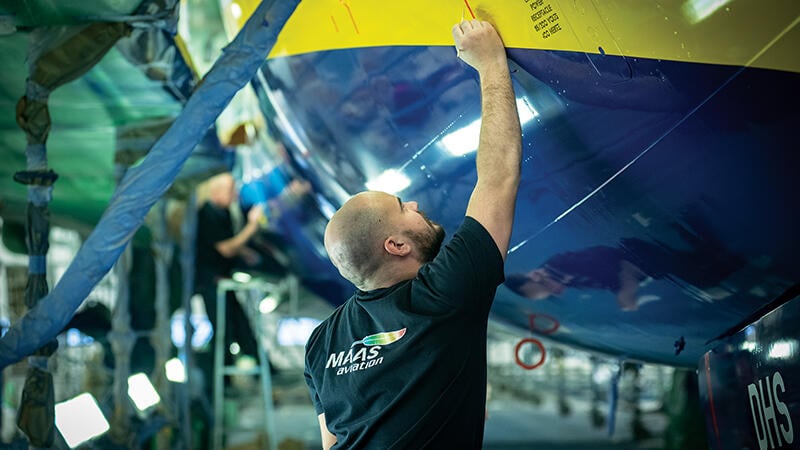
MRO providers are increasingly recognizing the importance of presenting career progression and long-term development opportunities to applicants.
European MRO providers have been steadily investing in their workforce pipelines as the continent seeks to meet the need for 169,000 new aviation maintenance technicians over the next decade, according to Boeing’s most recent Pilot and Technician Outlook. However, new research suggests a disconnect between recruiting strategies and employee satisfaction.
German MRO giant Lufthansa Technik welcomed nearly 300 new apprentices in August. Condor Technik, which opened a new training center near Frankfurt that month, plans to add specialized manufacturing technology and aircraft electronics training next year. AMAC Aerospace aims to open a new aircraft maintenance academy in Switzerland in January.
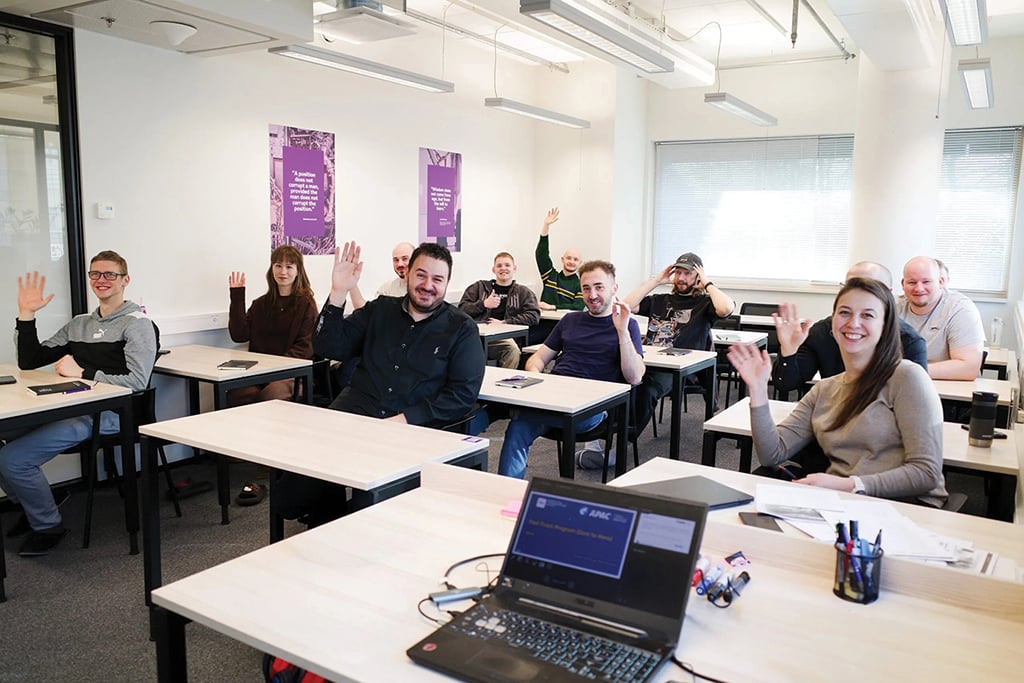
Magnetic Group opened a new training center in Tallinn, Estonia, last October. Ene Krinpus, managing director of Magnetic Talents, says the center has helped connect students’ theoretical learning with practical exposure. “It also gives us more flexibility to develop programs based on what we actually see the business and the market needing, rather than looking at training only as a catalog of courses,” she says.
“Taking more responsibility for creating the next generation” of MRO talent is critical, Krinpus says. “If 10 MROs are competing for the same 10 engineers, we haven’t solved the workforce shortage. We have simply moved people from one company to another.” She asserts that MROs need to be “willing to bring people in earlier, invest in them and accept that they will not be fully productive from Day 1.”
Compounding the issue is the time it takes for an aspiring technician to go from the classroom to the hangar floor, she suggests—and the challenge of retaining them once a company has invested considerable time and resources into their training.
To address this challenge, Magnetic launched its Zero2Hero program in 2024. The program trains people with minimal or no aviation experience through 350 hr., covering aviation fundamentals, technical subjects, technical English and practical knowledge. Krinpus says Magnetic sees 90% average retention per group.
“We have also learned that delivering the initial training is actually the easier part,” she says. “The bigger question is what happens afterward,” such as practical experience, Part 66 modules, on-the-job training and licensing. “Ideally, we should also be able to show [new talent] what Steps 2, 3 and 4 look like.”
Krinpus says two other strategies Magnetic relies on include expanding geographic reach for where it seeks talent and developing workforce partnerships. “We need cooperation between MROs, Part 147 organizations, technical schools, universities and regulators,” she says. “There simply aren’t enough experienced instructors, licensed engineers and technical specialists for everyone to keep competing for the same people. The long-term solution has to be increasing the size of the talent pool, not only becoming better at taking people from somebody else.”
The seasonal nature of MRO work in the narrowbody market “creates a natural challenge to employing painters on a full-time, year-round basis, especially over the summer months, when paint hangars are quieter,” says Richard Marston, chief commercial officer at painting specialist MAAS Aviation.
“To retain our skilled team during these periods, MAAS redeploys team members to our European facilities that paint for our OEM customers,” he says. “However, this approach depends on maintaining steady OEM workloads, which can also fluctuate due to wider aviation supply-chain challenges.”
While the company occasionally supplements staff with third-party labor providers, Marston says “this tends to be a short-term solution driven primarily by pay, and can create variability within the team,” so the company prefers to invest in developing and retaining its own staff. MAAS introduced a dedicated training program and personal coaching “to give employees a clearer perspective on career progression and long-term development.” He says the company has also invested in artificial intelligence (AI), language support and “shared values to help blend a multicultural team more effectively.”
Like Krinpus, Marston says that addressing MRO providers’ workforce shortage “will require coordinated action from industry leaders, government and local authorities, and training institutions.” He adds: “In recent years, the sector has commissioned studies, produced reports and developed plans for these challenges—but the priority now must be implementation.”
RECRUITING DISCONNECTS
LoveJob, a Poland-based agency that has worked with companies such as EME Aero on employer branding and recruitment marketing strategies, recently conducted a study on MRO industry workforce and recruitment challenges. The study evaluated digital presence, career portals, recruitment communication and employee reviews of over 20 European and UK aftermarket employers.
The study stemmed from LoveJob’s work with aviation and MRO companies, which repeatedly highlighted labor shortages and talent burnout. “[MRO companies] can’t recruit enough engineers, and engineers who they already have are burned out,” says Patrycja Czerwińska, employer branding expert at LoveJob. “As we looked closer at daily operations, we realized something crucial: This isn’t just a recruiting or labor capacity issue. In our opinion, it’s a profound communication and disconnection crisis.”
LoveJob’s study found a “massive gap between corporate public relations and hangar floor reality,” Czerwińska says. Industry subject matter experts have long lamented that MRO needs to find ways to advertise its careers to younger people. Many of them suggest that companies highlight innovations such as AI, sustainability and advanced air mobility to capture attention.
However, LoveJob asserts that this type of branding is more effective for clients and investors, while technical job candidates are more interested in the practical details of day-to-day work. The study says misalignment between job advertising and actual hangar floor work conditions, alongside complex application processes, leads to considerable attrition during recruitment and early-stage employment.
“Sometimes I think we make aviation sound very glamorous, when the person considering the job actually wants answers to much more practical questions,” such as the nature of shifts, schedules, compensation and licensing, Magnetic’s Krinpus says. “Technology, AI, sustainability and innovation are all important, but I don’t think these are necessarily the reasons why a technician chooses one employer over another or decides to stay.”
Krinpus acknowledges that aviation’s highly regulated nature means it takes longer to become licensed and start working, but she suggests the hiring process could still be improved. “I think we should still challenge our own HR processes. For example, how many interviews do we really need? How quickly do we give feedback? How long does it take from application to an actual offer?” she says. “If our process takes weeks and another industry can move in days, we should not be surprised if we lose people along the way.”
LoveJob’s study also found recurring complaints on workplace rating websites such as Glassdoor, GoWork and Kununu. Unpredictable shift patterns seem to generate significant stress and attrition, while shift leaders are often under intense pressures related to turnaround times and feel they lack the communication tools to support their teams effectively. LoveJob found hangar personnel also feel neglected compared with office staff, who can take advantage of flexible, hybrid work options.
“I think there are two sides to this,” Krinpus says. “We need to be realistic about the industry we work in. You cannot maintain an aircraft from your home office. There will be shifts, there will be weekends, and sometimes there will be pressure because the aircraft needs to leave the hangar. I don’t think we should hide that when recruiting people. At the same time, that doesn’t mean we cannot do better.”
Krinpus suggests flexibility for hangar floor staff could mean something different, such as “knowing your shifts well in advance, having fewer last-minute changes, managing overtime properly and having some predictability in your personal life.”
When it comes to shift leader pressures, Krinpus notes that aviation often promotes “technically excellent people into aviation positions,” creating significant pressure once the job entails responsibility for both aircraft and people. “If we don’t give those people the tools to lead, the pressure very easily gets transferred directly to their teams,” she adds. “For me, leadership development is therefore also a retention topic.”
Magnetic has developed its Learning2Lead program to address this challenge. “We recognized that being technically excellent doesn’t automatically make somebody a good people leader,” Krinpus says. “When technical specialists move into management positions, suddenly they need to give feedback, manage conflicts, motivate people, communicate difficult decisions and lead teams under pressure. Learning2Lead was created to give our managers practical tools to do that better.”
Czerwińska suggests that MROs consider offering technical expert career tracks that match managerial salary brackets but do not force staff out of their domain expertise into managerial tasks for which they are less suited. “Traditionally, the only way an engineer could get a promotion was to become a manager, but some people don’t want to [pursue] this pathway,” she says. Instead, LoveJob suggests guiding these people toward more senior-level technical expert tracks in areas such as avionics, structures and technical support.
The agency also advises MROs to highlight their employee development programs, which show applicants potential career advancement pathways. During its audit of European and UK aftermarket providers, LoveJob found that many such programs were “buried in dry, formal and unappealing text” on company websites. The agency suggests that this is one area in which recruitment marketing could be more engaging.
Beyond how careers are marketed, “perhaps one thing we, as an industry, could do better is simply being more honest about the career we are offering,” Krinpus says. “Aircraft maintenance can be demanding. There are shifts, regulations, responsibility and pressure. We shouldn’t hide that.
“But at the same time, somebody can enter this industry with relatively little aviation experience and, with the right training and motivation, develop into a highly skilled professional with an international career,” she adds. “I think that’s already a very strong story. We don’t need to make it more glamorous than it is.”

Related Content