This article is published in Aviation Week & Space Technology and is free to read until Oct 14, 2026. If you want to read more articles from this publication, please click the link to subscribe.

Asia-Pacific MROs Face Labor Hurdles As Demand Accelerates

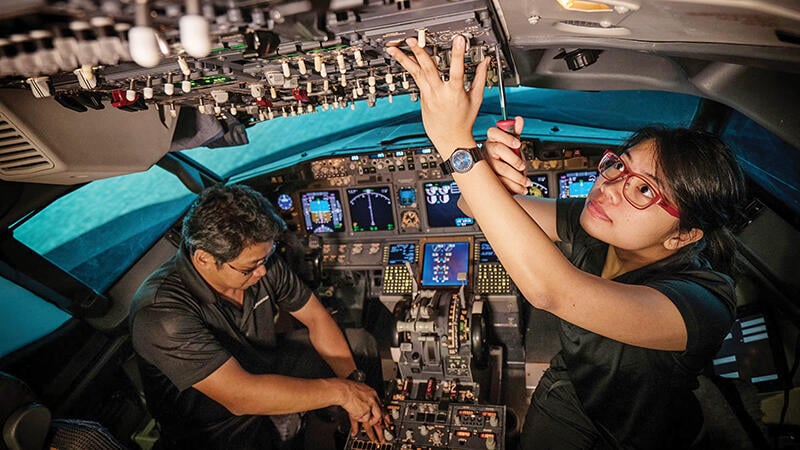
aviation maintenance technicians

Boeing predicts the Asia-Pacific will need more than 40% of the world’s new aviation maintenance technicians through 2045.

Credit: Boeing

Demand is rapidly increasing for qualified aviation maintenance technicians in the Asia-Pacific as the region’s growing fleet drives a need for more maintenance capacity. Yet the ability to meet this demand varies considerably by market, with some countries facing acute shortages due to career perceptions, compensation gaps, regulatory hurdles and competition from other industries.

In its most recent Global Services Forecast, Airbus projects that the Asia-Pacific region will account for more than 45% of its worldwide services demand by 2044, while Boeing’s 2026 Pilot and Technician Outlook predicts that more than 40% of the 710,000 global aviation maintenance technicians (AMT) needed through 2045 will be in that region. Compared with last year’s outlook, demand has increased the most in South and Southeast Asia, while China continues to drive considerable demand—for more than 130,000 AMTs—over the next decade.

Asia Digital Engineering's Maintenance Training Organization classroom
Asia Digital Engineering opened its Maintenance Training Organization in May. Credit: Asia Digital Engineering

According to Chris Broom, vice president of commercial training solutions at Boeing Global Services, this demand primarily stems from the rapid fleet growth and rising block hours as well as ongoing fleet renewal requirements in the Asia-Pacific region.

“As airlines in South and Southeast Asia expand capacity, more aircraft deliveries and higher utilization directly increase MRO and line maintenance workload,” he tells Inside MRO. “In addition, evolving aircraft technology—like more composites, advanced avionics, increased software content and automation—changes the skill level and training requirements for technicians, so workforce head count must grow faster than flight hours alone to preserve reliability and readiness.”

Asia Digital Engineering (ADE), which is building new hangars in Kuala Lumpur and looking at potential operations in Bahrain, plans to hire “several hundred additional maintenance personnel” across its network, CEO Mahesh Kumar says. He cautions that the Asia-Pacific region may struggle to meet this demand.

“The Asia-Pacific region continues to produce highly capable aviation professionals, but the pace of industry growth is now exceeding the rate at which experienced talent is entering the workforce,” Kumar says. “This is particularly evident as airlines expand fleets, aircraft utilization increases, and more maintenance work is being performed within the region. The challenge is less about attracting interest in aviation and more about accelerating the development of qualified, licensed personnel without compromising safety or quality.”

ADE has successfully leveraged its broader operational network across Cambodia, Indonesia, Malaysia and the Philippines to support workforce requirements. “Talent mobility is a natural part of our industry. Skilled engineers and technicians today have opportunities to work across different markets, creating both challenges and opportunities for the region,” Kumar says. “Where there is increased demand, we work closely with relevant stakeholders and governments to facilitate the movement of qualified ADE personnel between our countries of operation to support operational needs.”

Kumar adds that industry, regulators and schools will need to collaborate more closely to meet labor demand, noting that “workforce development should be viewed as a long-term strategic investment rather than a short-term recruitment exercise.”

To boost its own workforce pipeline, the company opened its ADE Maintenance Training Organization (ADE MTO) in May. ADE MTO provides both structured, hands-on training for new hires and upskilling for the company’s current employees. Kumar says the organization is also focused on preparing AMTs to work with technology, data analytics and digital platforms as the industry evolves.

UPHILL BATTLE

In South Korea, the challenge may be more acute. “South Korea will absolutely struggle to keep up with the growing demand forecasted by Boeing and Airbus,” says Sanghoon Jang, technical consultant at KMTEC, a technical services and project management company. “The core issue is the effort-to-reward ratio. Young talents realize that the same amount of effort yields much better compensation in other industries.”

For instance, Jang says, the lower compensation MROs and low-cost carriers offer compared with major airlines “causes immediate disappointment and high turnover.” Meanwhile, he questions whether the new MRO Cluster at Incheon International Airport (ICN) will be able to find qualified staff fast enough. “The physical infrastructure is expanding, but the human capital pipeline is failing to meet the timeline,” he adds.

 GMR Group technician
Airbus partnered with GMR Group to open the GMR School of Aviation in Hyderabad in 2024. Credit: GMR Aero Technic

One potential bottleneck in South Korea is a May 12 revision to the country’s Aviation Safety Act, “which was hurriedly rushed through simply to satisfy [International Civil Aviation Organization Universal Safety Oversight Audit Program] criteria,” he says. The change removed practical examination exemptions previously granted to graduates of Approved Training Organizations. Jang says the revision “is expected to create severe difficulties and a massive bottleneck for students trying to obtain their licenses, as the training infrastructure on the ground cannot keep up with the sudden testing mandates.”

In conjunction, Jang says South Korea sees retention issues with students in aviation maintenance programs. “Many students enter these programs without a deep-rooted passion for aircraft maintenance,” he says. “When they are faced with the heavy burden of technical English, they quickly lose confidence. Consequently, they easily pivot to other booming industries in South Korea, such as the semiconductor sector, which offers significantly better pay and benefits for arguably less physical strain.”

Other Asia-Pacific markets such as Hong Kong and Japan have recently expanded visa programs to make it easier for international talent to work in industries experiencing labor shortages such as MRO. However, Jang says South Korea’s Land, Infrastructure and Transport Ministry “tightly controls visa issuance for aviation mechanics,” so while some independent MROs have occasionally succeeded in hiring temporary foreign labor, “it remains highly limited and is not considered a sustainable solution at this time due to rigid institutional barriers.”

Companies in the Greater China region seem more optimistic about their ability to meet high labor demand. During Aviation Week’s MRO Greater China event in May, HAECO Group Chief Commercial Officer Gerald Steinhoff told Inside MRO that the company is seeing a stable workforce in Xiamen, with attrition in the “low-one-digit numbers.” In Hong Kong, the company has had to expand its talent searches into other countries, such as the Philippines, but he says this has helped improve diversity and inclusion at the company.

HAECO also sends Hong Kong-based staff to the Chinese mainland for training at partner schools, and “the governments there help us a lot by lowering visa requirements, making it easier to cross the border and work for us in Hong Kong,” he said.

Norbert Marx, the recently retired CEO of China Aircraft Services Ltd., told Inside MRO that competition from other industries in Hong Kong does cause challenges and that younger generations have been harder to sell on MRO roles due to the demands of the job. He suggested that future concerns about artificial intelligence (AI) eliminating jobs could draw young people into skilled trades such as MRO.

ADDRESSING SHORTFALLS

Broom of Boeing Global Services echoes many of these perspectives about differing labor dynamics in the Asia-Pacific area. “Regions with large labor pools, like China and India, can ease volume hiring but still require upskilling for modern aircraft systems; while smaller markets face limitations due to local labor supply and may rely more on visa and access policies to attract overseas MRO talent,” he says. “Other dynamics include societal perceptions of trade careers, competition from other industries for [Science, Technology, Engineering and Mathematics] workers, and variable training infrastructure.”

He suggests that strategies to face these challenges include “expanding flexible learning approaches, targeted apprenticeship incentives, competitive compensation to retain skilled technicians, cross-industry recruiting and government industry partnerships to streamline visa, certification and training pipelines.”

For instance, Boeing has been expanding its regional training capacity in the Asia-Pacific region. The company is adding training facilities and capacity, such as a recently opened center in Shanghai. Boeing also focuses on increasing competency-based training and assessment (CBTA) methodologies, virtual and immersive learning options and courses in areas where AMT skills shortages are common, such as composites and avionics.

These strategies also aim to address the “juniority” issue that Boeing identified in its 2022 Pilot and Technician Outlook, driven by accelerated hiring efforts as more senior-level AMTs reached retirement age.

“Juniority—a growing population of less experienced technicians entering the workforce—increases on-the-job training burdens and slows productivity. In the Asia-Pacific region, this amplifies safety and capacity pressures as fleets expand,” Broom says. “Effective mitigations are scalable instructor training, structured apprenticeships and workplace mentor-ship programs, CBTA [methodologies] that emphasize soft skills and troubleshooting, and modular virtual coursework to front-load knowledge before hands-on practice. Industry collaboration to standardize curricula and develop more examiner/instructor capacity is also critical to rapidly scale qualification pipelines.”

Kumar says ADE is addressing these concerns through ADE MTO. “Beyond certification, proper onboarding, mentorship and hands-on exposure are critical to ensure new technicians are equipped with the right knowledge and experience,” he says. “We believe continuous training and knowledge transfer are key. By combining structured development programs, guidance from experienced engineers and practical exposure, we can build the next generation of aviation professionals while preparing them for future leadership roles.”

Jang raises safety concerns about the rush to hire. “We rely heavily on vocational and high schools, bringing in [Millennial and Gen Z] workers who often lack long-term industry commitment and want quick results without investing the arduous effort required to master complex systems,” he says. “This creates a dangerous gap: Mechanics know the ‘how’ (following steps) but not the ‘why’ (system logic).”

He points to recent incidents, such as a 2021 tail-tipping incident with a UPS Airlines Boeing 747-400F aircraft at ICN that “resulted from a failure to understand system logic and center of gravity during maintenance.” He adds: “In aviation, a true maintenance professional is defined as someone who strictly satisfies the structured progression of being trained, certified, qualified and authorized. Simply injecting a raw ‘head count’ into a hangar to fill a vacancy is an extremely dangerous gamble that jeopardizes flight safety.”

One South Korean company that successfully addresses skills shortages, Jang says, is Korean Air, through its two-year in-house technical training school. “Companies must invest heavily in robust, internal apprenticeship programs to groom future leaders,” he adds.

INDIA RAMPS UP

In India, which Steinhoff noted is likely the only Asia-Pacific country “that has no problem with talent at all,” stakeholders have been systematically building up training infrastructure to support its burgeoning MRO industry.

GMR Group, the infrastructure conglomerate that owns the independent Indian MRO provider GMR Aero Technic, partnered with Airbus in 2022 to provide aviation maintenance training. The companies opened GMR School of Aviation in Hyderabad at the beginning of 2024, which offers a four-year aircraft maintenance engineer (AME) program and type training certified by the European Union Aviation Safety Agency and India’s Directorate General of Civil Aviation (DGCA).

The school calls itself the first in India to introduce aircraft systems trainers for modern commercial aircraft. Airbus collaborated with GMR to design course content, courseware and software for virtual training.

In 2024, Boeing partnered with Air India subsidiary AI Engineering Services Ltd. (AIESL) to boost the Indian MRO provider’s internal training programs. The aircraft manufacturer agreed to provide support, including training materials, aids and instructor guidance, as AIESL sought DGCA Civil Aviation Regulation approval. When the partnership was announced, AIESL CEO Sharad Agarwal said Boeing’s help would “support training requirements for at least 100 engineers each year going forward.”

Air India is scheduled to open a new aviation maintenance training school in Bengaluru this year, although it has not yet responded to Inside MRO’s requests for comment. Located near the airline’s new 12-bay MRO facility at Bengaluru International Airport, the school will operate a program that includes two years of classroom training and two years of practical on-the-job training at the airline’s maintenance facilities.

Air India has also launched a Cadet AME program modeled after its Cadet Pilot program. This gives trainees the chance to gain hands-on experience at the airline’s Bengaluru MRO facility while they study at Air India’s school or partner schools, such as GMR School of Aviation, Hindustan Aviation Academy and Hindustan Institute of Engineering Technology.

Lindsay Bjerregaard

Lindsay Bjerregaard is managing editor for Aviation Week’s MRO portfolio. Her coverage focuses on MRO technology, workforce, and product and service news for MRO Digest, Inside MRO and Aviation Week Marketplace.