OSHKOSH—As the global aviation industry accelerates efforts to meet Boeing’s projected demand for 728,000 new aviation maintenance technicians (AMT) by 2045, the aircraft manufacturer says new tactics will be necessary to keep up with changing norms.
During a press briefing at EAA AirVenture, Boeing senior leaders discussed how the skill requirements and career progressions for AMTs are changing—as well as bottlenecks that must be addressed in the workforce pipeline.
Sergio Bustamante, vice president and chief engineer of Boeing Global Services Engineering, says high demand for AMTs is driving more customers to create apprenticeship programs to get people in the door faster, before they have obtained their airframe and powerplant (A&P) licenses. “There’s still an A&P licensed person signing off [on their work], but [customers are] paying for them to go get their license, and they’re getting on-the-job training as well,” he said.
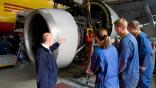
Boeing itself is also prioritizing mentorship by experienced professionals. Bustamante said the company has later-stage career mechanics come in to teach the next generation. “We call them workplace coaches, and we have that at all our production sites where the senior mechanics mentor the newer junior mechanics in those roles,” he said.
Boeing is also hearing from customers that traditional career progression for AMTs is changing. Chris Broom, Boeing Global Services’ vice president of commercial training solutions, says the traditional three-step pathway would entail a person who worked on cars or motorcycles in high school attending an A&P school, getting a first job at an MRO or regional airline, and then progressing to a role at a major airline.
“[Customers are] saying that steps one and three aren’t happening a whole lot, that [aspiring AMTs don’t have] as much hands-on experience working on mechanical things before they go get their A&P, and then [they need] to get a lot more on-the-job training as part of their job at an airline,” Broom said.
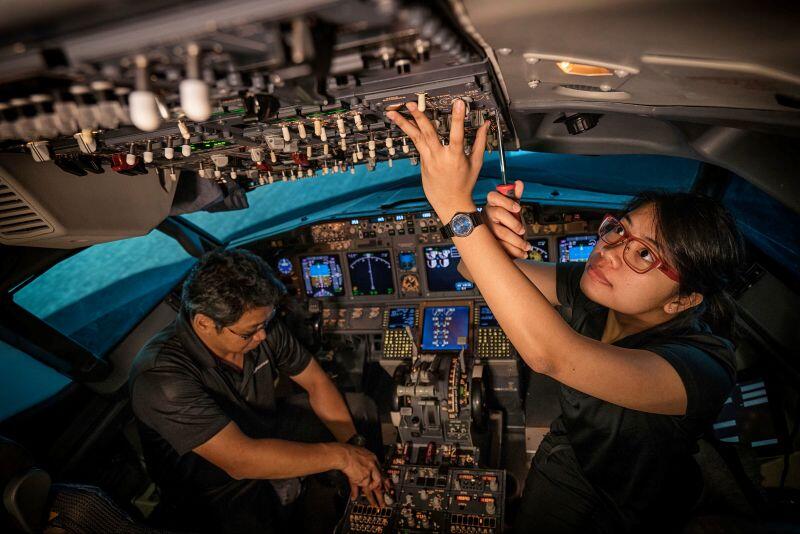
Bustamante noted that as aircraft technology evolves, so, too, do the skill sets required of AMTs. “Our technicians used to just turn wrenches, and now we have complex testers they have to use that are validating the performance of the airplane on the ground to buy themselves reliability between checks,” he said. “[Customers are] trying to turn an unscheduled event into a scheduled event, and that doesn’t happen with just a wrench. So, we’re applying technology, and we need engineers to develop these solutions, and then technicians to grow and learn those.”
Mike Miller, Boeing’s director of commercial training engineering, said that during his time as a pilot in the U.S. Air Force, much of his training revolved around aircraft systems. However, “when you look at training today, or you look at operations today, no matter what career field you’re in—pilot, technician, manager—you have to understand data and what it’s telling you to make informed decisions.”
Broom emphasized that competency-based training and assessment (CBTA) methodologies are replacing task-based training models, which can reduce maintenance incidents and improve line readiness. He pointed to a case study from the European Aviation Maintenance Training Committee that reported a 35% reduction in human factors-related incidents within a year of CBTA implementation that emphasized soft skills, real-world environments and team performance.
“CBTA is a structured, data-driven and scenario-based approach to training, where the core competencies, in addition to procedures, maneuvers and tasks, are trained and assessed,” he said. “Early integration across the training life cycle produces more operational-ready pilots, mechanics and cabin crew members.”
Boeing’s Training Solutions business has incorporated CBTA, as well as advanced training systems and technologies, to prepare customers and its own workforce for evolving requirements, Broom said. He noted that the company recently opened a new training center in Shanghai, and Boeing Training Solutions has five training campuses, four development offices and three commercial training sites and operates in nine countries.
While training advancements and mentorship may help future AMTs on their career path, this still does not address existing bottlenecks, such as the shortage of aviation maintenance instructors, designated mechanic examiners (DME) and designated pilot examiners. Aviation Week asked Boeing how it thinks the industry can overcome these hurdles to ensure trainees can get their FAA certifications.
Broom, Bustamante and Miller all emphasized the importance of marketing and creating an instructor training pipeline.
“I think instructors become examiners, and then you scale from there,” Miller said. “It starts with everybody in the industry who has a stake in that, whether you run a flight school, an airline or a college, or you’re an OEM, coming together, identifying the problem, identifying what the curriculum should be and then coming up with a plan to rapidly scale.”
Broom said A&P schools and flight schools should take advantage of the upcoming retirement wave to encourage those in later career stages to give back. “Many of them want to keep working past the mandatory retirement age, and it goes back to mentorship as well. They’re also incredible mentors, not just in flying careers, but in life,” he said.
Bustamante added that Boeing wants to bring industry experts at later stages of their careers into the company to help develop curriculum for AMTs, pilots and schools. “Also, we need to advertise,” he said. “I don’t think we do as great a job of marketing that there’s this later career progression, and I think we probably need to do a better job of that.”

Related Content