This article is published in Aviation Week & Space Technology and is free to read until Jun 01, 2026. If you want to read more articles from this publication, please click the link to subscribe.

Schools Say FAA Testing Hurdles Are Stifling MRO Workforce Growth

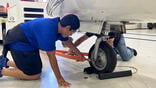
designated mechanic examiner pic

There are currently fewer than 300 designated mechanic examiners in the U.S.

Credit: Phovoir/Alamy Stock Photo

Stakeholders in the U.S. MRO industry have been accelerating initiatives to recruit, train and hire new technicians to get ahead of a projected labor shortage. However, aviation maintenance schools say barriers to testing and certificating those technicians stand in the way.

While the Aviation Technician Education Council (ATEC) reports that new mechanic certifications increased 32% in 2023, it still expects the industry to be about 20% short by 2028. In a survey of ATEC members, nearly one in five Part 147 schools reported problems from a lack of designated mechanic examiners (DME), the proctors of oral and practical tests that aspiring technicians must take to become certificated. ATEC says the existing DME population must grow by nearly 30% to accommodate all Part 147 school graduates.

Before aviation maintenance technician (AMT) students take their oral and practical exams, they must first complete a written FAA knowledge test. Although the FAA previously contracted multiple companies to provide test delivery, the agency tells Inside MRO this was a costly and inefficient model, so in 2018 it awarded a sole-source contract to testing specialist PSI.

During ATEC’s Annual Conference March 16-19 in Norfolk, Virginia, a breakout session about the organization’s legislative priorities quickly turned into a discussion highlighting schools’ complaints about PSI’s practices and perceived shortcomings. “I think we all have a little PSI PTSD,” the head of one Part 147 school joked, spurring laughs in the room.

While many Part 147 schools were eager to tell Inside MRO about their grievances, most would only speak anonymously, citing fear of retribution from PSI. When asked about this, the FAA said: “PSI doesn’t have any authority or oversight of any FAA certificated school and would not be capable of any sort of ‘retribution.’ ”

TESTING SHORTAGES

To Inside MRO’s knowledge, the FAA and PSI have not publicly released full lists of DMEs or agency-approved Knowledge Testing Centers by state. The FAA says 268 DMEs completed nearly 18,000 activities in 2024. One can search for DMEs by state on the agency’s website, but results often show duplicates of the same individual—for instance, the website lists 15 in Arizona, but once duplicates are eliminated, there are only eight.

The FAA says PSI operates a network of an estimated 800 active testing centers across the U.S. Those centers are only searchable by zip code on the company’s FAA testing website. ATEC says its request for a comprehensive list of all FAA Knowledge Testing Centers was denied, so the organization gathered its own data from its membership. ATEC provided Inside MRO with a document it compiled of nonmilitary PSI FAA testing center locations, which totaled 673 in the U.S.

While some states appear to have many testing centers—often based at Part 147 schools—certain areas are “testing deserts.” Inside MRO manually crosschecked a wide variety of nearest testing center locations with zip codes across the country for schools listed in ATEC’s directory of FAA Part 147 certified institutions.

Students at Southwest Texas College in Uvalde and at Helena College  of the University of Montana—the state’s only Part 147 school—would need to drive nearly 70 mi. to the nearest testing center. Students at Columbia Gorge Community College in Oregon have to drive nearly 60 mi.; students at Arkansas Northeastern College, 45 mi.

PSI’s website shows Hawaii has four testing centers—a comparatively large number for the state’s one FAA-certified AMT school—but it has no in-state DMEs. Several sources said students in Hawaii must fly to the mainland to test with a DME.

Many states only have 1-4 DMEs handling testing. Arkansas only has one for its four certified Part 147 schools, and Louisiana has two for its four. The states with the most DMEs are California (23), Florida (22), Texas (17) and New York (15). However, according to ATEC’s most recent data from 2023 on total AMT school enrollment by state, these DMEs have their hands full.

Florida had nearly 3,000 Part 147 school students in 2023. If all of them were to pursue oral and practical testing, each DME would need to test around 135 students over the typically two-year programs to handle the full load. In Nevada and New York, the disparity is even larger. Nevada had 394 students in 2023, but only two DMEs, meaning each would need to test 197 students if all pursued their A&P certification. New York had 2,724 students in 2023, so between its 15 DMEs, each would need to test around 181 students.

The director of a Part 147 school in Alabama said the institution previously had five local DMEs, but is down to two, so he has tried to get a third certified. “But the FAA won’t act on my request,” he said. “Our FAA inspector believes it is acceptable for our students to drive 90 min. to find another DME.” He also repeated the anecdote about students in Hawaii flying to California and those in parts of Texas driving 6 hr. to their nearest DME.

The FAA says it assesses need for DMEs based on regional demand, but that Flight Standards District Offices have limits for how many DMEs they can support, and even qualified applicants may be turned away if the office believes it has sufficient coverage.

Oral and practical examinations are also time-consuming. According to Jesse Hauch, Delaware’s only certified DME, the FAA said in its initial DME training seminar last year that the new oral and practical examination process averages 16 hr. over two days, “so it takes a lot of fortitude to get through all of them once you have the necessary training and experience.”

Hauch said he conducted more than 50 examinations last year, most of which were two-day tests lasting 16-20 hr.—meaning he spent more than 800 hr., or over 33 days total, conducting examinations. These time estimates do not include pre-examination processes, such as coaching and guiding applicants, setting up tests, inspecting testing facilities, and ordering required tools and equipment.

“This year, in May, I’m up to about 20 [examinations] for the year, so the potential is there to have enough applicants to make [being a DME] a full-time option, but it’s a feast-or-famine thing,” Hauch said. “Are you close enough to a population center where you can disengage from your day job and do nothing but test applicants? . . . You either have to be willing to spend your free time on a side hustle, doing applicant testing and getting everything set up, or you have to be at retirement age where you fully stepped away from your day job and can put time into this.”

Hauch said DMEs also face added cost burdens that are typically passed on to test-takers. He noted that the new Airman Certification Standards require test-takers to perform a flareless fitting, for which they must use equipment that costs around $45 apiece. DMEs must use PSI’s website to generate tests, and each now costs $10, when they were previously free, meaning a “full-form practical” is a $30 expense.

Haunch reported that the test generating system is “kind of a glitchy, buggy website” that often goes down. When Inside MRO spoke with Hauch, he said the website was scheduled to go down from Friday through Sunday, “so if I had an applicant or I needed to process test results, I’m out of luck.”

Hauch said DME schedules frequently book up far in advance, so applicants may need to wait 6-7 months for a slot. Further compounding the delays, students must schedule, take and pass written exams before they can schedule oral and practical exams with a DME. The FAA says it allows applicants up to 24 months to complete the testing sequence once it begins, but this may be easier said than done.

BUGS AND BARRIERS

Every Part 147 school that spoke with Inside MRO shared similar complaints about what they called PSI’s “monopoly” on written exams, ranging from a shortage of testing centers and capacity to technology glitches, increased costs, lack of communication and barriers to approving more independent testing centers.

Brad McDonald, CEO and director of training at the Federal Aerospace Institute (FAI) in Ohio, said he has been trying for three years to get a testing center at his school. “I have everything under our roof except for the written test,” McDonald said. “I have the privacy, I have the video, I have the proctor and . . . everything in place required to be a testing center, [but PSI] will not allow me to become a testing center. They say there are two testing centers already in the region.”One  is around 9 mi. from the nearest airport, and the other is 30 mi. away. “The problem [we’ve] also run into is our students will call to test, and they don’t have any openings,” he added, noting that PSI’s regional testing centers handle exams for many other industries beyond aviation.

Bryan Despain, lead aviation maintenance instructor at Columbia Gorge Community College in The Dalles, Oregon, said students must travel some 80 mi. to Portland to take their FAA written tests. While scholarships or stipends can cover testing costs—currently $175 for students—travel “is sometimes the biggest hurdle,” Des­pain noted. “This has proven a concern for our students and graduates as they consider fuel costs and time,” he said. “It takes a tank of gas and about half of their day. They do it because there is no other choice for them.”

testing center
Some Part 147 schools report challenges getting new testing centers approved by PSI. Credit: Imagic Education/Alamy Stock Photo

The head of a large Part 147 school with several locations across the country said one of its campuses only has one testing center within a 40-mi. radius, and this center “does not have the capacity to efficiently serve the volume of AMT students and graduates currently in the pipeline.”

At another campus, the school requested to move its approved test center to another room on the same campus, but did not receive approval from PSI for more than 40 days, after which it had to wait another 11 days before it was allowed to begin testing in the new space.

“To ensure continued compliance, any change in testing location needs to be assessed in the same way we assess a new site—even if it is to another location within the same complex,” a representative for PSI told Inside MRO in response. “When a testing center decides to relocate, the ‘new site’ process starts over.”

One Part 147 school in the Midwest had just recently opened a new PSI testing center “after an 18-month ordeal to get it up and running” when it spoke with Inside MRO. The school’s vice president of aviation and workforce development said when his staff reached out to PSI to ask about the process of becoming a testing center because its students struggled to find enough capacity for testing, the company’s immediate response was, “Your application has been denied,” even though the school had not yet applied. “I have heard from a lot of operators that [PSI is] trying to push all of the independent testing centers out,” he said.

A PSI representative says the company “carefully reviews every request we receive to become an authorized PSI test center” to ensure sites meet strict environmental and security requirements. The company says its contract with the FAA requires it “to provide reasonable accessibility to the aviation community and maintain adequate coverage of locations throughout the country.” It also notes that “FAA exams only used a small proportion of the total seats that were available” from January 2024 to May 2025.

“What I believe PSI is doing is sort of amortizing all tests taken over a length of time and saying, ‘We are fulfilling our obligation, because if 100 students need to take the test, we have enough seats over a 12-month calendar to meet those demands,’” said Jackie Spanitz, general manager of Aviation Supplies & Academics, a company that provides aviation industry training materials to Part 147 schools. “Well, that’s not how people actually test.” Instead, students typically finish their last class and then all want to take the test around the same time, Spanitz explained. “What I hear from schools [is] that the students don’t have access to testing seats when they need them.”

Asked about getting the Midwest school’s test site up and running, “They [PSI] were ridiculous,” the school’s vice president of aviation said. “We went back and forth for a year and a half, sending them pictures and drawings of our testing center, computer outlines for our testing center, [discussions about required cameras] . . . back and forth. They made it as difficult as possible, and I’ve heard that if you make any changes at all, they will shut you down for at least 60 days to get it going again.”

He also noted that the school’s IT staff was incredulous because PSI required an operating system that “hasn’t been supported in 10 years.”

The testing center site administrator for one Part 147 school in Illinois said that despite operating as a testing site for more than 30 years, the school had to invest in “about $10,000 worth of equipment to accommodate PSI.”

A representative for PSI says the company is meeting and exceeding FAA regulations and procedures for test center and equipment requirements “to ensure these tests are secure and that the results are valid, reliable and fair,” and that “the compliance processes involved are necessarily rigorous and take time.” The company’s computer specifications for testing sites are listed on its website and call for Windows 10 or 11 operating systems.

Every Part 147 school with a testing center that spoke with Inside MRO complained of a “buggy” system with frequent outages. Several DMEs reported similar issues.

McDonald at FAI said he has been locked out of the oral and practical testing system for up to four days before he could submit test results. The site administrator in Illinois said frequent glitches would kick students out of the system while they were testing, one of which lasted for around three months.

When tests do not load, testers “must wait an hour to make sure the test doesn’t populate; otherwise, they forfeit the test fee,” said the head of the Part 147 school with multiple campuses. “If the test doesn’t repopulate within that hour, the tester must wait about three business days before they can reschedule their test. The tester is not notified of an outage prior to showing up for their test, even if PSI is aware of an outage.”

In response to these complaints, a representative for PSI said: “PSI has procedures in place for notifying applicants when unexpected events occur, including outages and testing closures due to weather or staffing. Our goal is to notify applicants in advance whenever possible if there is a need to change their testing appointment. Occasionally, issues arise at the last minute, and it’s not always possible to contact the applicants who will be impacted. In these cases, we assess each individual situation and assist the applicant appropriately, whether it is to reschedule or provide a refund.”

The FAA says nationwide outages are “extremely rare and well documented” and suggests outages at third-party testing centers could stem from differing internet speeds and computer equipment.

Several sources told Inside MRO the system to sign up for tests is confusing and difficult. For instance, the head of the Part 147 school in Kansas said students can only see availability for testing dates a single day at a time, rather than a range of dates, and once a tester clicks the date, “you’re locked in,” he said. “It’s like, ‘You picked this date and you have to go test now or we’re keeping your $175.’ ” He added that PSI and the FAA frequently blame technical issues on each other.

“Our focus is always on resolution and not blame,” a PSI representative says. “All technical issues are investigated with the aim of establishing root cause and resolving the issue. Our priority is in supporting the applicant to complete the assessment.”

The head of the Part 147 school with multiple campuses called PSI’s response time a recurring issue. “When leaving a message, you may never receive a call back,” she said. “When sending an email, you don’t receive a response for at least a week or more. All test center support is on Pacific Standard Time, so East Coast test centers often have issues reaching representatives when experiencing difficulties.”

ADDRESSING COMPLAINTS

The FAA’s contract with PSI stipulates that the company should have a process to capture complaints from test-takers and provide a monthly report to the agency. While some Part 147 schools told Inside MRO they did not believe this was happening and believed their complaints went unheard, PSI says it compiles regular reports for the FAA and has clear procedures to review, measure and assess this data. The FAA says it receives this data, which is “reviewed, measured and adjudicated for continuous improvement,” although it does not provide specifics.

“Where relevant, these complaints feed into a continuous improvement process,” a PSI representative says. “In support of our goal to provide an excellent testing experience for every applicant, we take all complaints very seriously and take action when warranted.”

Increased testing fees and reduced reimbursement for test centers and DMEs were among the biggest complaints Inside MRO heard from many schools that operate testing centers. PSI’s contract says the FAA reserves the right to set a maximum fee of $160 per test, to be reevaluated every three years. The company increased its FAA Airman Knowledge Test fee to $175 in 2021, then reduced third-party test centers’ reimbursement in late 2022. Schools operating testing centers said they previously were reimbursed $65 for every exam, but this has dropped to $10-30 per test.

The school in Illinois previously paid proctors $50 to administer each exam, but with the new pricing structure, “[the reimbursement] doesn’t even cover us, [so] the university considered cutting the program after 30+ years of being an FAA testing site because we’re losing money at it,” the testing site administrator said.

Despain said Columbia Gorge Community College has not tried to open a testing center due to the cost. “PSI requires that they receive their $175, and then any additional costs are extracted from the test-taker,” he said. “And then that drives the cost even higher for the student, or the school would need to fold that added cost into their budget [when it] is already too thin.”

ATEC surveyed its members after the pricing structure changes. One-third of respondents reported that the development resulted in lower testing capacity in their area, whether because of test center closures, reduced hours or fewer seats. More than half of respondents reported that the change either somewhat or greatly affected students’ access to testing. However, only one said their school’s testing center definitely would close as a result of the fee change.

PSI maintains that its test costs have been agreed upon with the FAA “and are below industry average for this type of high-stakes test.” The company says the fees it pays to third-­party testing centers vary depending on test length and “are in line with industry standards and are consistent across our network.” The FAA says current testing fees are “below average for the high-stakes testing industry” and negotiated when the contract is modified “by continuous modernization efforts and program advancements.”

ATEC and a coalition of other schools and industry associations shared concerns with the FAA in early 2023 about PSI’s performance and how the fee change would diminish testing capacity. ATEC Executive Director Crystal Maguire said the group and other stakeholders were in communication with the FAA about the industry’s “top 11” concerns about PSI when the agency stopped responding in February.

OVERSTEPPING BOUNDS?

ATEC and Spanitz at Aviation Supplies & Academics also raised concerns that PSI has solicited public feedback on FAA test development—a task they say the agency’s Airman Certification Standards (ACS) Working Group is supposed to handle. The group was established in 2016 to recommend revisions to the ACS to improve and standardize pilot and crew testing. Last year’s FAA Reauthorization Bill specifies the ACS Working Group as responsible for training and testing recommendations.

Spanitz shared with Inside MRO a screenshot of a call to action PSI put on its website in June 2024 asking for subject-matter experts to apply for committees the company was creating to work on “FAA test development activities.” PSI also asked for a screenshot of an email it sent to previous FAA knowledge exam test applicants in January 2025, asking them to respond to a survey to analyze “tasks performed by drone pilots nationwide,” the results of which “will be used to update the specifications for certification examinations so [they] reflect current practices.”

FAA practical tests
There are no DMEs in Hawaii, so students there must travel to the mainland to take FAA oral and practical tests. Credit: FAA Designee Management System
PSI Website
Aviation maintenance students in some regions must travel long distances to get to their nearest PSI-approved test center. Credit: PSI Website

Spanitz, who is on the ACS Working Group, stressed that PSI does not have aviation expertise, so “they are not qualified to be writing test questions or determining the relevance of test content.” She also expressed “grave concerns that the FAA silence means they may not be getting the work done that we need them to get done so that we have new additions and ongoing improvements to the ACS, the handbooks and the test.”

The FAA says it most recently met with the ACS Working Group in May, and “continually makes decisions concerning [the group’s] meeting cadence, attendance and agenda.” The agency says writing test questions is not an ACS Working Group task, but that various ACS exam boards, which review new and revised questions, do include at least one member from the working group.

“We’re supposed to be two sides of the same coin,” Spanitz told Inside MRO in late March. “The training and the testing communities have to work in collaboration, and if half that coin has gone silent, what are the rest of us supposed to do?”

She suggested that an obvious answer would be for the testing and training community to be given control over its own testing. Most sources for this article agreed.

“FAA needs to retake control of the testing of airmen and allow Part 147 schools to proctor the written tests as they do the tests/exams that they already proctor through their testing centers on campus,” Despain said. “This brings the testing resource to the student, reducing educational costs in time and travel.”

“We believe DMEs should be able to create their own test,” Spanitz said. “They know the system better than anybody. Having PSI prescribe the test is something new. This has happened within the last three years, and it’s a degradation to the system. They should . . . revert back to allowing DMEs to issue their own exams under the guidance of the mechanic ACS. They don’t need a prescription, which ends up in a lower-quality test.”

The head of the Part 147 school in the Midwest said: “PSI should be required to have testing centers within 50 mi. of every school and . . . they should ensure that there are enough seats to meet the needs of all the students, because since they are a sole-source provider, it should be on them to make sure that our students have access to testing in a reliable distance and in a reliable place,” said the head of the Part 147 school in the Midwest.

“PSI is a business that is making decisions for profit,” Spanitz noted. “That makes good sense, but that means some of our rural communities aren’t served, and we aren’t getting the testing capacity when we need it versus when it makes business sense for them—it’s just two different agendas.”

“The testing process should involve more than one testing company,” said the head of another school. “Relying on a single source for testing is problematic. If the sole testing company were to suddenly close or have a security breach or extended network outage, who would administer the exams? How long would it take to establish a new system and provider?

“Having multiple companies involved would mitigate such risks and ensure a more reliable process,” the school administrator continued. “Furthermore, having competition in the space would put pressure on providers to deliver better technology, customer service and response time to requests.”


Lindsay Bjerregaard

Lindsay Bjerregaard is managing editor for Aviation Week’s MRO portfolio. Her coverage focuses on MRO technology, workforce, and product and service news for MRO Digest, Inside MRO and Aviation Week Marketplace.