This article is published in Aviation Week & Space Technology and is free to read until Apr 02, 2026. If you want to read more articles from this publication, please click the link to subscribe.
As global MRO providers grapple with skills shortages, supply chain bottlenecks and growing geopolitical risk, African maintenance organizations are developing resourceful, often overlooked solutions on their own or through selectively structured international partnerships. These developments are challenging long‑standing assumptions about creating and sustaining MRO capacity.
Africa’s aircraft maintenance and supply chain landscape is overwhelmed with challenges. The continent’s fleets are often older than the global average, local MRO capacity is limited, spare parts are costly and slow to source, and airlines remain heavily dependent on overseas providers. Despite these constraints, resourceful adaptations are emerging across African hangars. Operators are increasingly turning to local solutions to address global problems, including skills shortages and supply chain disruptions.
PRACTICAL STRATEGY
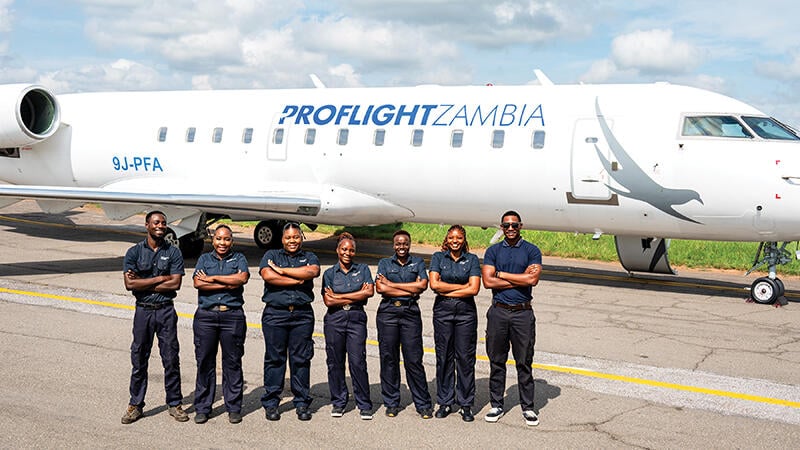
In Southern Africa, regional operator Proflight Zambia flies a small fleet of six Bombardier CRJ200s, five British Aerospace Jetstream 4100s and one British Aerospace Jetstream 3200.
“We have adopted a practical, risk-based approach to maintenance that prioritizes reliability by optimizing available resources, such as personnel, tools and facilities,” says Oliver Ndhlovu, director of maintenance.
While the local aircraft maintenance ecosystem continues to mature, Ndhlovu notes that the airline prioritizes robust internal controls, disciplined maintenance planning and strict compliance with OEM guidelines and regulatory standards.
“Critical tasks are carried out in-house where capability exists, while specialized work is carefully outsourced to approved regional and international partners,” he says. Ndh-lovu explains that this hybrid model enables Proflight to maintain dispatch reliability and steadily build internal competence and tooling over time without overextending local capacity.
IMPROVISING AMID CONSTRAINTS
In Africa, sourcing aircraft parts is often costly and subject to long lead times, posing operational challenges for carriers with small fleets. Recently, Uganda Airlines experienced major disruptions after two of its aircraft were reportedly grounded, including at least one of its two Airbus A330neos.
Even major carriers like Ethiopian Airlines must carefully strategize to ensure a reliable flow of parts and to reduce reliance on overseas suppliers. The airline is pursuing a multilayer strategy, a spokesperson explains, working closely with industry stakeholders and enhancing its MRO capacity with a particular focus on expanding in‑house repairs. This includes leveraging its advanced component maintenance technologies.
Ethiopian also is expanding in-house capability development through its advanced component maintenance facility in Addis Ababa, with the goal of reducing the component repair turnaround time the carrier is currently experiencing with the OEM.
Partnerships are key to that strategy. Ethiopian says its MRO division takes on OEMs’ offload repair business. That in turn helps ease piece‑part shortages because OEMs usually provide better parts access to the shops handling their overflow. Ethiopian cites Dowty blade and hub repairs, along with its engine maintenance facility’s additional engine and auxiliary power unit capability. The airline is also looking into partnerships to establish a local spares stock to reduce response time, signaling a shift toward more regionally anchored inventory models.
Meanwhile, Ethiopian has stepped up in managing its suppliers. The airline now keeps a closer eye on contracts and tracks supplier performance more carefully to make sure parts arrive when promised and meet quality and service standards.
Ethiopian is boosting its stock of critical parts as well. The airline’s material planning team constantly reviews and adjusts safety stock levels and is building up forward inventory for components that have long lead times or are prone to repeated shortages.
Working closely with the broader MRO community is still important to Ethiopian’s strategy. The airline continues to partner with OEMs, distributors and other MRO players to improve commercial terms, access specialized repair capabilities and shorten turnaround times.
Ethiopian relies on global pooling providers when necessary to support parts availability and turns to surplus parts suppliers when unexpected issues arise. The airline says it uses these channels to source aircraft-on-ground (AOG) and other critical components quickly, helping it manage unplanned events and work around wider supply chain delays.
Back in Zambia, Ndhlovu describes the complexities of maintaining a small but mixed fleet. “It can be very challenging and requires flexibility, foresight and great teamwork,” he says.
According to Ndhlovu, Proflight Zambia places a strong emphasis on predictive maintenance trends, inventory management and close collaboration with its approved suppliers. “We leverage strong AOG support agreements with most of our long-standing suppliers and advance provisioning for high-risk components to mitigate supply chain disruptions,” he says.
Ndhlovu adds that Proflight encourages engineers to maximize parts’ serviceable life through better troubleshooting and repair decisions, reducing unnecessary part removals and dependency on long-lead-time components.
LOCAL ADAPTATIONS IN ACTION
Two recent initiatives in Namibia and Uganda illustrate how African aviation stakeholders are developing capability models shaped by local constraints, national priorities and selective international partnerships.
In Namibia, Westair Aviation and Signa Aviation Services have created the country’s first domestic aviation maintenance engineer training school, replacing dependence on South African institutions with a fully local pathway aligned with Namibia’s Civil Aviation Authority. The program combines classroom lessons, hands-on training and in-country trade testing to tackle skills shortages. That combination appears to be favored locally as a practical approach that strengthens technical expertise where outside support has been limited.
Uganda’s approach targets an earlier point in the pipeline but follows the same logic of context‑specific innovation. Through a partnership among the Presidential Advisory Committee on Exports and Industrial Development of Uganda, Boeing, Uganda Airlines and the U.S. Embassy in Uganda, the country has launched an aviation career initiative at Makerere University that exposes students to emerging technologies, such as artificial intelligence, automation and green energy.
Ethiopian is strengthening maintenance capability and skills development by working closely with regional and global partners. Beyond training technicians from neighboring countries, the airline also supports regional operators with MRO services. In collaborating with major players like Airbus, Boeing, Collins Aerospace and GE, Ethiopian is able to bring advanced technology, tooling and training programs to Africa, helping partners grow and lifting the regional aviation sector.
BOOSTING TECHNICAL TRAINING
International collaboration and partnerships remain vital alongside local adaptations. Vallair’s partnership with Cameroon’s Certified Aircraft Maintenance and Recycling (CAMRA) aviation training program, which started in 2024, has matured into a practical, results‑driven collaboration, says Rachel Hugonnet, director of workforce, resources and training at Vallair Group and CEO of Aircraft Academy.
Vallair now regularly hosts CAMRA interns at its MRO facilities in Chateauroux, France, giving them the hands‑on experience required to complete their diplomas. Several trainees are integrated into Vallair’s workforce each year, especially in technical office and production planning roles.
The CAMRA program is a high-level training course by the Cameroon Civil Aviation Authority in partnership with Vallair and the University of Yaounde to develop skilled aviation managers for aircraft maintenance, airworthiness and end-of-life management, addressing Africa’s growing need for technicians and positioning the country as a regional training hub.
Hugonnet adds that the partnership is already delivering tangible workforce outcomes. She notes that trainees gain strong technical foundations and hands-on experience in a European MRO environment, and some move into full-time positions. “It has created a sustainable talent pipeline benefiting both the program and the industry,” she adds.
In 2025, Vallair Group subsidiary Aircraft Academy began developing a program that Hugonnet hopes will further cement its partnership in Cameroon. She explains that this provides key skills in disassembly, parts recycling and safe handling of aircraft components, fully aligned with global MRO and environmental standards.
Vallair’s work in Cameroon has revealed practical lessons that could translate well across Africa. Hugonnet notes that close coordination between training bodies, government agencies and industry players is a foundational requirement. She adds that blending classroom learning with real operational exposure, especially through internships in established MRO environments, greatly improves graduates’ readiness for employment.
Ethiopian’s Aviation University is expanding rapidly to help tackle Africa’s aviation skills shortage and support regional partners such as Zambia Airways. The university trains professionals from across the continent and beyond and is steadily enlarging its facilities and adding new courses.
Ethiopian Aviation University also delivers tailored training for the workforces of partner airlines, helping them meet international safety and operational standards. The airline says this is becoming a key driver in reducing Africa’s skills gap and supporting the development of regional carriers.
SEEKING SOLUTIONS
Industry observers have acknowledged efforts by African airlines to seek local solutions to global problems. Last year, Kenya Airways expressed a desire to invest in internal repair capabilities for parts, something Ethiopian has largely achieved with OEM partners.
During the International Air Transport Association media day conference in December, Kamil Al-Awadhi, the organization’s regional vice president for Africa and the Middle East, highlighted the structural limits facing African airlines as they try to build up local MRO capability. Even with more repairs being done in‑house, he stressed that airlines “still need parts to repair a part,” so full independence is not possible, and reliance on the global supply chain inevitably remains.
Al-Awadhi said he is actively engaging aircraft manufacturers to increase regional spare parts availability and support the establishment of more MRO capacity in Africa but emphasized that the global supply chain is fragile end to end. “If you take the chain, you take one link off, and that chain is broken,” he said, adding that Africa faces tougher conditions than other regions.
Al-Awadhi also highlighted a major frustration among airline CEOs: OEMs invest far more heavily in winning new customers than in supporting them afterward. “You have all these guys knocking on your door when they want to sell you something, and then you can’t find them when you need the parts,” he said.