This article is published in Aviation Week & Space Technology and is free to read until Feb 28, 2026. If you want to read more articles from this publication, please click the link to subscribe.

CommuteAir Boosts Training, Tech To Support Third-Party MRO Ambitions
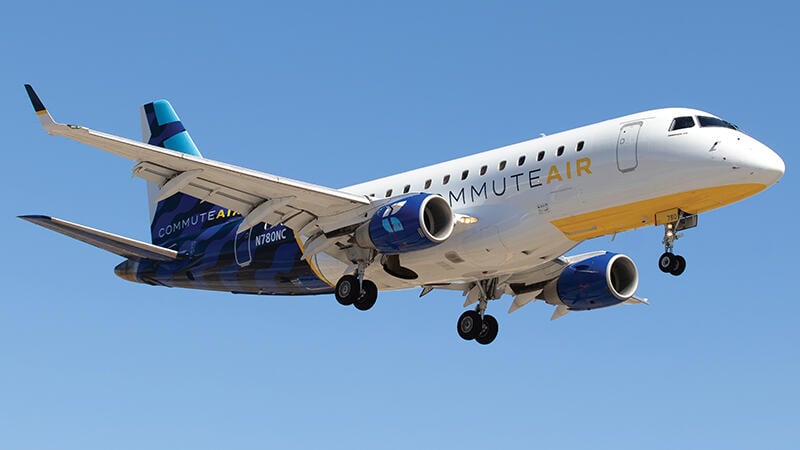
CommuteAir aircraft in flight

CommuteAir is exploring third-party MRO capabilities for Embraer aircraft.

Credit: CommuteAir

CommuteAir’s 2026 road map calls for bringing more maintenance capabilities in-house and for the exploration of offering third-party services to other carriers. To achieve these goals, the U.S. regional airline is leveraging labor and efficiency improvements from its recently implemented apprenticeship and technology programs.

Operating from three maintenance bases at Albany International Airport in New York, Houston Intercontinental Airport and Washington Dulles International Airport DC, under its FAA Part 121 certificate, CommuteAir has to date focused solely on servicing its own fleet of Embraer 145, 170 and 175 aircraft. “We are actively exploring opportunities to outsource that space and provide external services beyond our own aircraft,” says Ryan Kee, CommuteAir’s senior vice president of maintenance and technical operations. “We have some top talent here, and we need to see how we can leverage that to support other carriers wherever they need.”

This could include line maintenance services or general familiarization courses on the types of aircraft CommuteAir operates through its training center in Houston. Kee says the airline is “actively exploring some [Part] 145s, but nothing permanent as it stands.”

CommuteAir operates a tire shop in Houston, but it outsources most component maintenance. Kee says the maintenance division’s top goal for the year is to bring more component capability in-house, starting with thrust reversers and auxiliary power unit overhauls.

“As we expand the amount of work and capabilities that we’re providing, we’ll absolutely need to expand both our labor pool as well as our physical footprint,” he says.

Training Strategy

CommuteAir established its maintenance apprenticeship program in 2022 in response to a backlog of graduates from aviation maintenance schools that had shut down during the COVID-19 pandemic. The airline launched the initial program in April 2022 and welcomed its first apprentices by September.

aircraft technician working on landing gear
CommuteAir has a tire shop in Houston but hopes to bring more component capabilities in-house. Credit: CommuteAir

Joe Kirby, managing director of maintenance training, says the 30-month program starts with six weeks of classroom experience and then integrates lab and hands-on education—including custom augmented and virtual reality tools built by the airline’s own staff—which focus on aircraft fundamentals.

The augmented and virtual reality tools allow apprentices to perform virtual tours of an aircraft with labeled components and open panels. “We’re integrating this right now into our apprentice program so we don’t interfere with line maintenance or hangar maintenance,” Kirby says. Apprentices can complete dozens of virtual walk-arounds of aircraft before they enter the hangar, “so by the time they do get there, they already know where everything is, what it’s called and the description of it,” he says.

The Houston training facility also features an electronics training lab, a sheet metal structures lab and what Kirby calls “the dirty lab,” which includes parts such as landing gear, tires and engines. Apprentices also use full-motion simulators to perform procedures such as aircraft runs and taxiing. “There is almost nothing on our aircraft that we can’t teach in our training department,” he says.

After classroom and lab training, apprentices move to the hangar floor under the guidance of field trainers and technicians. Kee says CommuteAir has found this approach more successful than putting apprentices in the physical environment on Day 1 because “we absolutely want to ensure that they’re supported.” He notes that when the airline first implemented the apprenticeship program, some line technicians expressed hesitance because they “didn’t want to be training people.” After six weeks of classroom and lab training, however, “we get nothing but positive feedback from our front-line workers that these apprentices come out and they’re hungry, they’re knowledgeable, and they’re there to learn and develop,” Kirby says.

Even new hires with prior experience go through 12 months of structured on-the-job training “so you’re not just thrown into your job,” Kirby says. “We found that it [improves] the time to competency.”

aircraft apprentices in training
Apprentices hone their skills in various labs at CommuteAir’s Houston training facility. Credit: CommuteAir

Like some other airlines, CommuteAir first launched the apprenticeship program with a cohort of internal employees because “we strongly believe in promoting from within,” says Kwasi Bandoh, director of maintenance recruiting. Most of those apprentices are “at the back end of it and almost ready to test” for their airframe and powerplant (A&P) licenses, he says. The program has since expanded to external candidates, and CommuteAir is “marketing it as a zero-to-hero program,” Bandoh says, which is “a great selling point for folks that don’t want to go the traditional route, or either go into the military or an A&P school to get that relevant experience.”

Bandoh notes that A&P schools can be time-consuming and expensive, ranging from $6,000 to nearly $60,000, so programs like CommuteAir’s, where apprentices are paid to learn while working as uncertified technicians, can be an appealing alternative. The airline also covers the cost of an apprentice’s initial attempt at A&P testing. Kirby says five apprentices from CommuteAir’s initial cohort have taken their written tests—all of whom passed on their first try—and 15 more are preparing for the test.

CommuteAir does not have an in-house FAA testing center, so it partners with nearby A&P school programs, such as Mohawk Valley Community College in Utica, New York, and Chennault Aviation in Conroe, Texas. Beyond this, the airline partners closely “with schools that are in or near our maintenance operations,” Bandoh says, including sponsoring teams for the Aerospace Maintenance Competition at MRO Americas.

However, CommuteAir does not recruit current students as apprentices because “we want to make sure we’re doing what’s best for business on both sides and not stepping on their toes,” he explains. “We help them out on the back end by hiring some of their [graduates], and they help us out with testing and prepping our apprentices.”

To address the skills gaps in recent A&P school graduates about which some airlines have complained, CommuteAir conducts resume workshops and prep interviews with students at most of its partner schools. The carrier also offers additional classes, such as Principles of Troubleshooting, an in-depth electronics and avionics program. Newly hired technicians must take a general familiarization and avionics course “before they even hit the floor,” Kirby says, “so we do try to set them up with a solid foundation before they start turning wrenches.”

Technology Transformation

CommuteAir is also hoping technology will help bridge the gap with younger generations. In addition to using augmented and virtual reality in training, the airline began transitioning to paperless maintenance in 2024 using TrustFlight’s Electronic Tech Log and MEL Manager software.

CommuteAir apprentice logging data
 Dustin Allen is the first to complete CommuteAir’s apprenticeship program from start to finish. Credit: CommuteAir

“With any technology, there are always difficulties onboarding and getting it up to speed,” so the airline hopes to “get across the finish line” with implementation in 2026, Kee says. “All of the new technicians are expecting to rapidly have everything at their fingertips, so we want to put them on iPads and get them to return aircraft sooner, rather than having to sit there and handwrite [documents], scan a piece of paper and possibly lose it in transit.”

The airline is also exploring how artificial intelligence (AI) could be used to simplify access to thousands of documents from maintenance manuals. “We’re interested in seeing how AI can support getting the answer as quickly as possible, right from our own manuals,” Kee says. “I don’t need [technicians] going to ChatGPT for how to fix an aircraft. We’re talking to a couple of different vendors [about] how to use these AI bedrock infrastructures [such as Amazon Web Services] for agent development to support our technicians, maintenance controllers and engineers to rapidly review any documentation.”

While CommuteAir expects its apprenticeship program and technology implementation to attract new talent, it is still aware of steep competition from major airlines, which typically can pay more than a regional carrier or third-party MRO.

Bandoh says CommuteAir felt this particularly acutely in the wake of the COVID-19 pandemic. “It was a very rough time because the majors were hiring left and right, and they primarily pulled from all of us regionals,” he says. “But we have increased our pay significantly, and that’s no longer an issue for us.”

Kee notes that major airlines frequently try to headhunt from CommuteAir’s technician labor pool. “We will never be able to compete direct blow-for-blow with majors—they’re constantly raising the bar,” he says. “I think UPS caps out at $75 an hour for their technicians in five years, which is amazing, and that sets a tone. They’re skilled professionals, and they deserve to be paid as such. But at the end of the day, we also derive an inherent culture that supports [our staff] wanting to stay.”

Kee says CommuteAir’s culture and benefits have enticed technicians to stay 10-20 years, despite “nothing but opportunities that are knocking at their door to go somewhere else.” He adds: “Somebody will jump overnight for $1 more [an hour] if they don’t like where they’re working,” but this will likely require moving to a new city and “working the night shift for the next 20 years.”

Lindsay Bjerregaard

Lindsay Bjerregaard is managing editor for Aviation Week’s MRO portfolio. Her coverage focuses on MRO technology, workforce, and product and service news for MRO Digest, Inside MRO and Aviation Week Marketplace.