This article is published in Aviation Week & Space Technology and is free to read until Nov 29, 2025. If you want to read more articles from this publication, please click the link to subscribe.

ATEC Highlights U.S. MRO Workforce Progress And Challenges

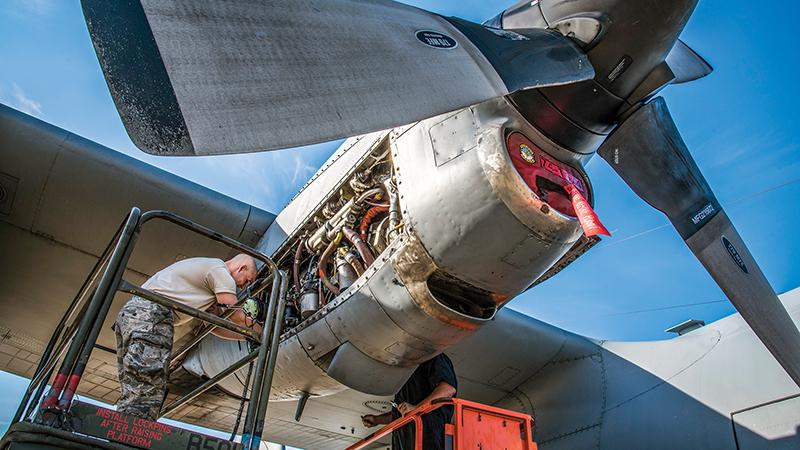
military-trained mechanic working on aircraft

The FAA is streamlining the process for military-trained mechanics to quality for civilian jobs as part of a larger technical workforce development effort.

Credit: U.S. Air Force

Efforts to fill the U.S. aviation maintenance workforce pipeline are paying dividends, industry leaders say. But long-term challenges to meet demand for skilled workers not only remain, but are growing more formidable as bureaucratic interference stalls key programs.

The Aviation Technician Education Council (ATEC) built its annual Fly-In in Washington, D.C., around the release of its latest Pipeline Report. Produced jointly with Oliver Wyman, the annual update details U.S. airframe and powerplant (A&P) mechanic workforce trends. This year’s edition mixes a large dose of good news with a sprinkle of sobering reality.

Among the positives: The FAA issued just more than 9,000 new mechanic certificates last year, about 4% below 2023’s record-setting total. Enrollment in aviation maintenance technician schools (AMTS) rose 9%, suggesting that efforts to increase their throughput are bearing fruit. The total number of graduates decreased 5% from 2023’s record-setting figure of just more than 10,000, the report stated.

“We’re seeing some measurably positive trends at the grassroots level, building interest in pursuing aviation maintenance and the training needed to earn an FAA certificate,” said James Hall, president of ATEC and vice president of aviation and workforce development at WSU Tech. “Near-term challenges will include bolstering these trends while ensuring that we have enough specialized personnel, notably instructors and examiners, to support it.”

Oliver Wyman estimates that there are about 431,000 personnel in the U.S. commercial aviation maintenance workforce, counting both certificated mechanics and noncertified technicians. Growing demand and projected retirements from the aging A&P workforce are projected to leave commercial aviation with 10% fewer certificated mechanics than it needs this year, the report stated. According to FAA data, 35% of certificate holders in 2024 were 62 or older. Factor in business and general aviation as well as demand for noncertified technicians across the industry, and the gap is even larger.

The commercial shortfall is projected to shrink to 6% by the end of the decade, representing a gap of 4,200 certificated mechanics in 2035, the report noted.

The uptick in A&P enrollment is encouraging. About two-thirds of new A&Ps come through schools; the other third are trained either on the job (20%) or in the military (14%).

A survey conducted for the report found some schools are struggling to keep up with higher demand. Although enrollment increased in 2024, the instructor workforce did not. Others described being below capacity despite having waiting lists—reflecting a shortage of instructors, space or training aids.

“As demand for technical talent grows, AMTS face steep competition from industry, where salaries are significantly higher,” the report noted. Through its ATEC Academy, ATEC is spearheading efforts to target retired mechanics and offer training that supports a transition into teaching.

A 2018 FAA grant program to help grow the pilot and aviation maintenance workforce has offered schools funds to bolster enrollment. That program was originally funded at $5 million annually for each industry segment—pilots, mechanics and assembly technicians—and increased to $20 million each as part of the 2024 FAA Reauthorization Act.

But the program appears to have stalled amid Trump administration efforts to remove perceived bias from federal funding programs. An FAA notice of funding opportunity went out in January, and applicants responded, but no grants have been awarded. Industry sources tell Inside MRO that they expect the FAA to reissue the notice with approved language and require applicants to resubmit.

Missing ARACs

A separate White House initiative is forcing industry to grapple with a purge of advisory committees that play key roles in rulemaking to keep congressionally mandated FAA workforce development initiatives on track.

The 2024 FAA Reauthorization Act requires the agency to streamline a pathway for military-trained mechanics to civilian jobs. Section 426 of the law calls on the FAA to issue a “written competency test that addresses gaps between military and civilian experience” and a new airman certification standard that qualifies military-trained A&P mechanics for civilian work.

Lawmakers gave the agency 18 months—or until late November this year—to issue its proposed rule and urged it to solicit input from the Aviation Rulemaking Advisory Committee (ARAC) Airman Certification System (ACS) working group. But ARAC and subcommittee members were terminated this year when the administration elected to restaff federal advisory committees.

The working committees will be formed once the ARAC is reconstituted, and former members who received termination letters can reapply. But the process has just begun. The FAA sent out a notice on Sept. 19 seeking ARAC nominees by Oct. 20.

Former ACS working group members are pressing on, developing plausible processes that should meet the rule’s intent. Several involved tell Inside MRO they expect to be part of soon-to-be-restaffed ARAC working groups, which the FAA plans to involve, per the law’s language.

“We definitely want to hear back from the ARAC” about the written competency test, Kevin Morgan, FAA airmen section manager for the airman and special programs group, told ATEC Fly-In attendees Sept. 17.

Another mandate from the 2024 FAA law faces a similar hurdle. Section 405 orders the agency to study whether high school students who complete a recognized maintenance curriculum could take a general written knowledge exam and earn limited privileges upon passing, similar to student pilots.

Such a pathway would address several issues. One is an acknowledged fear of testing among students and related incompletion rate under the current requirement to complete all coursework before any testing. Another is creating means for students with verified general knowledge to make smoother transitions to A&P schools or industry apprenticeships.

But the law calls on the FAA to task an ARAC working group with examining the issue and developing recommendations. The working group was supposed to be in place by May 16—one year after the bill’s passage—and its report due in November 2026.

“FAA’s termination of industry committee appointments has stalled ACS progress and delayed other congressional mandates,” ATEC said in its Fly-In primer for attendees. “ATEC urges Congress to press [the Transportation Department] to promptly reappoint members to keep reforms on track.”

Attendees heard from PSI Services, the FAA-contracted A&P test developer and provider. Among the hot-­button topics is the number of test centers PSI provides for mechanic testing. Several A&P schools have said that access to a testing center is one of the major hurdles prospective students face in their journey to complete their programs (Inside MRO June, p. 20).

Although the ATEC survey showed just 10% listed test center access as the most significant barrier to obtaining an A&P certificate, it is a major problem for that 10%. Some students must travel 70 mi. or more to take a test.

Brett Greenwood, senior vice president of federal programs at PSI and one of several company executives who attended the ATEC event, said that access is a familiar challenge.

“We’ve heard this for 20 years,” Greenwood said. “We understand everyone wants to be a test center, and we have no reason to deny it, except there is a huge regulatory cost.”

He cited cybersecurity requirements for linking a system outside the FAA’s digital universe to the agency. He said such requirements probably will not ease, but he pledged to work with schools directly or through ATEC and other groups.

Another issue on ATEC’s radar is increasing the availability of designated mechanic examiners (DME) who give oral and practical tests. The FAA had 254 active DMEs in 2024, down slightly from 2023. The examiners oversaw 11,600 tests, or about 2,000 more than in 2023. ATEC projects industry needs 75 more DMEs—about a 30% increase—to meet expected testing demand.

The FAA has been working on expanding its organization designation authorization (ODA) program to ease the burden on DMEs since 2018. The in-process policy will permit other industry experts, such as AMTS faculty, to administer tests through FAA-­approved ODA units within their organizations.

Long-awaited draft guidance was released in mid-2024. Industry is still waiting for the final version.

Sean Broderick

Senior Air Transport & Safety Editor Sean Broderick covers aviation safety, MRO, and the airline business from Aviation Week Network's Washington, D.C. office.