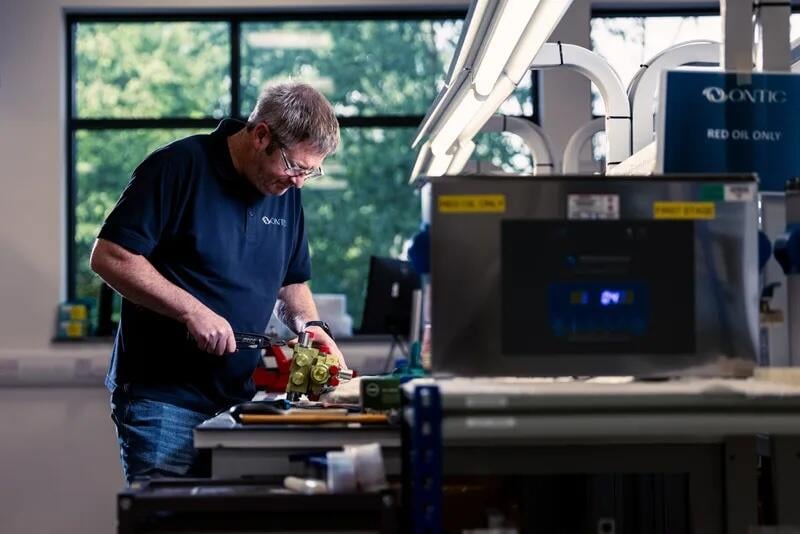
TEWKESBURY, England—Aircraft parts and services specialist Ontic has opened a dedicated component maintenance facility in the United Kingdom as part of a $30 million global maintenance, repair and overhaul (MRO) investment to improve aftermarket service and win repair work back from third-party providers.
The 72,000-ft.² facility, located in Tewkesbury, England, was the recipient of a $15 million investment—half Ontic’s global investment. That figure includes $11 million for the facility and $4 million for test equipment upgrades and duplication. Ontic’s Tewkesbury operation consolidates repair activities from nearby sites in Bishop’s Cleeve and Staverton in southwest England into one location.
Around 200 staff across engineering, maintenance, customer service, supply chain and logistics roles are transferring across. Product lines are also moving, with the transfers expected to be completed in the first quarter of 2027.
Ontic has operated from the site since last year, after taking over a former secure document processing center and repurposing it to meet its MRO requirements.
The Tewkebury facility opening follows the unveiling of Ontic’s dedicated MRO facility in Miramar, Florida, last year. The company consolidated its MRO product lines in Creedmoor, North Carolina, and Chatsworth, California, into the 60,000-ft.² Florida site, which opened at the beginning of 2025.
Jack Karapetyan, Ontic’s senior vice president of global MRO, says the expansion in the United Kingdom supports both organic aftermarket growth and the company’s model of licensing products from original equipment manufacturers (OEMs).
Before Ontic licensed some products, third-party repair stations had already captured maintenance work from the OEMs. “This is us becoming competitive with those third-party MROs and winning that work back,” he says.
Karapetyan says separating repairs from manufacturing has reduced turnaround times (TAT) at Miramar. For example, he says TATs for vacuum blowers used on Boeing-manufactured aircraft have fallen from about 45 days to 15 days.
Ontic expects similar TAT improvements at Tewkesbury. The company expects technicians transferring from existing sites to bring the operation up to speed more quickly compared with the Miramar operation, which largely recruited a new workforce. For certain product lines, Ontic opted to duplicate test machinery rather than transfer it across from other sites. According to Ontic, this allows its existing manufacturing sites to retain capability while Tewkesbury gains equipment specifically for aftermarket work. Moving repairs also releases manufacturing space for further licensing deals.
The new site combines pneumatic and hydraulic infrastructure with avionics workshops, an ISO Class 7 cleanroom, nondestructive testing, machining and a darkroom. Environmental stress screening enables components to undergo temperature, vibration and altitude testing intended to identify possible failures before returning to service.
The facility holds United Kingdom Civil Aviation Authority (UK CAA) and European Union Aviation Safety Agency Part 145 certifications following audits in December 2025. The Federal Aviation Administration (FAA) also has approval for the facility under UK CAA oversight. Ontic is pursuing Chinese regulatory approval from the Civil Aviation Administration of China (CAAC), targeting the fourth quarter of 2026.
The facility also has room to expand. According to Ontic, approximately 18,000-20,000 ft.² is expected to remain available after planned equipment and personnel transfers, while a mezzanine provides additional expansion space. Consolidation will also enable technicians to cross-train across products previously supported at separate sites.
A United Kingdom-based, 24/7 global aircraft on ground (AOG) team is also located onsite and is staffed by six new hires handling around 60 requests daily, including a mix of AOG, exchange and technical support. Inventory is stored at locations in London for the EMEA region, Miami for North and Latin America and Singapore for Asia-Pacific.
Karapetyan links repair demand to aircraft delivery delays and operators opting to keep existing fleets in-service for longer than previously anticipated. “The supply chain crunch means people aren’t getting the newer fleets that they expect or hope for. Airlines and operators are flying their fleets longer, they’re flying them harder, they need more availability, and therefore there is greater demand for our MRO services,” Karapetyan said.

Related Content